

Why Beneficiary Designation Mistakes Can Impact Your Entire Estate Plan
Beneficiary designation mistakes are one of the most common, and most costly, errors in estate planning. Financial institutions and estate planning professionals regularly warn that these designations control who receives retirement accounts, insurance proceeds, and similar assets, often regardless of what a will says. For a broader checklist of common errors, see U.S. Bank’s guide to beneficiary designation mistakes to avoid.
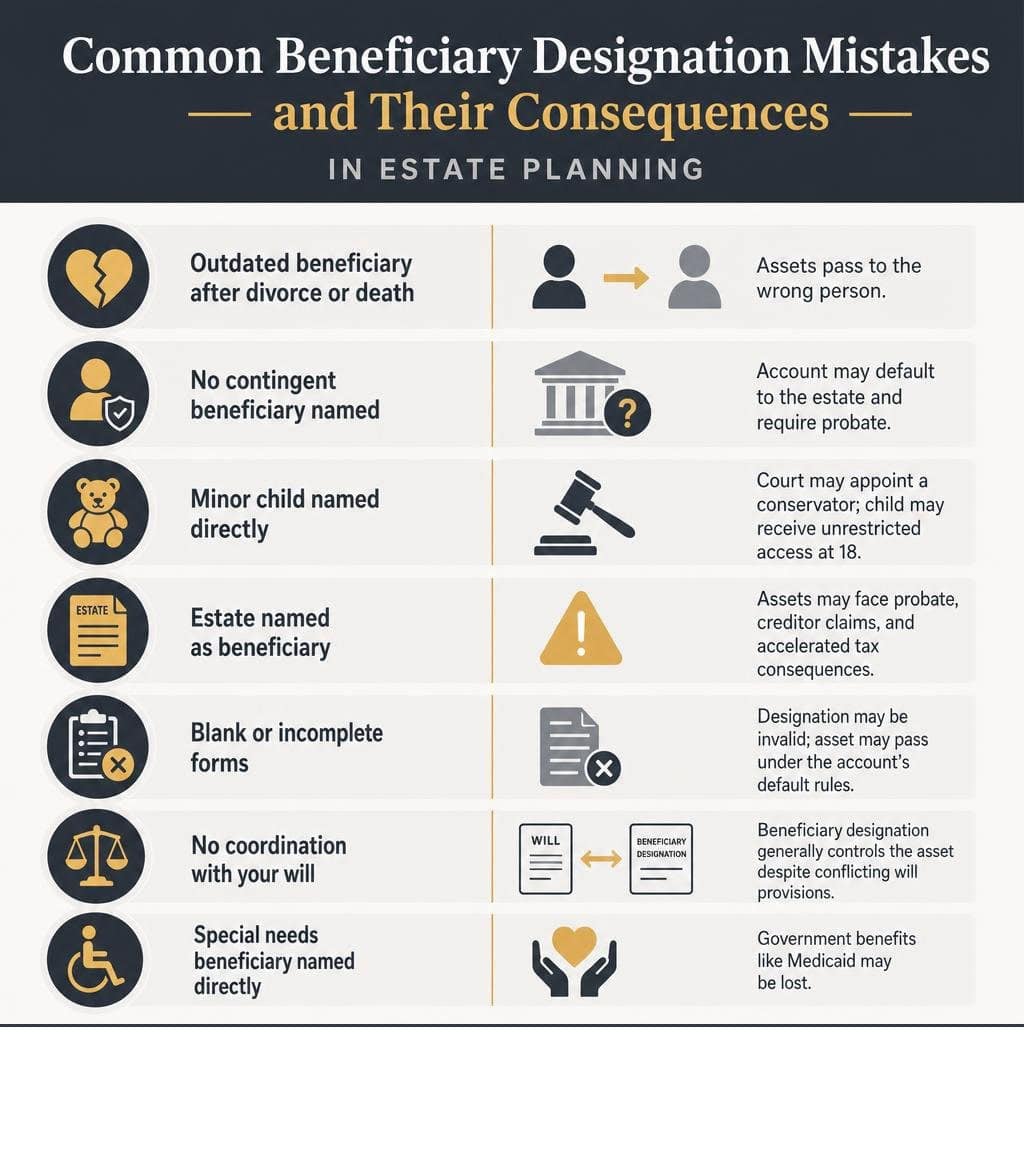
Here is a quick summary of the most common mistakes to avoid:
| Mistake | What Goes Wrong |
|---|---|
| Outdated beneficiary after divorce or death | Assets pass to the wrong person |
| No contingent beneficiary named | Account may default to the estate and require probate |
| Minor child named directly | Court may appoint a conservator; child may receive unrestricted access at 18 |
| Estate named as beneficiary | Assets may face probate, creditor claims, and accelerated tax consequences |
| Blank or incomplete forms | Designation may be invalid; asset may pass under the account’s default rules |
| No coordination with your will | Beneficiary designation generally controls the asset despite conflicting will provisions |
| Special needs beneficiary named directly | Government benefits like Medicaid may be lost |
People spend significant time and money for a will or trust. Then they never look at the beneficiary forms sitting on file at their 401(k) provider or life insurance company. A valid beneficiary designation generally controls the disposition of that asset, even when other estate-planning documents say something different.
Consider this hypothetical: a retired schoolteacher’s pension, life insurance, and IRA, totaling $400,000, could pass to her estranged sister instead of her two adult daughters, simply because she never updated her beneficiary designations.
Many of these issues can be reduced or avoided with coordinated planning and regular beneficiary reviews.
I’m Gerard Deffenbaugh, a Colorado estate planning attorney with over a decade of experience helping small business owners, real estate investors, and families avoid beneficiary designation mistakes that quietly derail otherwise solid estate plans. Below, I’ll walk you through exactly what to watch for and how to fix it.
An Often-Overlooked Beneficiary Issue: How Beneficiary Designations Can Override Your Will
Some people believe that their last will and testament is the ultimate authority on who gets their assets when they pass away.
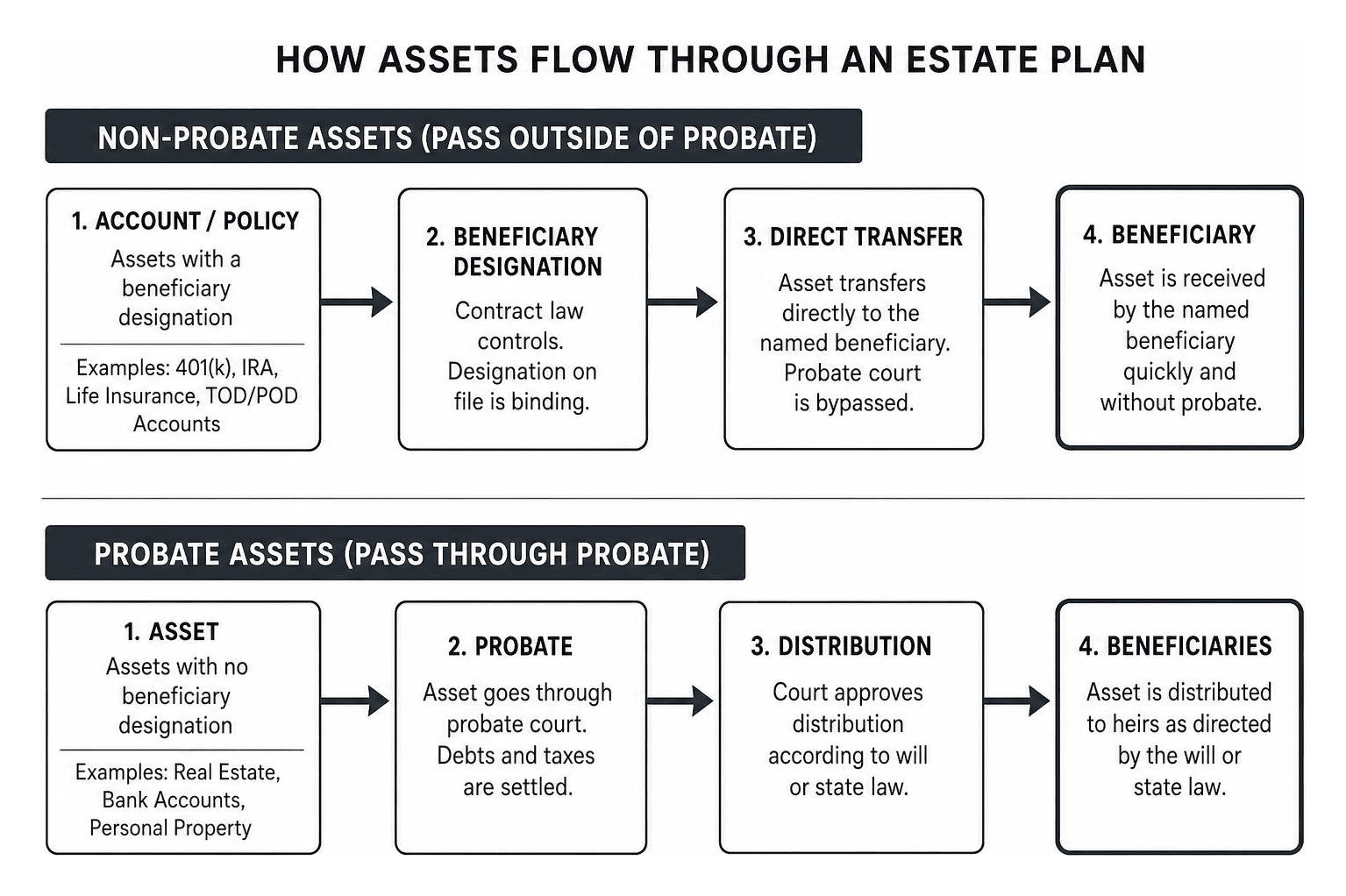
Certain financial accounts and insurance policies are classified as “non-probate assets.” These assets transfer directly to designated individuals by operation of contract law, bypassing the probate court entirely. When you open a 401(k), IRA, or life insurance policy, you sign a binding contract with the financial institution. Part of that contract is your beneficiary designation form.
Beneficiary designations generally control the disposition of non-probate assets regardless of contrary provisions in a will. Although beneficiary designations generally control, they can occasionally be challenged based on fraud, incapacity, undue influence, or failure to comply with plan requirements. If your will states that all your assets should be split equally among your three children, but your IRA beneficiary form lists only your oldest child, the oldest child legally inherits the entire account. The custodian of the account is contractually obligated to pay the person named on the form, regardless of what your will says.
This direct-transfer mechanism is highly beneficial when used correctly because it gets money into the hands of your heirs quickly without the delays of probate. However, when there is a mismatch between your estate planning documents and your beneficiary forms, it can lead to unintended consequences. You can read more about how these moving parts fit together in my guide on Estate Planning Mistakes to Avoid: A Lawyer’s Perspective.
To visualize how your assets flow upon your death, look at the hierarchy below:
Common beneficiary designation mistakes in Colorado Estate Planning
In my Centennial, CO estate planning practice, I regularly see clients make errors on their beneficiary forms. Some common errors include:
- Leaving the designation blank: If you fail to name a beneficiary, the financial institution’s default policy rules will dictate where the money goes. Sometimes, this means the asset defaults to your estate, forcing your family into probate court.
- Failing to name contingent beneficiaries: A primary beneficiary is your first choice. A contingent (or backup) beneficiary is who receives the asset if the primary beneficiary passes away before you. If you name your spouse as the primary beneficiary but do not list a contingent, and you both pass away in a common accident, the asset may flow directly into your estate.
When assets default to your estate due to these errors, your family must navigate the court system to distribute them. To understand what this process looks like, review my article on Understanding Uncontested Probate: A Simple Guide for Grieving Families.
What Happens When a Minor Is Named Directly?
You may want to provide for your children or grandchildren. However, a minor generally cannot manage beneficiary proceeds in the same manner as an adult. A direct designation can therefore require a custodian, conservator, or other legally authorized arrangement before the funds can be administered, depending on the asset and circumstances.
A properly drafted trust can sometimes be named as beneficiary so a trustee manages inherited assets under the terms you establish. Retirement accounts require additional analysis because naming a trust can affect the applicable distribution rules. You can explore how to set up these structures in my article on Planning for the Future: A Beginner’s Guide to Wills and Trusts.
How One Beneficiary Decision Can Affect the Rest of Your Plan: Divorce, Blended Families, and Special Needs
Major life changes demand an immediate review of your estate plan. Failing to update your beneficiary designations after a divorce, remarriage, or a change in your family’s health status can create outcomes that differ significantly from your estate-planning goals.
In Colorado, there is a “revocation-on-divorce” statute under the Colorado Probate Code (C.R.S. § 15-11-804). However, relying on this statute to protect your assets is a strategy that can create significant planning risk if used without considering the beneficiary, account type, and governing rules for two reasons:
- ERISA Preemption: Federal law governs employer-sponsored retirement plans, such as 401(k)s and 403(b)s, under the Employee Retirement Income Security Act (ERISA). Federal ERISA law can preempt state revocation-on-divorce laws for covered employee benefit plans; the U.S. Supreme Court addressed this issue in Egelhoff v. Egelhoff. Under ERISA, the plan administrator is generally required to follow the plan documents and beneficiary form on file. If you divorced your ex-spouse but left them as the beneficiary of your employer 401(k), they may still receive that money when you die.
- Litigation and Delays: Even for non-ERISA assets (like individual IRAs or private life insurance policies), relying on the statute can also create uncertainty or delay if the institution, former spouse, or surviving family disputes how the designation should be treated.”
To see how easily these situations create disputes, delay, or unintended distributions, you can read the case studies detailed in Beneficiary Designations Gone Wrong.
Blended Families and Stepchildren
Blended families face unique estate planning hurdles. If you remarry and simply name your new spouse as the primary beneficiary on all your accounts, you may unintentionally disinherit your children from your first marriage.
For example, if you name your spouse as the sole beneficiary of your traditional IRA, those funds belong entirely to them once you pass away. They can then name their own children as the beneficiaries of that account, leaving your children with nothing.
To prevent this, you must carefully coordinate your beneficiary designations. You can use percentages to split the account balance between your spouse and your children.
In some cases, a properly designed trust may be used to balance support for a surviving spouse with preservation of remaining assets for children. Retirement-account beneficiary trusts require additional tax and distribution-rule analysis.
Special Needs Beneficiaries and Government Benefits
If you have a child or family member with special needs who relies on government assistance programs like Medicaid or Supplemental Security Income (SSI), leaving them a direct inheritance can be a mistake.
SSI has strict resource limits: the Social Security Administration currently says countable resources generally cannot exceed $2,000 for an individual or $3,000 for a couple. Receiving a direct payout from a life insurance policy or retirement account can increase countable resources and affect eligibility for means-tested programs such as SSI and certain Medicaid programs. They may then have to “spend down” the inheritance on basic medical care before they can reapply for assistance.
For beneficiaries who receive means-tested benefits, a properly designed special needs trust may help preserve eligibility while allowing inherited assets to supplement the beneficiary’s needs. The appropriate trust and beneficiary designation should be coordinated with the specific benefit programs and, for retirement accounts, the applicable inherited-account rules.
The trustee can use trust assets to supplement the beneficiary’s needs in accordance with the trust terms and applicable benefit rules, including for items such as recreation, technology, therapy, or travel.
Tax Pitfalls: The SECURE Act and Naming Your Estate
Beneficiary choices can also have significant income-tax consequences, particularly for retirement accounts. This is particularly true after the passage of the SECURE Act, which fundamentally changed how inherited retirement accounts are taxed.
Under the SECURE Act, most non-spouse beneficiaries (such as adult children) are no longer permitted to “stretch” distributions from an inherited traditional IRA or 401(k) over their lifetimes. Instead, they are subject to the 10-year rule, which generally requires the entire account balance to be fully distributed by the end of the tenth year following the owner’s death, subject to IRS regulations that may also require annual distributions in certain situations. The IRS explains inherited IRA beneficiary rules, including the 10-year rule and 5-year rule, in Publication 590-B. Because these distributions are treated as taxable income, inheriting a large retirement account can push your heirs into a much higher tax bracket during their peak earning years.
| Beneficiary Type | Distribution Rule | Tax Treatment |
|---|---|---|
| Spouse | Special rollover and beneficiary options may allow continued tax deferral; applicable rules depend on the account and election | Tax-deferred growth continues |
| Non-Spouse Individual | Generally must fully distribute within 10 years; annual RMDs may also apply in certain cases | Taxed as ordinary income upon withdrawal |
| Minor Child of Owner | Life-expectancy treatment may apply until age 21; the 10-year period generally begins at age 21. | Taxed as ordinary income upon withdrawal |
| Your Estate | Distribution period depends on whether the owner died before or after the required beginning date; naming an estate may eliminate more favorable designated-beneficiary treatment | Distributions are taxable under applicable estate/trust and beneficiary income-tax rules |
| Qualified Charity | Distribution rules for a non-designated beneficiary apply; timing depends on the account and owner’s circumstances | Generally no federal income tax on retirement distributions received by the charity |
Why Naming an Estate Can Create Tax and Administrative Complications
Naming an estate as the beneficiary of a retirement account can create less favorable tax and administrative results in some circumstances.
When your estate is named as the beneficiary of a traditional IRA or 401(k):
- A Shorter Distribution Period may Apply: If the account owner dies before the required beginning date and the estate is the beneficiary, the five-year rule generally applies. If death occurs on or after the required beginning date, distributions generally follow the owner’s remaining life expectancy. Either result can differ significantly from the rules available to an individual designated beneficiary.
- Highest Tax Brackets: Estates reach the highest federal income tax bracket far faster than individuals do. For 2026, the IRS tax table for estates and trusts reaches the 37% bracket when taxable income exceeds $16,000, compared with much higher thresholds for individual taxpayers. See the IRS 2026 inflation-adjustment guidance for estate and trust income tax brackets.
Step-by-Step Guide to Aligning Your Assets
Now that you know what can go wrong, let’s look at how to ensure your assets are aligned correctly. Fixing these mistakes is a straightforward administrative process, but it requires diligent follow-through.

How to Check For and Fix Your Beneficiary Designation Mistakes
I recommend that my clients in the Denver metro area walk through this five-step process:
- Create a Comprehensive Inventory: Write down every single financial account you own. This includes employer 401(k)s, old pensions, individual IRAs, Roth IRAs, health savings accounts (HSAs), life insurance policies, and transfer-on-death (TOD) or payable-on-death (POD) bank and brokerage accounts.
- Request Current Beneficiary Forms: Obtain confirmation of the beneficiary designations currently on file with each plan administrator, insurer, or custodian.
- Review with an Estate Planning Attorney: Bring these forms to my Centennial office. I will compare them against your documents and overall estate planning goals to make sure they match. I will check for outdated names, ensure contingent beneficiaries are listed, and verify that the exact, formal legal name of your trust is used if you are naming a trust as a beneficiary.
- Submit Updated Forms: Submit changes using the administrator’s required process and retain confirmation that the updated designation was accepted.
- Set a Recurring Review Schedule: Make it a habit to review your beneficiary designations every three to five years, or immediately following any major life event (marriage, divorce, the birth of a child, or the death of a named beneficiary).
Frequently Asked Questions about Beneficiary Designations
Does a Colorado divorce automatically revoke my ex-spouse as a beneficiary?
Colorado law (C.R.S. § 15-11-804) generally revokes certain revocable beneficiary designations in favor of a former spouse upon divorce, subject to statutory exceptions.
However, Colorado’s revocation-on-divorce statute may not control beneficiary rights under ERISA-governed plans. For employer-sponsored retirement benefits, the plan documents and applicable federal rules require separate review, so beneficiary forms should be updated directly rather than relying on Colorado’s automatic-revocation statute.
Can I name a charity as a co-beneficiary on my retirement account?
Yes, naming a qualified charity as a beneficiary of your traditional retirement assets can be a tax-efficient estate planning strategy.
Because qualifying tax-exempt charities generally do not pay federal income tax on retirement-account distributions they receive, traditional retirement assets can be particularly tax-efficient charitable gifts. By contrast, distributions of traditional pre-tax retirement assets to individual beneficiaries generally constitute taxable income to the recipient.
However, if you name a charity as a co-beneficiary alongside individuals, you must ensure the account is structured correctly. Under the SECURE Act, having a non-individual (like a charity) on a retirement account can sometimes disrupt the distribution timeline for the individual co-beneficiaries. It is highly recommended to split the accounts or work with an attorney to ensure the designations are executed properly.
Conclusion
Your estate plan is only as strong as its weakest link. You can have a beautifully drafted, customized trust, but an outdated beneficiary form can undermine important parts of an otherwise well-designed estate plan.
At Colorado Trusts & Taxes, I specialize in taking a comprehensive, big-picture look at your estate. I don’t just draft wills and trusts; I work with you to review your entire asset portfolio, ensuring your bank accounts, retirement plans, life insurance policies, and real estate are aligned with your legal documents.
If you live in Centennial, Denver, or the surrounding Colorado communities, let me help you secure your legacy and give your family peace of mind. Schedule an estate planning consultation with my office today to review your beneficiary designations and build a coordinated estate plan.