

Why This Decision Significantly Influences How Your Estate Plan Operates
When setting up a trust, the choice between a corporate trustee vs individual trustee is one of the most consequential decisions you will make. And yet, it is often treated as an afterthought.
Here is a quick breakdown to answer the core question:
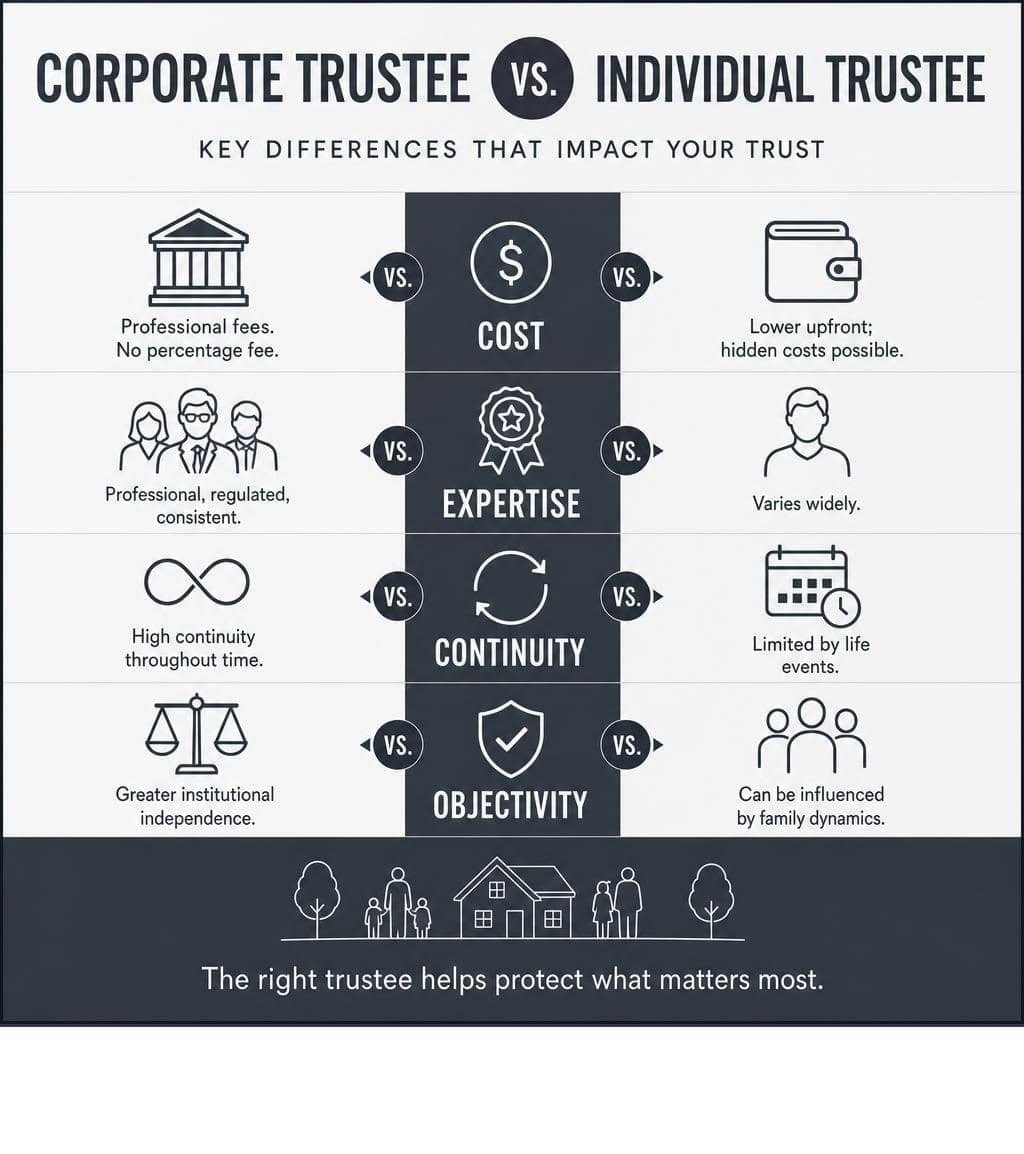
| Factor | Individual Trustee | Corporate Trustee |
|---|---|---|
| Who they are | Family member, friend, or advisor | Bank, trust company, or financial institution |
| Cost | Lower upfront; hidden costs possible | Many corporate trustees charge fees based on assets under management, although fee schedules vary widely by institution and trust complexity (see fee considerations) |
| Expertise | Varies widely | Professional, regulated, consistent |
| Continuity | Limited by life events | High — administrative continuity typically maintained despite personnel changes |
| Objectivity | Can be influenced by family dynamics | Generally greater institutional independence |
| Personal connection | High | Low |
| Best for | Simple, short-term, smaller trusts | Complex, long-term, or high-conflict situations |
| Removal / Replacement | May require successor provisions or court involvement depending on the trust. | Usually governed by the trust terms and institutional procedures. |
The right answer depends on your specific assets, your family situation, and how long the trust needs to last. There is no one-size-fits-all choice here.
Think of it this way: naming a family member as trustee can feel like the obvious, cost-effective move. But a family trustee faces the same pressure as a driver stopped at a “No Turn on Red” sign while everyone behind them is honking. The rules are clear, but the social pressure to bend them is real. That tension can create serious problems over time.
I’m Gerard Deffenbaugh, an estate planning attorney at Colorado Trusts & Taxes with over a decade of experience guiding Colorado families and business owners through the corporate trustee vs individual trustee decision — including complex trust administration, real estate, and small business succession situations. In this guide, I’ll walk you through everything you need to know to make a confident, informed choice.
Understanding the Core Differences Between Trustee Types
Here’s what these roles mean legally and operationally under Colorado law.
An individual trustee is a natural person—often a family member, trusted friend, or professional advisor like a CPA or attorney—whom you designate to manage your trust assets. They are bound by the law to manage these assets according to your trust instructions. However, their ability to do so depends entirely on their personal availability, health, and financial literacy.
Conversely, a corporate trustee is a professional, regulated financial institution, such as a bank or dedicated trust company, authorized or chartered under applicable banking or trust company regulations to provide fiduciary services. These entities employ professional trust officers, investment managers, and tax specialists who handle trust administration as their primary business.
Both individual and corporate trustees are bound by strict fiduciary duties. A fiduciary duty is the highest legal standard of care one party can owe to another. Under the Colorado Uniform Trust Code (CUTC), these duties include:
- The Duty of Loyalty: The trustee must administer the trust solely in the interest of the beneficiaries.
- The Duty of Impartiality: If a trust has two or more beneficiaries, the trustee must act impartially in investing, managing, and distributing the trust property.
- The Prudent Investor Rule: The trustee must invest and manage trust assets as a prudent investor would, considering the trust’s purposes, terms, and distribution requirements.
While the legal responsibilities are identical, the execution varies wildly between a corporate trustee vs individual. An individual may have a deep personal understanding of your family’s values but lack the technical expertise to manage complex investment portfolios or navigate intricate tax reporting. A corporate trustee brings deep professional expertise and administrative systems but lacks the personal history with your beneficiaries.
To understand how these roles fit into your broader planning, you can read more about the foundational structures of trusts in my article, Planning for the Future: A Beginner’s Guide to Wills and Trusts.
Weighing the Pros, Cons, and the Hybrid Approach
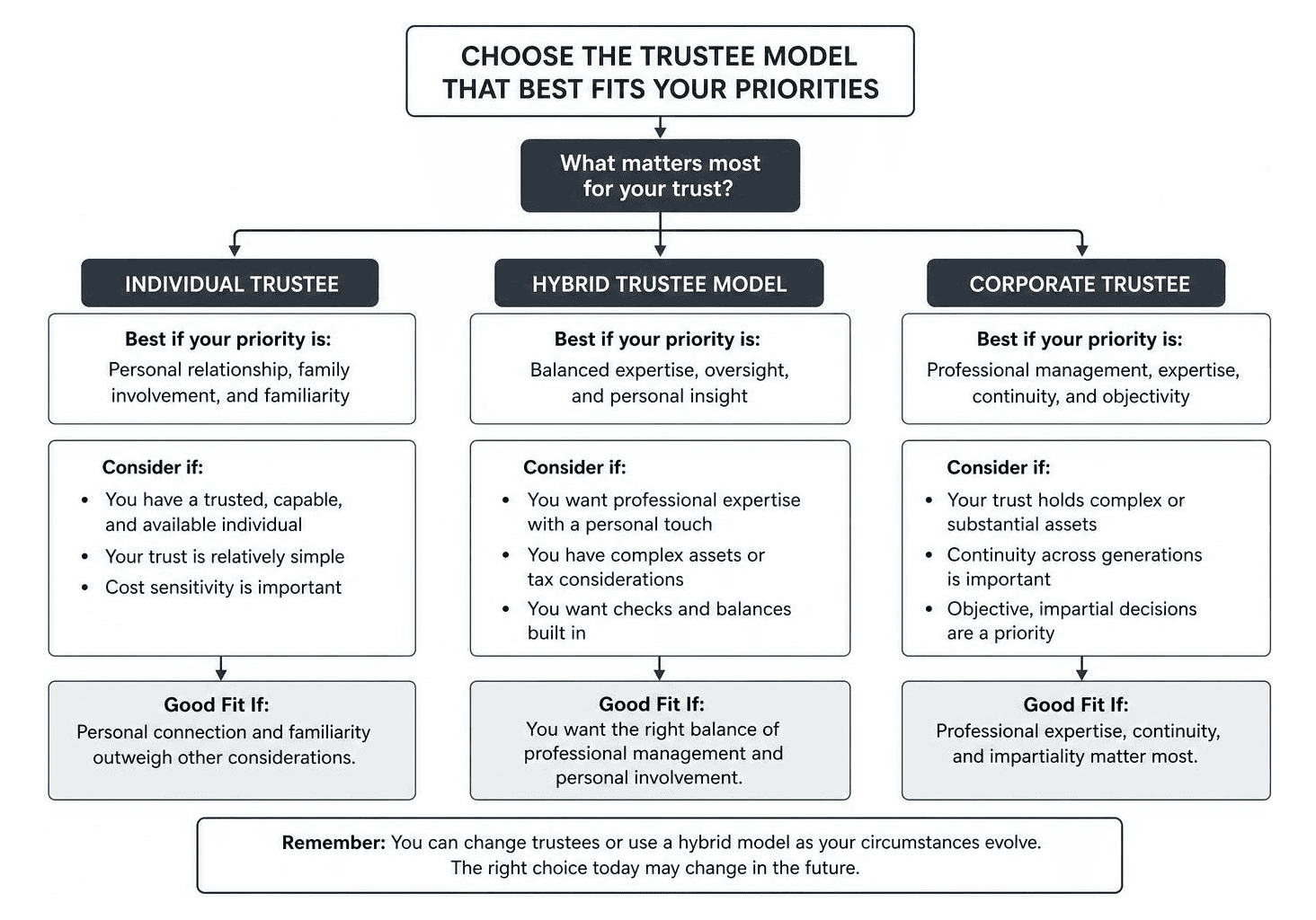
Choosing a trustee is not a simple binary choice. In addition to selecting a single individual or a corporate entity, many Colorado families find that a hybrid model (examples below) offers the ideal balance.
The Individual Trustee: Personal Touch and Potential Pitfalls
For many creators of a trust (known as “settlors” or “grantors”), naming an individual trustee is the default choice.
The Advantages
The primary benefit of an individual trustee is their personal relationship with the beneficiaries. A family member or close friend often has firsthand insight into your family dynamics, your values, and the unique needs of your children or grandchildren, which can allow them to bring empathy and a personal touch to distribution decisions.
Additionally, some individual trustees, particularly family members, agree to serve without taking a fee or request only nominal compensation, which can make them cost-effective for smaller, straightforward trusts, though fee arrangements vary by individual and by trust.
The Disadvantages and Hidden Costs
While an individual trustee may not charge a direct fee, they often incur significant hidden costs. Because most individuals are not professional investment managers or tax experts, they must outsource these tasks. They often choose to hire CPAs, financial advisors, and estate planning lawyers to ensure compliance with Colorado laws. These professional fees are paid directly out of the trust assets, which can narrow the cost gap between an individual and a corporate trustee.
Furthermore, individual trustees face personal liability for breaches of fiduciary duty. If they make a bad investment decision that violates the prudent investor rule, or if they accidentally favor one beneficiary over another, they can be sued personally by the beneficiaries. Unlike corporate entities, individual trustees rarely carry professional errors and omissions (E&O) insurance, meaning their personal assets may be at risk.
Finally, individuals are subject to life’s unpredictability. They can become ill, suffer from cognitive decline, face personal bankruptcy, or pass away, which can disrupt trust administration. In my practice, I’ve seen this happen even with well-intentioned family members — a sudden illness or a cross-country move can leave a trust without an active trustee for months.
For common pitfalls to avoid when structuring your estate plan, see Estate Planning Mistakes to Avoid: A Lawyer’s Perspective.
The Corporate Trustee: Professionalism and Continuity
For larger trusts or complex family situations, a corporate trustee offers unmatched stability and professional oversight.
The Advantages
- Administrative Continuity: Corporate trustees generally provide administrative continuity because institutional personnel may change without requiring appointment of a new fiduciary, supporting long-term, multi-generational trust administration.
- Professional Investment and Tax Management: Corporate trustees have dedicated departments to handle complex tax filings and meticulous recordkeeping. Depending on the institution and the trust terms, investment management may be performed internally or coordinated with outside investment professionals.
- Institutional Independence: Because they are outside the family dynamic, corporate trustees generally provide greater institutional independence and consistent fiduciary administration, although the quality of service varies among institutions and trust departments. This distance from family dynamics can reduce the emotional pressure and interpersonal friction that may arise when one sibling is put in charge of another’s inheritance.
The Disadvantages
The most obvious disadvantage is cost. Some corporate trustees charge fees based on assets under management, although fee schedules vary widely by institution and trust complexity. Many corporate trustees also require minimum annual fees, which can make them cost-prohibitive for trusts with smaller balances. For a broader explanation of how cost, continuity, expertise, and objectivity factor into trustee selection, see Baird Trust’s guide, Selecting the Right Trustee.
Additionally, some beneficiaries find corporate trustees to be bureaucratic or rigid in their decision-making. Because they must comply with strict internal controls and banking regulations, the process of requesting a distribution can feel slow and impersonal.
These institutional benefits are discussed further in The Benefits of Using a Corporate Trustee.
The Hybrid Model: Co-Trustees and Trust Protectors
If you find yourself torn between the personal connection of an individual and the professional security of a corporation, you do not have to choose just one. A hybrid model can give you the best of both worlds.
Co-Trustee Arrangements
You can name an individual (such as a adult child or trusted family advisor) and a corporate trustee to serve together as co-trustees. In this setup, you can divide the responsibilities:
- The corporate trustee handles the technical, heavy lifting: investment management, regulatory compliance, recordkeeping, and tax preparation.
- The individual trustee brings personal insight, guiding decisions regarding discretionary distributions for the beneficiaries’ health, education, maintenance, and support (HEMS).
This arrangement acts as an excellent check-and-balance system. It relieves the family member of administrative burdens while ensuring the trust’s distributions remain aligned with your family values.
Directed Trusts vs. Delegated Trusts
When using a corporate trustee, the trust document’s structure dictates how much control your family retains over investments:
- Delegated Trust: The corporate trustee has full fiduciary responsibility for both administration and investment management. They may delegate investment tasks to an outside advisor, but they retain the ultimate authority to hire or fire that advisor.
- Directed Trust: The trust document formally splits the trustee’s duties. It appoints an independent “investment trust advisor” (such as your family’s trusted financial advisor) to manage the investments, and directs the corporate trustee solely to handle the administrative duties. This ensures your family’s preferred financial professional is not sidelined after your passing.
The Trust Protector Role
Another highly effective hybrid strategy is to appoint a corporate trustee to handle day-to-day administration, while naming an individual as a trust protector. A trust protector is a neutral third party (often an estate planning attorney or trusted advisor) who does not manage the trust daily but holds specific, powerful veto rights—most notably, the power to remove and replace the corporate trustee if the beneficiaries are unhappy with their service.
For a thorough analysis of how professional trustees interact with financial advisors and family structures, see Recommending A Corporate Trustee To Serve Client Interests.
Key Factors in the Decision-Making Process
As you evaluate your options, several practical factors should guide your choice.
Evaluating Costs by Trust Size
When comparing costs, it is helpful to look at the size, complexity, and duration of your trust assets rather than relying on a single cutoff:
- Smaller or short-term trusts: For smaller trusts, the minimum annual fees of a corporate trustee can have an outsized effect on the trust’s principal. In these cases, naming an individual trustee who can hire external professionals on an as-needed, hourly basis may be the most practical option.
- Mid-sized or moderately complex trusts: This is often where a hybrid structure can make sense. A co-trustee arrangement or an individual trustee using a professional registered investment advisor (RIA) may provide a balance of professional oversight and cost efficiency.
- Larger, long-term, or complex trusts: For larger estates, the professional systems, liability coverage, continuity, and administrative ease of a corporate trustee may justify the additional cost, especially when the individual trustee would otherwise need to hire separate lawyers, CPAs, and investment managers.
For a detailed cost-benefit discussion based on trust size, complexity, and trustee responsibilities, you can read Corporate Trustee vs Individual Trustee: How to Choose | ProbatePedia.
Legal and Liability Implications
The legal exposure of a trustee in Colorado is significant. Under the Colorado Uniform Trust Code, trustees can be held personally liable for certain errors, tax compliance failures, or investment losses that violate the prudent investor rule.
If you name an individual trustee, they must carry this legal burden personally. If they make an honest mistake, it can lead to litigation among family members, permanently damaging relationships. I’ve seen this personal liability come as a surprise to family members who agreed to serve without fully weighing what it meant.
A corporate trustee, however, is a highly regulated financial institution with internal legal counsel, compliance officers, and substantial liability coverage. If an error occurs, the institution maintains insurance and internal risk-management systems, although protections vary.
To better understand the rights of beneficiaries and the fiduciary standards trustees must meet, review Trust Issues: A Complete Guide to Your Rights as a Beneficiary.
Frequently Asked Questions about Trustee Selection
When does a corporate trustee make the most sense?
A corporate trustee is often appropriate in the following scenarios:
- Complex Assets: If your estate includes complex assets.
- Multi-Generational Trusts: If the trust is designed to last for decades, spanning multiple generations, to ensure continuity that individual trustees cannot provide.
- Potential Family Conflict: If there is existing tension among your beneficiaries. An impartial, professional trustee may reduce the likelihood of disputes between siblings over financial distributions.
- Special Needs Trusts: Administering a special needs trust requires strict adherence to government benefit rules. A single administrative mistake can jeopardize a beneficiary’s eligibility for Medicaid or SSI. Specialized corporate trustees have the expertise to navigate these complex regulations safely.
Can an individual trustee hire external professionals?
Yes. Under Colorado law, an individual trustee is fully authorized to hire external professionals—including estate planning attorneys, CPAs, and investment advisors—to assist them with trust administration. The reasonable fees for these professional services are paid directly out of the trust’s assets. This is highly recommended to protect the individual trustee from personal liability.
How do Colorado laws affect trustee liability?
Colorado has adopted the Colorado Uniform Trust Code (CUTC), which establishes clear statutory fiduciary duties for all trustees. Under the CUTC, Colorado courts maintain oversight over trust administrations and have the authority to review trustee decisions, order accountings, and surcharge a trustee (meaning, force them to pay damages out of their own pocket) if they breach their fiduciary duties. This makes understanding and complying with Colorado trust law critical for any individual serving as a trustee.
Conclusion
Choosing between a corporate trustee vs individual trustee is not a decision to be made in a rush. It requires a careful analysis of your assets, your family dynamics, and your long-term goals. Whether a professional corporate trustee, a trusted family member, or a structured hybrid approach is best for your family, the key is intentional planning. The best outcomes come from coordinating that choice with the rest of your plan — how the trust is designed, how it addresses your family’s dynamics, and how it integrates with tax planning, investment management, and long-term administration.
At Colorado Trusts & Taxes, I specialize in helping small business owners, real estate investors, and families navigate these complex estate planning decisions. My Centennial office provides personalized, empathetic guidance tailored to Colorado’s unique legal landscape.
If you would like to discuss your trustee options and ensure your estate plan is structured for long-term success, I invite you to reach out. For more details on how my office can assist you, please visit my services page: More info about estate planning services.