

What Colorado Property Owners Need to Know About Real Estate Tax
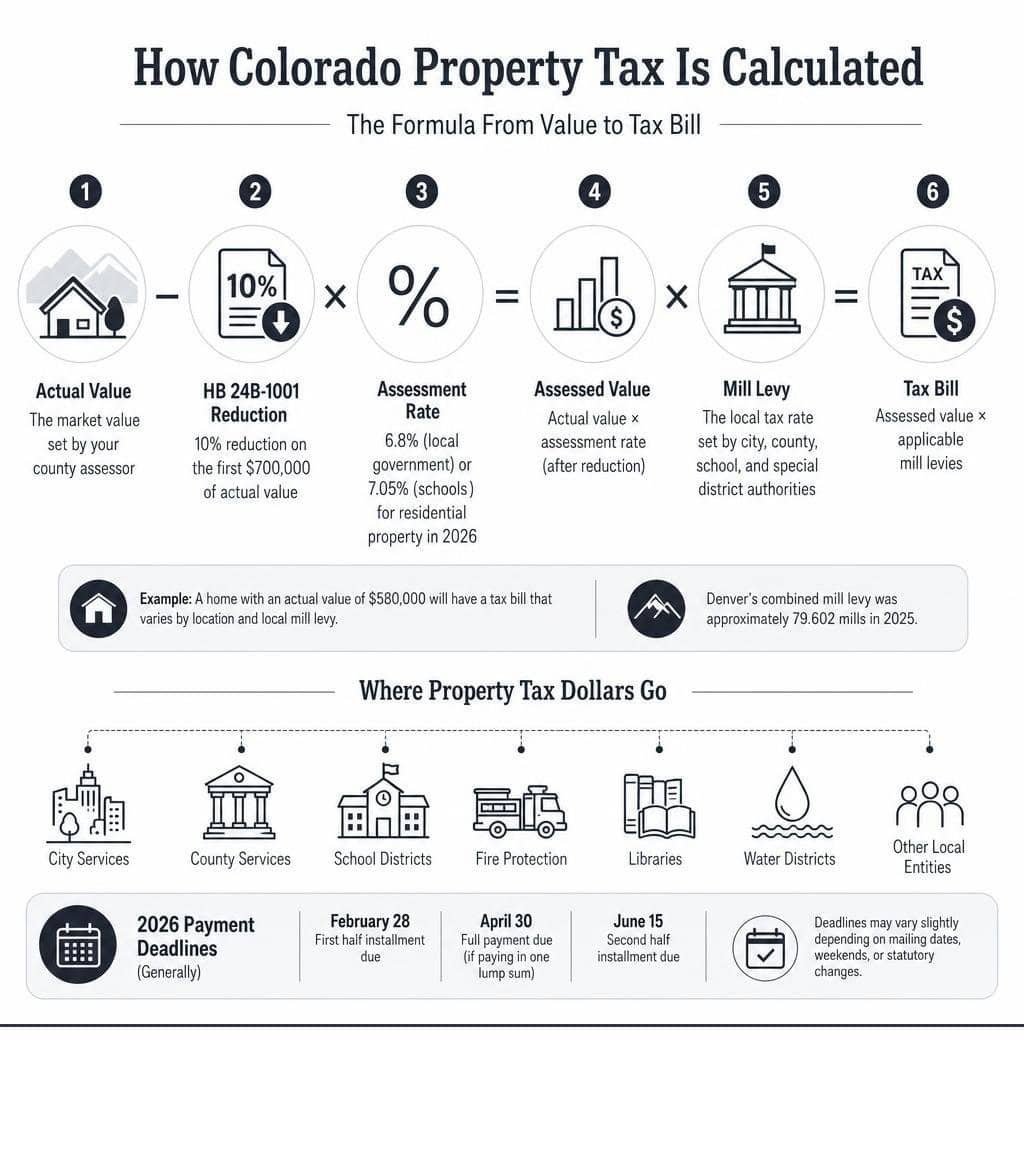
Property tax is generally calculated by multiplying the property’s assessed value by the combined mill levy imposed by the applicable taxing authorities. Actual tax bills may also reflect exemptions, credits, special districts, and other adjustments where applicable. The framework applies in cities across Colorado, including Denver, Centennial, Aurora, Littleton, Colorado Springs, Fort Collins, Boulder, and other communities.
| Step | What It Means |
|---|---|
| Actual Value | The market value set by your county assessor |
| Assessment Rate | 6.8% (local government) or 7.05% (schools) for residential property in 2026 |
| HB 24B-1001 Reduction | 10% reduction on the first $700,000 of actual value |
| Assessed Value | Actual value × assessment rate (after reduction) |
| Mill Levy | The local tax rate set by city, county, school, and special district authorities |
| Tax Bill | Assessed value × applicable mill levies |
For a Colorado home valued at $580,000 in 2026, the annual tax bill will vary depending on the local mill levy. In Denver, that can work out to roughly $3,000 to $3,200, while a similar home in another Colorado city may pay more or less depending on school district, county, and special district rates.
Colorado reassesses property values every two years in odd-numbered years. These taxes are generally collected and distributed to local taxing entities rather than the state government. Depending on where you live, those dollars may fund city services, county services, school districts, fire protection, libraries, water districts, or other local entities.
Payment deadlines to know generally follow this Colorado schedule:
- February 28 — First half installment due
- June 15 — Second half installment due
- April 30 — Full payment due (if paying in one lump sum)
Deadlines may vary slightly depending on mailing dates, weekends, or statutory changes.
I’m Gerard Deffenbaugh, a Colorado attorney with over a decade of experience in tax strategy for real estate investors and estate planning — including the ways Colorado real estate tax intersects with ownership structures, trust administration, and capital gains planning. In this guide, I’ll walk you through the statewide rules and city-specific considerations that matter whether you own property in Denver, Centennial, Aurora, Boulder, Colorado Springs, Fort Collins, or another Colorado community.
Understanding Your Colorado Real Estate Tax Bill
To understand your property-tax bill, you must first understand that Colorado separates how it values your property from how it taxes it. The process involves three distinct components: actual value, assessed value, and the local mill levy.
Your county assessor is legally responsible for discovering, listing, and valuing all real property within the county’s boundaries. In Denver, that role belongs to the Assessor’s Office – City and County of Denver. In other Colorado cities, the relevant assessor may be the Arapahoe County Assessor, Jefferson County Assessor, Adams County Assessor, Boulder County Assessor, El Paso County Assessor, Larimer County Assessor, or another county office. The assessor does not set your tax rate. Instead, the tax rate known as a mill levy is established by local taxing authorities, including city councils, county governments, school boards, and special districts.

Here is how the key terms on your statement break down:
- Actual Value: This is the market value of your property as determined by the county assessor. For residential property, assessors generally use a market approach, analyzing comparable home sales within a specific 24-month statutory window. For the 2025 and 2026 tax years, this window was set between January 1, 2023, and June 30, 2024.
- Assessed Value: This is the portion of your property’s actual value that is subject to taxation. It is calculated by multiplying your actual value (minus any statutory reductions) by the state-mandated assessment rate.
- Mill Levy: A mill represents one-thousandth of a dollar ($0.001). Therefore, a combined mill levy of 80 mills translates to a tax rate of $0.08 for every $1 of assessed value. Your exact mill levy depends on your property location and the taxing districts that serve it.
How to Calculate Your Colorado Real Estate Tax
Historically, Colorado applied a single assessment rate to residential properties. However, legislative changes under SB24-233 and HB 24B-1001 established a dual-rate assessment system. Under current Colorado law, starting in 2025 and continuing into 2026, residential properties are subject to two distinct assessment rates: one for local government services and another for school districts.
Additionally, HB 24B-1001 provides a universal residential relief mechanism: a 10% reduction on the first $700,000 of your home’s actual value (up to a maximum reduction of $70,000).
The table below outlines the residential assessment rates in effect for the 2025 and 2026 tax years under current Colorado law:
| Tax Year | Residential Assessment Rate (Local Government) | Residential Assessment Rate (Schools) | Value Reduction (Under HB 24B-1001) |
|---|---|---|---|
| 2025 | 6.25% | 7.05% | 10% on the first $700,000 of value |
| 2026 | 6.80% | 7.05% | 10% on the first $700,000 of value |
To see how this works in practice, let’s calculate the 2026 tax bill for a Colorado home with an actual value of $580,000 using an example combined mill levy of 80 mills (split as 30 mills for local government and 50 mills for schools):
- Apply the HB 24B-1001 Reduction: Because $580,000 is under the $700,000 threshold, the entire value receives a 10% reduction ($58,000). The adjusted actual value for assessment is $522,000.
- Calculate Local Government Assessed Value: Multiply the adjusted value by the 2026 local government rate of 6.8%.
- $522,000 × 0.068 = $35,496 (Local Assessed Value)
- Calculate School District Assessed Value: Multiply the adjusted value by the school rate of 7.05%.
- $522,000 × 0.0705 = $36,801 (School Assessed Value)
- Apply the Mill Levies: Multiply each assessed value by its respective mill levy.
- Local Government Tax: $35,496 × 0.030 = $1,064.88
- School District Tax: $36,801 × 0.050 = $1,840.05
- Total Annual Property Tax Bill: $2,904.93
This example is useful for planning, but your actual bill may differ substantially. A homeowner in Denver, Centennial, Aurora, Boulder, Colorado Springs, or Fort Collins may have different city, county, school district, fire district, library district, water district, or metropolitan district levies. Property taxes often influence broader ownership decisions, including trust planning, estate planning, and investment strategy.
TABOR and Colorado Property Tax Limits
Any discussion of Colorado property taxes must address the Taxpayer’s Bill of Rights (TABOR), a constitutional amendment approved by voters in 1992. TABOR limits the amount of revenue that local and state governments can retain and spend. If revenue exceeds these limits, the excess must be refunded to taxpayers unless voters approve a ballot measure allowing the government to keep it (a process commonly referred to as “De-Brucing”).
While TABOR requires voter approval for any new taxes or tax rate increases, it does not prevent your property tax bill from rising when market values rise faster than income or wages. Because property values in many Colorado communities have grown significantly over the last decade, local governments and homeowners alike have faced pressure.
To address this, SB 24-233 established a statutory revenue growth cap. If local property values rise so rapidly that they would generate more than capped revenue increase, the local government must temporarily lower its mill levy to remain compliant with the cap, unless local voters have previously authorized the entity to exceed TABOR limits.
How to View and Pay Colorado Property Taxes Online
Most Colorado counties now provide online portals where property owners can search for tax statements, review assessment records, and make payments. The exact portal depends on the county where the property is located. For example, Denver property owners use the City and County of Denver portal, while property owners in Centennial, Aurora, Littleton, Boulder, Colorado Springs, or Fort Collins may need to use Arapahoe, Adams, Jefferson, Boulder, El Paso, Larimer, or another county’s treasurer and assessor websites.
If you prefer to pay your bill online, my office recommends downloading and archiving digital copies of your tax statements each year for your financial and estate planning records.
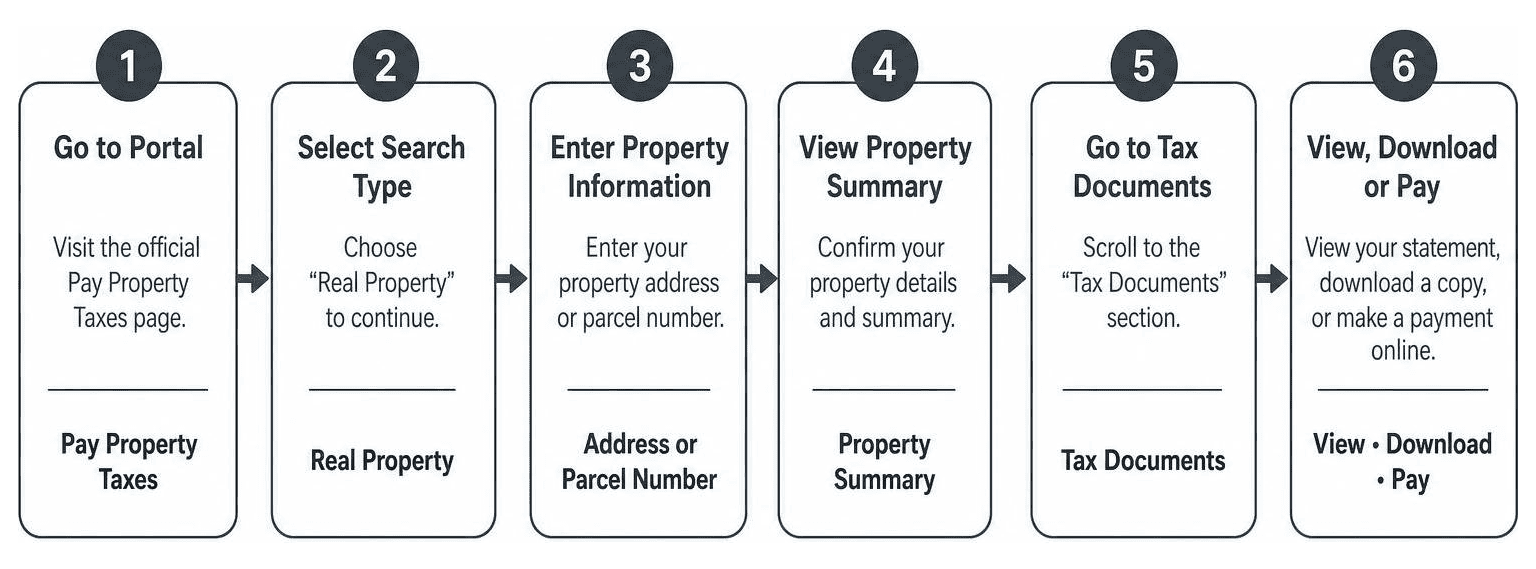
To view and pay your Colorado property taxes online, follow these steps:
- Identify the county where your property is located. City boundaries do not always match county boundaries, so confirm the county before searching.
- Navigate to your county treasurer’s property tax payment portal. Denver owners can start with Pay Property Taxes.
- Select the real property search option and enter your property address, parcel number, or schedule number.
- Download your current tax statement from the tax documents or statement section.
- Complete payment through the portal if you want to pay online. Many counties allow e-check or credit card payments, though third-party processing fees may apply to card transactions.
If you prefer to pay by mail, send payment to the county treasurer listed on your tax statement and write your parcel, schedule, or account number on the memo line of your check. In-person payment options vary by county.
Colorado Property Tax Relief and Exemptions
Colorado offers several property tax relief programs designed to support seniors, veterans with disabilities, and surviving spouses. If you qualify, these programs may reduce your annual tax burden:
- Senior Homestead Exemption: This program exempts 50% of the first $200,000 of a property’s actual value from taxation. To qualify, you must be at least 65 years old as of January 1 of the tax year, and you must have owned and occupied the property as your primary residence for at least 10 consecutive years. Eligibility rules and exemption amounts are set by Colorado statute and can change from year to year, so you should confirm current requirements with your county assessor before relying on this exemption in your planning.
- Senior Primary Residence Classification (Portability): For the 2025 and 2026 tax years, Colorado introduced a temporary “portability” rule. This classification allows qualifying seniors who previously received the Homestead Exemption to carry their exemption status to a new primary residence in Colorado, bypassing the standard 10-year occupancy requirement.
- Disabled Veterans Exemption: Veterans who have been rated by the VA as 100% permanently and totally disabled (or those receiving Individual Unemployability compensation) can qualify for a similar 50% exemption on the first $200,000 of value. The application deadline is July 1, and the program is also available to qualifying Gold Star Spouses.
How to Protest Your Colorado Property Valuation
Because Colorado property taxes are tied directly to your home’s actual market value, an overvaluation by the county assessor means you may pay more than your fair share. You have a statutory right to protest your valuation.
The valuation and appeal process generally follows this timeline, though county procedures can vary:
- Notice of Valuation (NOV): The assessor sends your NOV by May 1st of each year. This document outlines the actual value assigned to your property for the current cycle. In my experience, this is the single most common date homeowners overlook, so it is worth marking on your calendar each spring.
- The Protest Window: In many counties, you must file your formal protest with the county assessor between May 1st and June 8th. Always verify the deadline on your county assessor’s website or your NOV.
- Provide Comparable Sales: When protesting, you cannot simply argue that your taxes are too high. You must present objective evidence. One effective approach is submitting comparable sales from your immediate neighborhood that occurred within the statutory 24-month sales window (January 1, 2023, to June 30, 2024, for the 2025 and 2026 cycle).
- Notice of Determination (NOD): The assessor will review your protest and issue a determination according to the county’s published schedule.
- Board of Equalization Appeal: If the assessor denies your protest, you may be able to appeal the decision to your county Board of Equalization by the applicable deadline. In practice, most successful appeals I see are resolved at this stage once the homeowner presents organized, well-documented comparable sales data.
Real Estate Ownership Structures and Tax Implications
As an estate planning and tax attorney, I often find that property owners overlook how their deed’s titling affects their tax liabilities. How you hold title to Colorado real estate impacts not only your annual property taxes and eligibility for exemptions but also your exposure to capital gains taxes when the property is eventually sold.

Many co-owners default to holding property in joint tenancy with the right of survivorship. While this structure is highly popular because it allows the property to bypass probate court and pass automatically to the surviving owner upon death, it carries significant tax disadvantages in Colorado.
I cover these risks in more depth in How to Avoid Getting Taxed to Death on Colorado Capital Gains.
Joint Tenancy vs. Tenancy in Common Basis Step-Up
When an owner of real estate passes away, the tax basis of their property interest is adjusted to its fair market value as of the date of their death. This is known as a “stepped-up basis,” and it is significant because it can reduce or eliminate the capital gains tax on the property’s appreciation during the decedent’s lifetime.
However, because Colorado is a separate property state (as opposed to a community property state like California or Texas), the tax basis step-up rules apply differently depending on how your deed is written:
- Joint Tenancy: If a married couple owns a Colorado home as joint tenants, only the deceased spouse’s 50% share of the property receives a stepped-up basis upon their death. The surviving spouse retains their original tax basis on their own 50% share. When the surviving spouse eventually sells the home, they may face a substantial capital gains tax bill on their half of the historical appreciation.
- Tenancy in Common: Under a tenancy in common, co-owners hold distinct, fractional interests in the property. Like joint tenancy, only the deceased owner’s specific percentage interest receives a step-up in basis. However, tenancy in common does not avoid probate, meaning the deceased owner’s share must pass through the probate court or be directed by a will or trust.
Trust vs. LLC: Structuring Colorado Real Estate Tax and Asset Protection
For real estate investors and homeowners alike, choosing between a revocable living trust and a Limited Liability Company (LLC) is a critical decision. While LLCs have long been the default choice for rental properties, recent legal and legislative shifts in Colorado are making trusts an increasingly attractive alternative.
To explore broader tax-saving methods for high-value portfolios, you can review my article on Tax Strategies for High-Income Earners Reduce the Sting of Higher Brackets.
When comparing these two structures for your Colorado real estate, consider the following trade-offs:
1. The Impact of Commercial Property Tax Rates
In Colorado, commercial real estate is assessed at a significantly higher rate than residential property (25% to 26% for commercial versus 6.8% to 7.05% for residential). In recent legislative sessions, Colorado lawmakers and local officials have actively proposed taxing residential rental properties held within LLCs at commercial property tax rates. Holding your residential real estate in a trust can generally help avoid this commercial tax risk, as the property remains classified under residential rates.
2. Transaction Costs and HOA Fees
Transferring a property into an LLC after closing can trigger costly HOA transfer fees, title insurance reissue costs, and potentially activate “due-on-sale” clauses in your mortgage. Conversely, taking title directly in the name of a revocable living trust during the initial purchase may help avoid later transfer fees, maintain continuity in title planning, and protect your asset-transfer privacy.
Frequently Asked Questions About Colorado Property Taxes
Why did my Colorado property tax increase despite legislative caps?
Even though the state legislature passed assessment rate reductions (HB 24B-1001) and local revenue caps (SB 24-233), many Colorado homeowners still experienced tax increases. This occurs because Colorado’s biennial reassessment cycle is backward-looking.
Your current tax bill is based on property valuations established during the 24-month period ending June 30, 2024. Because home values in many Colorado communities grew during that window, the increase in your home’s actual market value may outpace legislative rate cuts. Additionally, voter-approved local school bonds and special district mill levies are exempt from certain revenue caps, which can push your final tax bill upward.
What happens to property tax when a joint tenant dies in Colorado?
When a joint tenant passes away, their ownership interest automatically transfers to the surviving joint tenant(s) by operation of law. However, this transfer does not automatically update the public land records.
To clear the title, the surviving owner typically records a redacted copy of the death certificate and a sworn statement of identity with the county clerk and recorder where the property is located. From a tax perspective, the deceased owner’s portion of the property receives a stepped-up tax basis. You should consider hiring a professional appraiser to document the property’s fair market value as of the date of death to establish this new tax basis for future capital gains reporting.
Is it better to hold Colorado residential rental property in a trust or an LLC?
The answer depends on your primary goals:
- Choose an LLC if your primary concern is operational liability protection and you are comfortable handling entity maintenance, annual state filings, and any applicable federal reporting obligations.
- Choose a Trust if your primary goals are avoiding probate, maintaining privacy, reducing transfer friction, and protecting your portfolio against future legislative attempts to tax LLC-held residential properties at commercial property tax rates.
Conclusion
Navigating the complexities of the Colorado real estate tax system requires a careful look at both statewide tax laws and your local city, county, school district, and special district levies. Whether you are seeking to protest an unfair valuation, apply for a senior exemption, or restructure your real estate holdings to minimize future capital gains taxes, the decisions you make today rarely stay confined to a single tax bill. They can carry forward into how your estate, business interests, and investment portfolio are structured for years to come.
At Colorado Trusts & Taxes, I provide personalized, empathetic guidance to help you protect your hard-earned assets. My office, located in Centennial, CO, serves property owners, families, small business owners, and real estate investors across Colorado with estate planning, trust administration, probate, and tax strategy.
If you would like to discuss how to structure your Colorado real estate holdings or integrate your properties into a comprehensive estate plan, please explore my Business Tax Lawyer Services and reach out to schedule a consultation.
This guide is for general informational purposes only and is not legal or tax advice. Property tax laws change frequently. Consult your county assessor, a qualified tax professional, or an attorney regarding your specific situation.