

Why Investment Property Depreciation Recapture Matters When You Sell
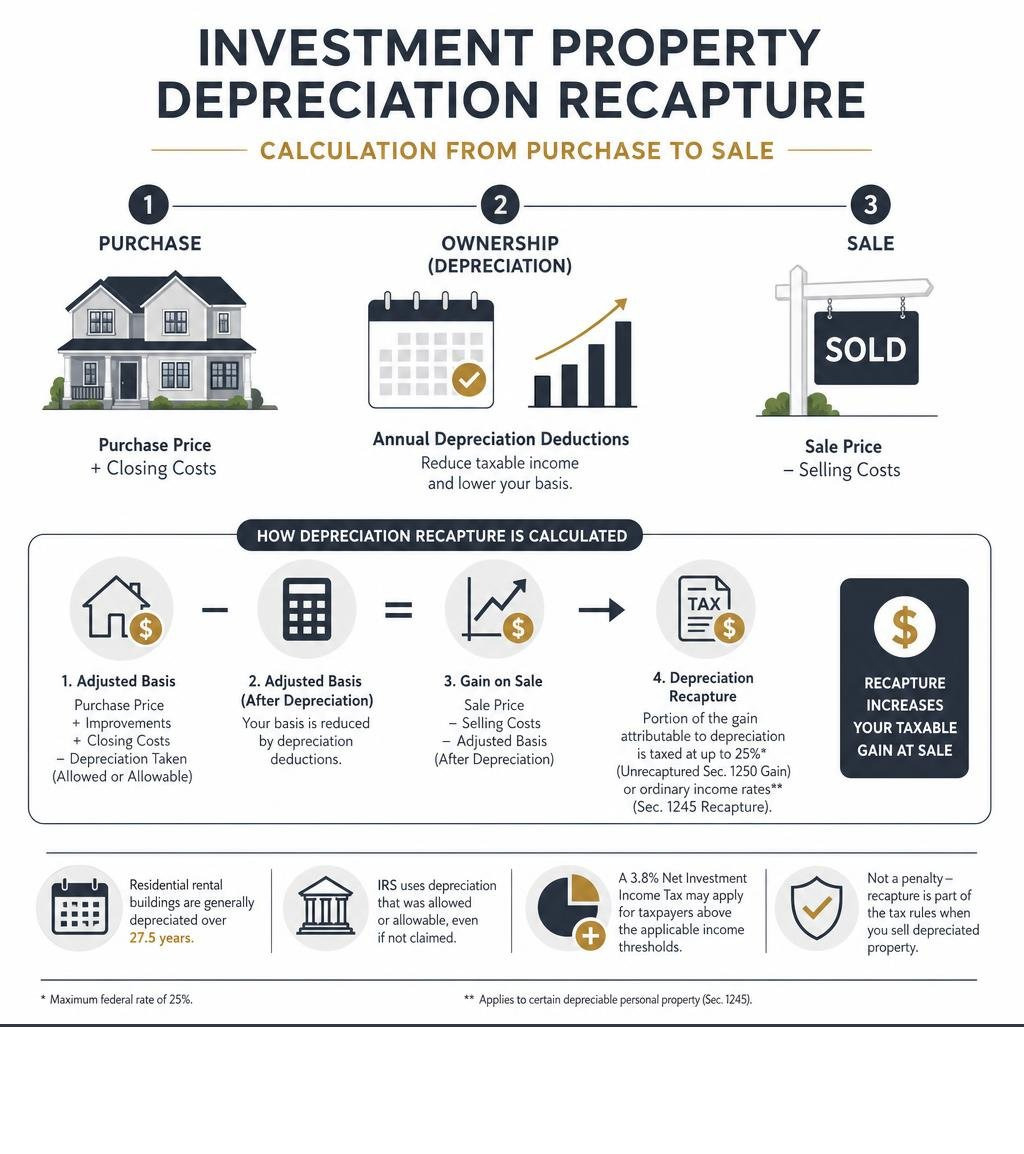
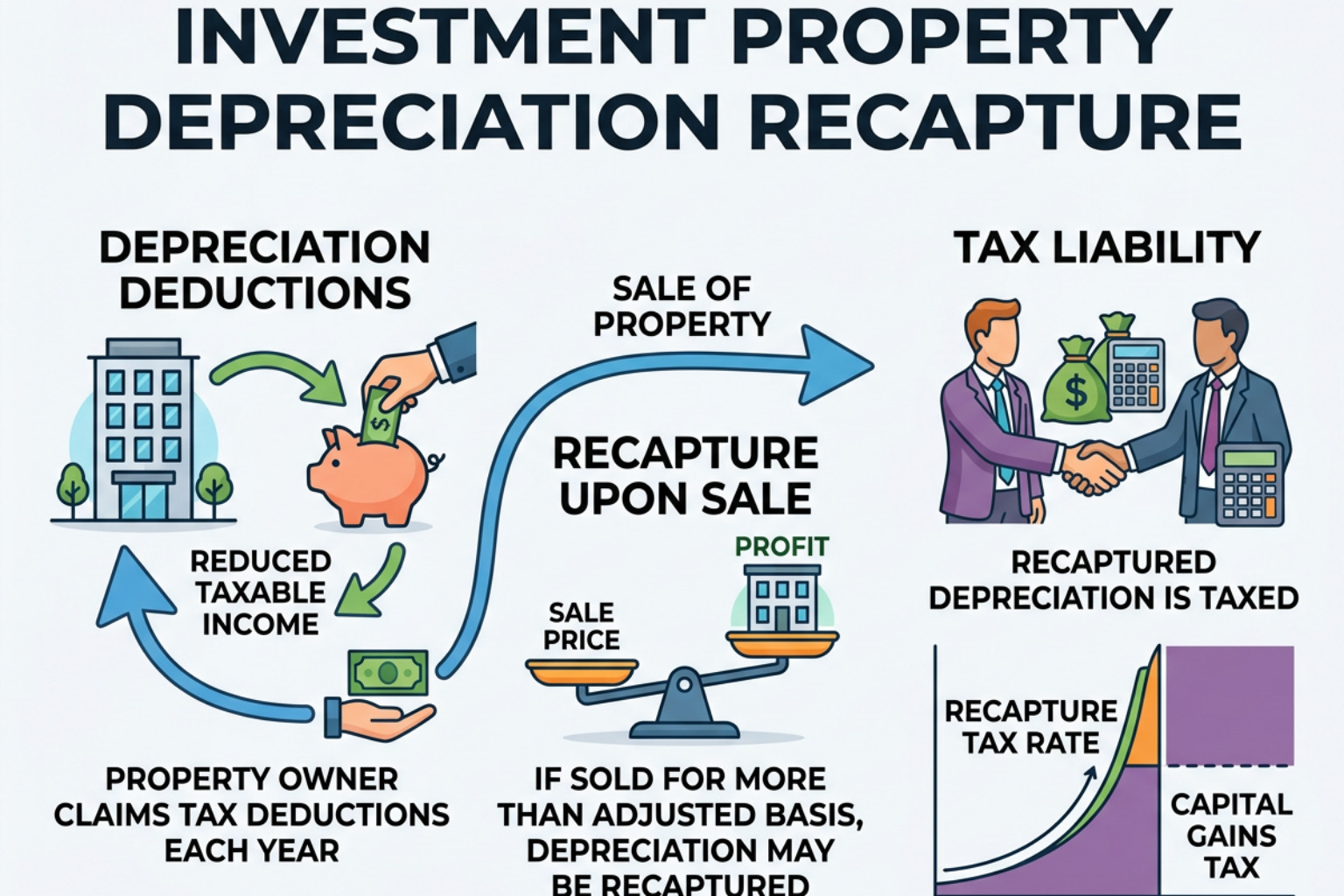
Investment property depreciation recapture is the federal tax treatment that can apply when you sell a rental or other depreciated property for more than its adjusted basis. In simple terms, depreciation deductions lower your taxable rental income while you own the property, but they also reduce your tax basis. That can make more of the sale proceeds taxable later.
For a quick answer:
- Residential rental buildings are generally depreciated over 27.5 years.
- Depreciation reduces your property’s adjusted basis, which increases the gain calculated at sale.
- Gain attributable to prior straight-line depreciation on Section 1250 real property may be treated as unrecaptured Section 1250 gain, subject to a maximum federal rate of 25%.
- Depreciation on certain cost-segregated assets, such as equipment and some land improvements, may be Section 1245 recapture and taxed at ordinary income rates.
- The IRS generally uses depreciation that was allowed or allowable, even when an owner did not claim the deduction.
- A 3.8% Net Investment Income Tax may also apply for taxpayers above the applicable income thresholds.
Depreciation recapture is not necessarily a penalty, but it can be an unexpected part of a rental property sale tax bill. The result depends on the property’s purchase allocation, improvements, depreciation history, selling costs, income, and whether the sale is structured as a taxable sale or a qualifying exchange.
In my work with Colorado real estate investors, I evaluate depreciation history alongside the planned sale, ownership structure, estate plan, and potential reinvestment strategy because each can affect the ultimate tax result.
What Is Depreciation Recapture and How Does It Work?
A taxable gain generally arises when the amount realized on the disposition exceeds adjusted basis.
Depreciation reduces your property’s adjusted basis over time. When you later sell or otherwise dispose of the real estate asset, that lower adjusted basis may increase the taxable gain calculated on the disposition. The portion of gain tied to depreciation may then be treated as depreciation recapture, depending on the type of property, depreciation claimed or allowable, and the structure of the transaction.
A taxable gain generally arises when the amount realized on the disposition exceeds the adjusted basis. The IRS calculates gain on sale by taking your net proceeds and subtracting the adjusted basis. Because accumulated depreciation systematically reduces your adjusted basis year after year, your calculated taxable gain increases by the exact amount of depreciation allowed or allowable during your ownership.
A critical nuance that surprises many real estate owners is the “allowed or allowable” doctrine. The IRS mandates that your adjusted basis must be reduced by the full amount of depreciation you were legally entitled to claim, regardless of whether you actually claimed those deductions on your tax returns. If you skipped claiming annual depreciation on a rental unit, the IRS still reduces your basis as if you had taken it. This rule underscores the necessity of proactive tax management throughout the entire lifecycle of real estate ownership.
When an investment property is sold, the tax treatment should distinguish actual depreciation recapture from unrecaptured Section 1250 gain. Actual Section 1250 recapture generally applies only to additional depreciation on real property beyond straight-line depreciation. By contrast, straight-line depreciation on Section 1250 real property is generally treated as unrecaptured Section 1250 gain, which is subject to a special maximum federal rate rather than ordinary income recapture treatment. Section 1245 property, such as certain personal property identified in a cost segregation study, may still produce ordinary income recapture. The remaining gain generally enters the Section 1231 netting process. Depending on the taxpayer’s other Section 1231 transactions and prior nonrecaptured Section 1231 losses, some or all of the resulting net gain may ultimately receive long-term capital-gain treatment. To gain a deeper perspective on structuring your real estate portfolio efficiently, review Understanding depreciation recapture on rentals as well as my guide on A Practical Guide to Tax Planning Strategies for Real Estate.
Section 1250 Unrecaptured Gain vs Section 1245 Recapture
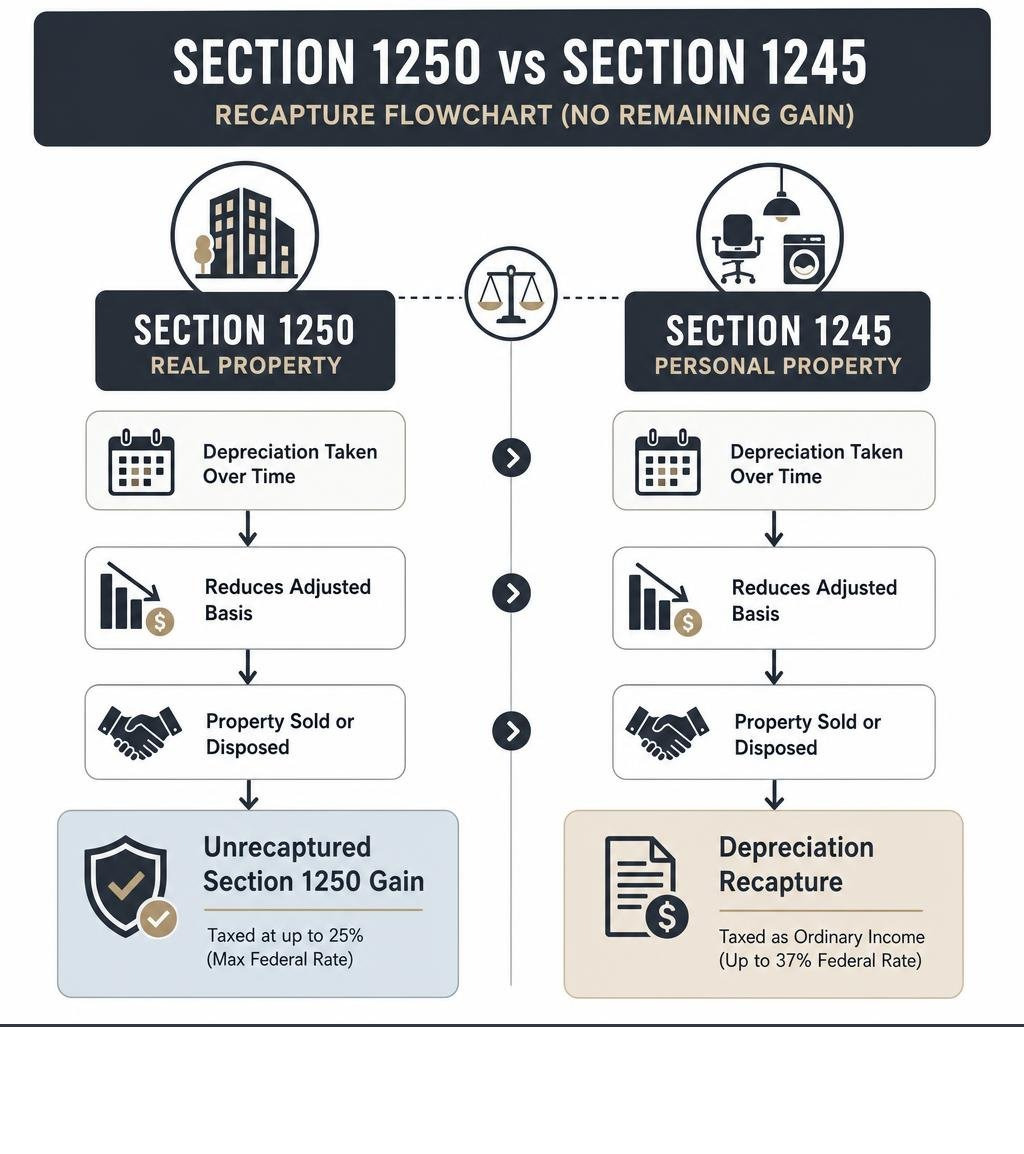
Understanding depreciation recapture requires distinguishing between real property and personal property components embedded within a real estate asset. The Internal Revenue Code categorizes depreciable property into distinct classifications, primarily Section 1250 real property and Section 1245 personal property.
Section 1250 property generally encompasses physical structural assets, including residential rental buildings, commercial office structures, warehouses, and structural additions. Under standard Modified Accelerated Cost Recovery System (MACRS) rules, residential rental properties are depreciated straight-line over a 27.5-year recovery period, while non-residential commercial properties are depreciated over 39 years.
Gain attributable to accumulated straight-line depreciation may constitute unrecaptured Section 1250 gain, subject to the applicable Section 1231 and capital-gain rules. Unrecaptured Section 1250 gain is subject to a maximum federal tax rate cap of 25%. While this rate exceeds standard long-term capital gains rates (which typically top out at 20%), it remains lower than top marginal ordinary income tax rates.
In contrast, Section 1245 property consists of personal property items, specialty machinery, light fixtures, carpet, and appliance packages. Classification of land improvements and other cost-segregated components depends on the particular asset and applicable tax rules. These assets carry much shorter recovery periods, usually ranging between 5, 7, and 15 years. Under Section 1245 rules, any gain attributable to depreciation on these personal property items is recaptured at full ordinary income tax rates, which can reach up to 37% at the federal level depending on your overall income tax bracket.
The Impact of Cost Segregation on Depreciation Recapture
Many real estate investors utilize cost segregation studies to accelerate tax deductions during early years of property ownership. A cost segregation study analyzes building components and other property items so they can be classified under the proper tax category. Depending on the asset, a cost segregation study can identify both Section 1245 components (such as certain tangible personal property) and certain Section 1250 components with shorter recovery periods (such as specific land improvements), separate from the main building structure. Recapture treatment must still be determined asset by asset.
By reclassifying eligible assets, property owners may be able to take advantage of shorter recovery periods and, where available, bonus depreciation provisions. This strategy can improve near-term tax liquidity during ownership, but the later sale analysis depends on the classification of each asset rather than a single blanket rule for all cost-segregated components.
When a property that underwent cost segregation is sold in a taxable transaction, the tax treatment should be applied asset by asset. Depreciation attributable to Section 1245 components can produce ordinary income recapture. Depreciation attributable to Section 1250 real property is generally analyzed under Section 1250 rules, with straight-line real property depreciation generally treated as unrecaptured Section 1250 gain rather than ordinary income recapture.
Furthermore, if you structure a property disposition using an installment sale under Internal Revenue Code Section 453, ordinary recapture income from Section 1245 property generally cannot be deferred over future payment years. Investors should carefully evaluate their planned holding period, asset classifications, depreciation history, and exit strategy before conducting aggressive cost segregation studies.
How to Calculate Depreciation Recapture on Real Estate Step-by-Step
Calculating your exposure to depreciation recapture requires systematically building your tax basis from original acquisition through disposition. The calculation involves identifying your initial cost basis, accounting for land exclusions, tracking capital improvements, and calculating total allowable accumulated depreciation.
Let’s review a simplified example with straight-line depreciation. Assume an investor acquired a residential rental property in Colorado for $400,000.
For tax calculation purposes, it is critical to explicitly clarify that figures like building basis exclude land, separate capital improvements from acquisition costs, and recognize that depreciation begins when the property or improvement is placed in service.
- Initial Purchase Allocation: Purchase price of $400,000, with $80,000 allocated to non-depreciable land and $320,000 allocated to the depreciable residential building basis.
- Placed in Service: The building structure was placed in service immediately upon purchase.
- Capital Improvements: After 5 years, the owner installed a broad roof replacement for $30,000, which was placed in service upon completion as a separate capital improvement.
- Holding Period: The property was held for a total of 10 years before sale.
- Depreciation Claimed: Annual straight-line depreciation on the $320,000 initial building basis over 10 years totaled approximately $116,364. Depreciation on the $30,000 roof improvement over its 5 years in service totaled approximately $5,455. Total accumulated straight-line depreciation equaled $121,819. (This example uses simplified depreciation approximations for illustration and does not model the applicable MACRS mid-month convention.)
- Disposition Proceeds: After 10 years, the property sold for $650,000, with selling costs totaling $40,000.
| Tax Component | Section 1250 Real Property | Section 1245 Personal Property |
|---|---|---|
| Asset Scope | Building and main structural components | Personal property |
| Depreciation Method | Straight-line MACRS (27.5 or 39 years) | Accelerated MACRS (5 or 7 years) or Bonus |
| Typical Federal Character of Depreciation-Related Gain | Straight-line depreciation may produce unrecaptured Section 1250 gain subject to a maximum 25% rate; actual Section 1250 ordinary-income recapture can apply in other circumstances | Gain attributable to prior depreciation generally is ordinary income to the extent required by Section 1245, up to 37% |
Calculating Adjusted Basis and Realized Gain
To compute the final gain subject to tax, you must establish the property’s adjusted cost basis as of the sale date. The formula for adjusted cost basis begins with the original purchase price, adds eligible capital improvements and capital closing costs, and subtracts total allowable accumulated depreciation.
Using our illustrative scenario:
- Original Purchase Price: $400,000
- Add Capital Improvements: $30,000 (roof replacement)
- Subtract Accumulated Depreciation: -$121,819 (building and roof straight-line depreciation)
- Adjusted Cost Basis at Sale: $308,181 ($430,000 total basis before depreciation minus $121,819 accumulated depreciation.)
Next, calculate the net realized gain by taking the gross sales proceeds and subtracting both selling costs and the calculated adjusted cost basis:
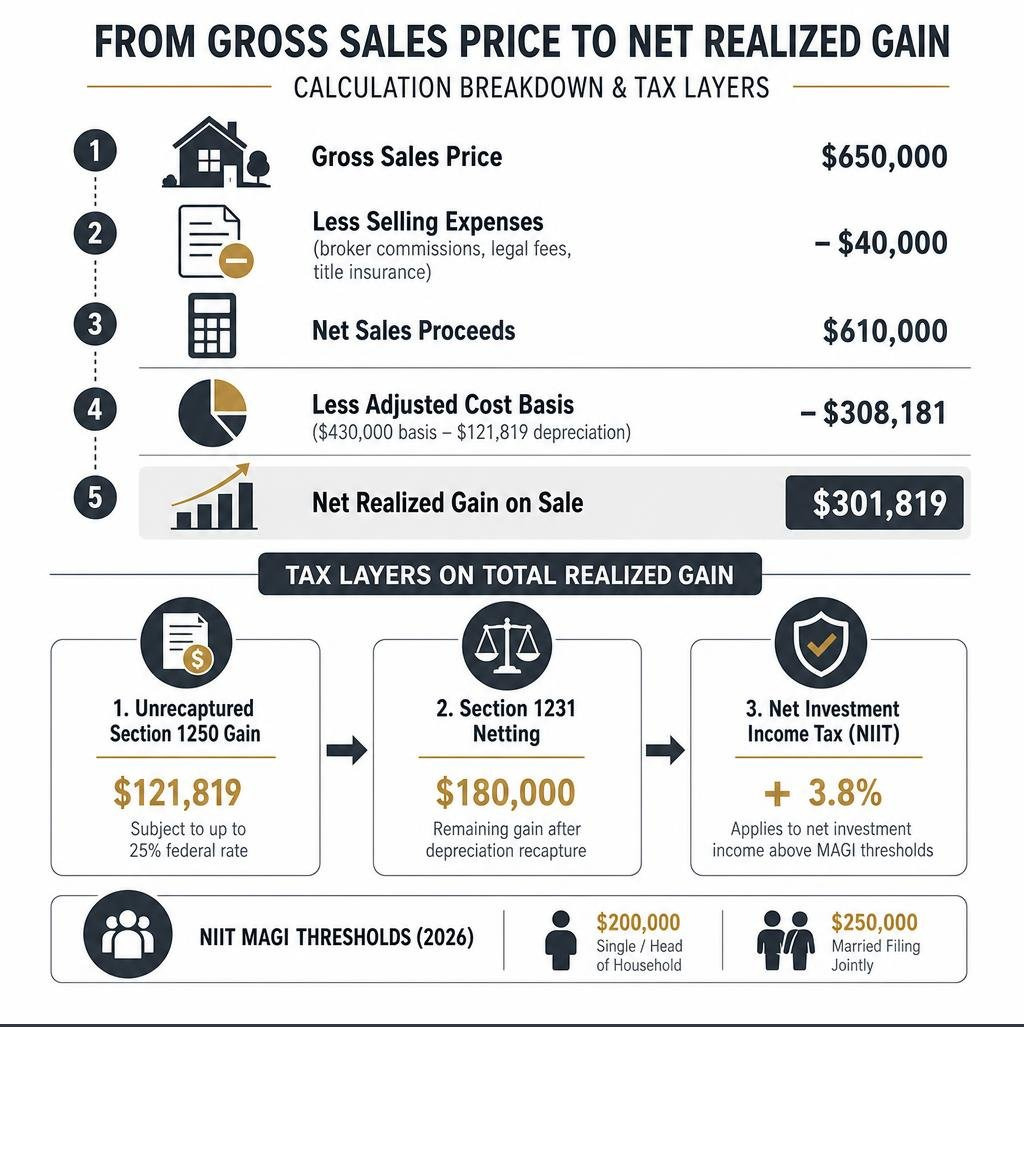
- Gross Sales Price: $650,000
- Less Selling Expenses: -$40,000 (broker commissions, legal fees, title insurance)
- Net Sales Proceeds: $610,000
- Less Adjusted Cost Basis: -$308,181
- Total Realized Gain on Sale: $301,819
Applying Tax Rates and Net Investment Income Tax (NIIT)
Once total realized and recognized gain is determined, the gain must be characterized under the applicable recapture, Section 1231, and capital-gain rules before the relevant tax rates can be determined.
First, the portion of gain attributable to prior straight-line depreciation must be evaluated for potential treatment as unrecaptured Section 1250 gain, subject to the applicable Section 1231 and capital-gain rules. In our simplified scenario, up to $121,819 may represent potential unrecaptured Section 1250 gain rather than ordinary-income depreciation recapture.
Second, the remaining gain above accumulated depreciation generally enters the Section 1231 netting process. Subtracting $121,819 from the $301,819 total gain leaves $180,000. The remaining $180,000 generally enters the Section 1231 netting process rather than automatically receiving long-term capital-gain treatment.
Third, high-income real estate investors must factor in the Net Investment Income Tax (NIIT) under Internal Revenue Code Section 1411. The NIIT may apply an additional 3.8% surtax on net investment income, which can include unrecaptured Section 1250 gain and long-term capital gain, depending on MAGI, passive-versus-nonpassive status, material participation, applicable trade-or-business rules, and the particular gain.
The NIIT applies to taxpayers whose Modified Adjusted Gross Income (MAGI) exceeds statutory thresholds:
For high-income Colorado investors, 28.8% represents a potential combined federal marginal rate only in the specific case where unrecaptured Section 1250 gain is both subject to the 25% maximum rate and also included in net investment income subject to the 3.8% NIIT, before factoring in applicable state income taxes.
Advanced Strategies That May Defer or Reduce Tax on a Property Disposition

Given the potential tax exposure resulting from depreciation recapture, real estate owners frequently seek proactive strategies to defer or reduce these tax liabilities upon property disposition. Tax deferral allows capital to remain invested in real estate, supporting long-term portfolio growth.
Real estate investors in Colorado can evaluate several established legal frameworks to address depreciation recapture liabilities. To review broader capital gains planning strategies tailored for Colorado real estate assets, explore my detailed overview on How to Avoid Getting Taxed to Death on Colorado Capital Gains.
Deferring Taxes Through Section 1031 Like-Kind Exchanges
One of the most effective strategies to defer depreciation recapture and capital gains taxes is a like-kind exchange under Internal Revenue Code Section 1031. A properly structured Section 1031 exchange may allow a property owner to defer some or all otherwise recognizable gain when qualifying investment or business real property is exchanged for qualifying replacement real property. The amount deferred depends on the transaction, and special recapture rules can apply when the relinquished property includes Section 1245 or Section 1250 components.
To work toward tax deferral in a 1031 exchange, taxpayers generally need to satisfy several requirements, though the extent of gain actually deferred depends on the specific transaction:
- The replacement property must be of like-kind (generally any real estate held for business or investment purposes).
- Purchasing replacement property equal to or greater in value than the net sales price of the relinquished property is generally part of working toward full deferral, though it does not by itself guarantee it.
- Reinvesting all net cash proceeds into the replacement property is likewise generally necessary, but recognized gain can still depend on liabilities relieved or assumed and other transaction-specific factors, and Section 1031 does not necessarily eliminate all Section 1245 or Section 1250 ordinary-income recapture.
- The taxpayer cannot have constructive receipt of funds. One approach is to use a qualified intermediary for the transaction.
- Strict timing deadlines must be met: replacement properties must be identified within 45 days of closing, and acquisition must be completed within 180 days.
If an investor receives non-like-kind property or cash during the transaction (known as “boot”), that boot triggers partial gain recognition. For comprehensive structured planning, review my detailed guide on Strategic 1031 Planning for Investors.
When considering structured investment vehicles as potential replacement options, such as Delaware Statutory Trusts (DSTs), investors should maintain a balanced perspective. A DST beneficial interest grants fractional ownership in real estate, offering passive ownership without direct management duties. However, investors retain limited control over underlying property management decisions, face potential illiquidity and transfer restrictions, and remain exposed to sponsor management risks and market real estate risks under applicable securities regulations.
How a Section 1014 Basis Adjustment May Affect Depreciation-Related Gain
While Section 1031 exchanges defer tax liabilities during an investor’s lifetime, holding investment property until death may substantially reduce or eliminate built-in federal income-tax gain attributable to pre-death appreciation and depreciation, depending on the basis adjustment and other applicable rules.
When an individual inherits qualifying real estate, the asset’s tax basis may receive a Section 1014 basis adjustment, often to its fair market value as of the decedent’s date of death, subject to certain exceptions. Where a full adjustment applies, it can eliminate the built-in gain that existed immediately before death, but subsequent appreciation or later basis adjustments can still create taxable gain.
Subsequent appreciation, depreciation, and other post-death basis adjustments can still affect the tax consequences of a later sale. If the heirs sell the inherited property shortly after the decedent’s death at close to its fair market value, taxable gain and depreciation recapture on that pre-death appreciation are typically minimal, but any appreciation or new depreciation after the date of death can still produce taxable gain or recapture upon a later sale.
Key Planning Strategies for Reducing Depreciation Recapture Exposure
Beyond 1031 exchanges and stepped-up basis, real estate investors can explore several additional strategies to mitigate tax exposure upon property disposition:
- Section 121 Primary Residence Conversion: If you convert a rental property into your primary residence and reside in it for at least two out of the five years prior to sale, you may qualify for the Section 121 exclusion ($250,000 for single filers, $500,000 for married filing jointly). Satisfying the two-out-of-five-year ownership and use tests does not necessarily make all appreciation excludable, however, gain allocated to periods of nonqualified use is generally not eligible for the exclusion. Gain attributable to depreciation allowed or allowable after May 6, 1997 generally remains taxable and, for straight-line depreciation on qualifying Section 1250 real property, may be treated as unrecaptured Section 1250 gain.
- Charitable Remainder Trusts (CRTs): Investors with genuine philanthropic goals and careful pre-sale planning may transfer appreciated rental property into an irrevocable Charitable Remainder Trust prior to executing a sales contract. A properly structured CRT may offer tax deferral advantages on the sale of the property, but distributions to the grantor carry out taxable income and gain under the CRT tier rules, and debt-financed property or other unrelated business taxable income (UBTI) can create adverse tax consequences for the trust.
- Tax Loss Harvesting: Timing property dispositions to coincide with years where you realize capital losses from other investments, such as equities or business interests, can help offset recognized Section 1231 gains, managing overall income tax bracket exposure.
IRS Reporting and Common Depreciation Recapture Pitfalls
Reporting investment property depreciation recapture accurately requires submitting specific forms to the IRS during tax filing season. Missteps in reporting can lead to IRS audits, unexpected penalties, or overpaid tax obligations.
Primary reporting forms include:
- IRS Form 4797 (Sales of Business Property): Gains and losses from rental real estate sales are calculated on Form 4797. Part I is used to report long-term Section 1231 transactions, while Part III is utilized to calculate Section 1245 and Section 1250 gain allocations when applicable.
- Schedule D (Form 1040): Net gains from Form 4797 flow to Schedule D. The Unrecaptured Section 1250 Gain Worksheet in the Schedule D instructions is completed to determine the specific tax rate cap applicable to building depreciation.
A common pitfall occurs when real estate owners fail to claim annual depreciation deductions during their ownership period. Because the IRS applies the “allowed or allowable” standard, the IRS calculates tax basis at sale as if depreciation was claimed every year.
If you discover prior missed depreciation before selling your property, IRS Form 3115 (Application for Change in Accounting Method) may be available to address the missed depreciation without amending past returns, when the missed depreciation constitutes an accounting-method issue and you qualify under current IRS procedures. Where available, Form 3115 allows a cumulative tax adjustment under Section 481(a) to account for prior missed depreciation in the current tax year, but eligibility and the specific adjustment depend on the facts and the procedural guidance in effect at the time of filing. For further guidance on rental property financial reporting, review Rental property depreciation tax guidance.
Frequently Asked Questions about Depreciation Recapture Tax
What happens if I never claimed depreciation on my investment property?
If you never claimed depreciation deductions on your investment property, the IRS still reduces your property’s adjusted basis by the full amount of depreciation that was allowable under the law. As a result, you may owe depreciation recapture tax on deductions you never actually received. IRS Form 3115 may be available to address missed depreciation before selling, when it constitutes an accounting-method issue and you qualify under current IRS procedures – potentially allowing a Section 481(a) catch-up adjustment for missed depreciation, though eligibility and the specific adjustment depend on the facts and current IRS procedural guidance.
Does depreciation recapture apply if I sell my rental property at a loss?
Depreciation recapture generally requires a taxable gain on the particular depreciable property being sold. If your property’s net sales price (gross proceeds minus selling costs) is less than its adjusted cost basis, the transaction is generally treated as a loss on that property. However, when a sale involves multiple assets – such as land, a building, and separate personal property components – the sales price and basis may need to be allocated among the individual assets, and an overall transaction loss does not necessarily establish that no recapture exists for a particular component that itself produced a gain.
Is depreciation recapture subject to the 3.8% Net Investment Income Tax?
Potentially. Gain from the disposition of rental real estate may be included in net investment income when the taxpayer’s modified adjusted gross income exceeds the applicable threshold ($200,000 for single filers and heads of household and $250,000 for married taxpayers filing jointly). However, NIIT treatment depends on the nature of the activity and the taxpayer’s circumstances. Qualifying as a real estate professional under Section 469 does not by itself exclude the gain from NIIT; material participation and whether the rental activity constitutes a trade or business for Section 1411 purposes can also matter.
Conclusion
Managing investment property depreciation recapture requires careful coordination between current tax strategy, asset disposition planning, and overall estate structure. While depreciation deductions provide valuable annual tax relief during property ownership, disposition tax rules require strategic attention when exiting an investment. Whether evaluating a 1031 like-kind exchange, preparing a property conversion, or organizing an estate plan to protect real estate wealth for future generations, taking a comprehensive view ensures your financial objectives are fully supported.
At Colorado Trusts & Taxes, I provide personalized legal guidance to real estate investors, small business owners, and families across Centennial, Denver, and the surrounding Colorado communities. My practice focuses on practical, tailored solutions in estate planning, trust administration, probate, and real estate tax planning. To discuss how I can help you structure your investment property holdings and legacy planning, explore my full range of legal and tax services at Explore Our Legal and Tax Services.