

Why Tax Planning for a Family Business Is More Complex Than Most Owners Realize
Tax planning for a family business involves much more than filing returns on time. It touches employment rules, ownership transfers, estate planning, and family governance, all at once. Here is a quick overview of the core areas to understand:
| Area | What It Covers |
|---|---|
| Family employment taxes | FICA and FUTA rules for hiring spouses, children, and parents |
| Wealth transfer strategies | Gifting, trusts, installment sales, and valuation discounts |
| Estate and gift tax planning | Current exemption rules and timing |
| Succession planning | Business readiness, tax structure, and family dynamics |
| Entity structure | How your business type affects every strategy above |
Succession research consistently shows that long-term continuity requires deliberate planning, although reported survival rates vary by study. Many family businesses operate without a fully documented and communicated transition plan. That can leave uncertainty around future leadership, ownership, decision-making authority, and family expectations.
Family-business transitions can falter for many reasons, including gaps in leadership readiness, ownership design, tax planning, and family communication. A durable succession plan addresses those areas together rather than treating the transfer as a single tax transaction.
This guide walks through all three layers, starting with the employment tax rules that affect your business today and building toward the long-term transfer strategies that coordinate ownership, tax, and estate-planning goals across generations.
I’m Gerard Deffenbaugh, a Colorado attorney with over a decade of experience in tax planning for family businesses, estate planning, and trust administration. My practice focuses on helping small business owners and families navigate exactly the intersection of tax strategy and life transitions covered in this guide.
Core Tax Strategies for Family Businesses

When you run a family business, hiring family members can support business operations while creating employment and tax considerations that differ by relationship and entity structure. However, the IRS maintains highly specific employment tax rules for family employees. These rules depend heavily on your business structure (sole proprietorship, partnership, or corporation) and the relationships involved.
Hiring Your Children
If you operate your business as a sole proprietorship or as a partnership where both partners are the parents of the child, special federal payroll-tax rules may apply:
- FICA Exemptions: Wages paid to your child under the age of 18 are typically exempt from Social Security and Medicare (FICA) taxes.
- FUTA Exemptions: Wages paid to your child under the age of 21 are generally exempt from Federal Unemployment Tax Act (FUTA) taxes.
Paying reasonable wages to a child for bona fide work can move earned income to the child while creating a deductible business expense, subject to the child’s own filing obligations and the applicable entity and payroll-tax rules. This isn’t primarily an income-shifting device: the work must be real, the pay must be market-based, records must be kept, and the child should be treated consistently with how you’d treat an unrelated employee. To qualify for the FICA/FUTA exemptions above, the compensation should be reasonable for the services performed, and the business must satisfy the applicable withholding, reporting, and payroll-filing requirements.
Hiring Your Spouse or Parents
- Spouse: When one spouse is genuinely employed by the other spouse’s sole proprietorship, wages are generally subject to income-tax withholding and FICA but not FUTA.
- Parent: When a parent works as an employee of the child’s sole proprietorship, wages are generally subject to income-tax withholding and FICA but not FUTA. Limited exceptions can apply to certain domestic services, and the treatment changes when the employer is a corporation, partnership, or estate.
The Corporate Exception
If the employing business is a corporation (either as an S corporation or a C corporation), or if it is a partnership where not all partners are the employed child’s parents, the special family-employment FICA and FUTA exceptions generally do not apply. Wages must then be handled under the generally applicable payroll-tax and withholding rules.
Understanding these rules is critical. If you are operating under a corporate structure, entity selection should account for employment-tax treatment alongside liability protection, income-tax treatment, administration, ownership, and succession goals. Entity classification affects payroll, income-tax, ownership, and succession considerations.
Additionally, local business owners must ensure they remain compliant with state-level obligations. You can review our guide on Colorado Business Tax Requirements Explained to keep your local filings aligned with your federal strategies. While you might work with a firm for routine bookkeeping, it is important to coordinate these employment decisions with a legal framework.
How Can a Qualified Joint Venture Simplify Reporting?
For married couples who jointly own and operate an unincorporated business, the IRS offers a simplified reporting method called a Qualified Joint Venture (QJV). A business jointly owned and operated by spouses is generally treated as a partnership for federal tax purposes unless an applicable election or classification rule provides otherwise.
For an eligible jointly owned and operated unincorporated business, spouses filing jointly may elect QJV treatment rather than partnership treatment. Each spouse reports their respective share of the business’s items on a separate Schedule C and generally calculates self-employment tax separately, so both spouses receive proper credit for Social Security and Medicare coverage.
To qualify for the QJV election, the business must meet the following criteria:
- The only members of the business are the married couple.
- Both spouses must materially participate in the trade or business.
- The couple must file a joint federal income tax return.
It is important to note that state-law entities, such as Limited Liability Companies (LLCs), are generally not eligible for the QJV election. A two-member spouse-owned LLC in Colorado is generally classified as a partnership for federal tax purposes unless it elects another eligible classification. It cannot use the ordinary QJV election merely because the spouses are its only members.
Wealth-Transfer and Gifting Strategies for Family Businesses

As a business owner who wants to keep ownership in the family, your long-term success is tied to how efficiently you can eventually transition the value of your company to the next generation. Federal estate and gift tax exemptions determine how much wealth can be transferred during life or at death before federal transfer tax may apply.
For 2026, the federal basic estate and gift tax exclusion amount is $15 million per individual, with inflation adjustments applying in subsequent years. For 2026, the federal annual gift-tax exclusion remains $19,000 per recipient, and annual exclusion gifts generally do not use the donor’s basic exclusion amount. However, Congress may modify these amounts in the future.
One of the simplest ways to begin this transition is by utilizing the annual gift-tax exclusion. For 2026, qualifying present-interest gifts of up to $19,000 per recipient generally fall within the federal annual gift-tax exclusion and ordinarily do not use the donor’s basic exclusion amount. Transfers of restricted or closely held business interests do not automatically qualify. The recipient’s present rights, governing documents, valuation, and gift-tax reporting requirements must be reviewed. Gradual transfers of non-voting or minority interests may move business value to the next generation over time. Whether a transfer qualifies for the annual exclusion, uses part of the donor’s basic exclusion amount, or requires a gift-tax return depends on the interest transferred, the recipient’s present rights, the governing documents, and the valuation.
For high earners, these transfer strategies must be coordinated with broader income tax reduction techniques. For further guidance, see Tax Strategies for High Income Earners: Reduce the Sting of Higher Brackets and Tax Strategies for Multi-Generational Family Businesses.
Valuing Minority Interests in Family-Business Transfers
When a minority or nonmarketable interest in a closely held business is transferred, a qualified appraisal may support a lower fair market value than a simple pro-rata share of the company’s total value.
These discounts generally fall into one of two categories:
- Lack of Control (Minority Interest) Discount: Reflects the reduced value of a minority shareholding because a minority owner cannot force decisions, declare distributions, or control the company’s direction.
- Lack of Marketability Discount: Reflects the difficulty of selling shares in a private, closely held business compared to publicly traded stocks.
Discounts for lack of control or lack of marketability are not automatic and do not follow a standard percentage. Their availability and amount depend on the transferred interest, governing agreements, financial condition, distribution history, market evidence, and other valuation facts. For illustration only, assume that an independent appraisal, based on the specific facts, supported a combined 30% adjustment; a 10% interest valued at $1 million might be reported at $700,000. The IRS may scrutinize both the underlying valuation and the facts supporting any discount.
A contemporaneous independent appraisal by a professional experienced in closely held business valuation is often essential to support the reported fair market value. The appropriate appraisal and reporting requirements should be confirmed for the specific transfer. For entrepreneurs managing high-value assets, additional context is available in Corporate Tax Planning for Wealthy Entrepreneurs.
Trust and Sale Strategies for Appreciating Business Interests
For rapidly growing family businesses, relying solely on annual gifting may not transfer enough value before exemption rules change. In these cases, advanced trust and sale structures may limit the amount of future appreciation remaining in the owner’s taxable estate when they are properly designed, valued, implemented, and administered.
Intentionally Defective Grantor Trusts (IDGTs)
An intentionally defective grantor trust is an irrevocable trust designed to be treated as owned by the grantor for federal income-tax purposes while, if properly structured and administered, transferred assets may be excluded from the grantor’s taxable estate. Because the grantor generally pays the income tax attributable to the trust, trust assets may grow without being reduced by that tax liability. Under applicable grantor-trust principles, the grantor’s payment of that income tax generally is not treated as an additional gift, although reimbursement provisions and administration can affect the analysis.
A properly structured sale may replace the transferred business interest with a promissory note in the grantor’s estate. Future appreciation above the note economics may accrue for the trust beneficiaries, subject to valuation, interest-rate, cash-flow, and estate-inclusion risks. The transaction also requires sufficient trust funding or other support, commercially reasonable note terms, accurate valuation, and administration consistent with the transaction documents.
Grantor Retained Annuity Trusts (GRATs)
A GRAT is an irrevocable trust where you transfer business shares in exchange for a series of annual annuity payments over a set term of years. The annuity payments are calculated using the IRS Section 7520 interest rate. To the extent the transferred property outperforms the assumptions reflected in the Section 7520 valuation and the GRAT operates as intended, value may remain for the beneficiaries after the annuity term. If the grantor dies during the retained-annuity term, some or all of the trust property may be included in the grantor’s gross estate. A GRAT can also underperform if the transferred property does not appreciate sufficiently above the Section 7520 assumptions or if business distributions are inadequate to satisfy the annuity obligation.
Intra-Family Installment Sales
Another option is an installment sale of the business to a family member. This structure may allow the purchaser to fund note payments over time from available business distributions or other resources, but the seller remains exposed to the purchaser’s cash-flow and default risk. An installment sale may replace the business interest with a promissory note and spread eligible gain over the payment term as principal is received. The result depends on the note terms, buyer’s ability to pay, interest requirements, security, valuation, and related-party rules. Certain items, including applicable depreciation recapture, may be taxable in the year of sale rather than deferred. A sale to a family member must be respected as a bona fide transaction with commercially reasonable terms and actual payment performance. A technically efficient transfer is not durable if the business cannot support the required payments or the successor lacks clear authority.
Owners weighing these paths can compare the tax-efficient transfer approach in Family Business Succession Plan: Tax-Efficient Transfer Guide, the step-by-step methods in How to Transfer Business Ownership to a Family Member, and the decision framework in Sell Business or Pass to Children: 2026 Owner’s Decision Guide.
Designing a Multi-Layered Succession Plan
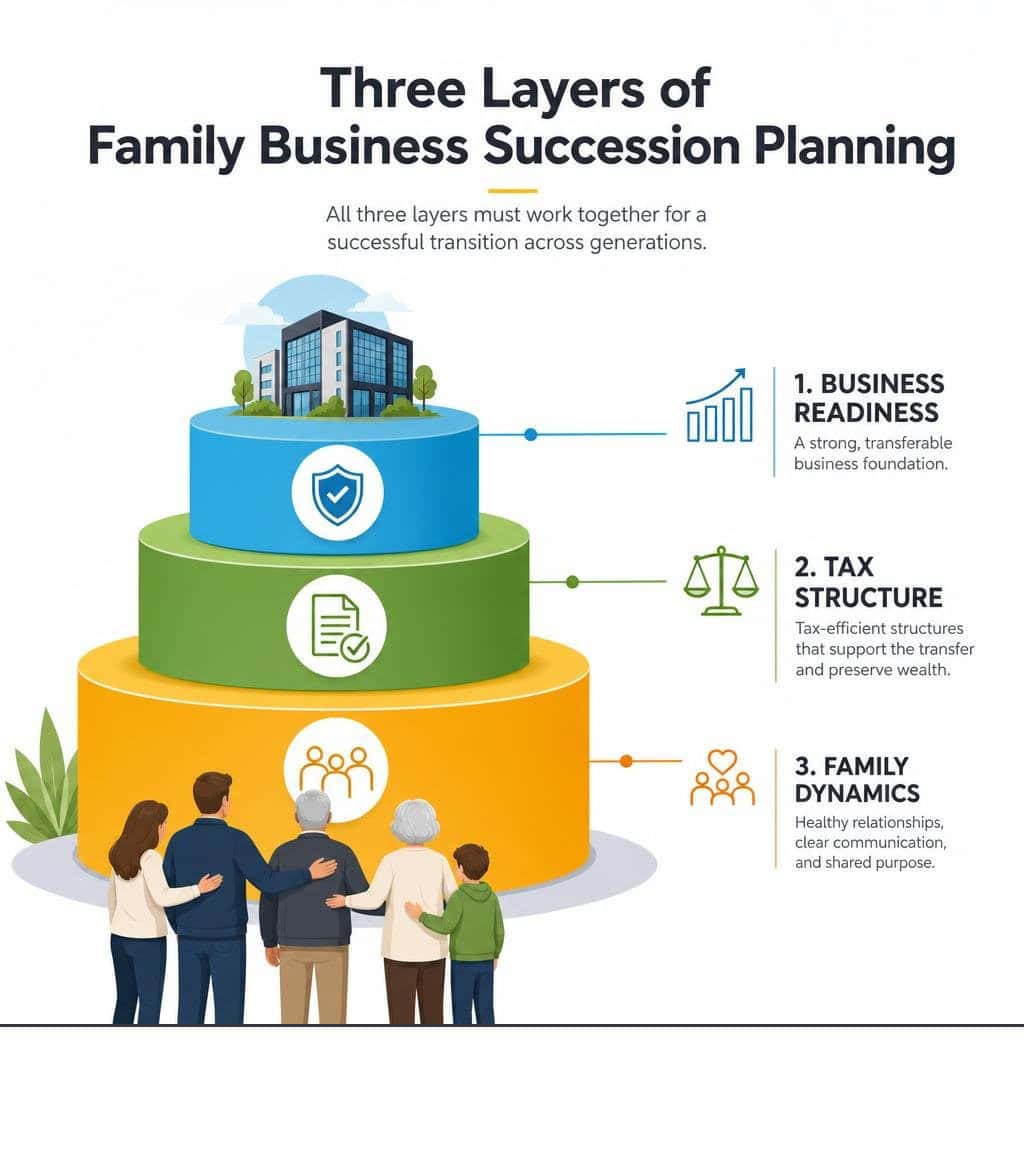
A successful family business transition to future generations requires balancing three distinct layers: business readiness, tax-efficient structures, and family dynamics. Addressing only one layer can leave significant weaknesses in the transition plan. In practice, you need to evaluate a proposed transfer alongside the company’s cash flow, governing documents, valuation, and the successor’s ability to operate the business.
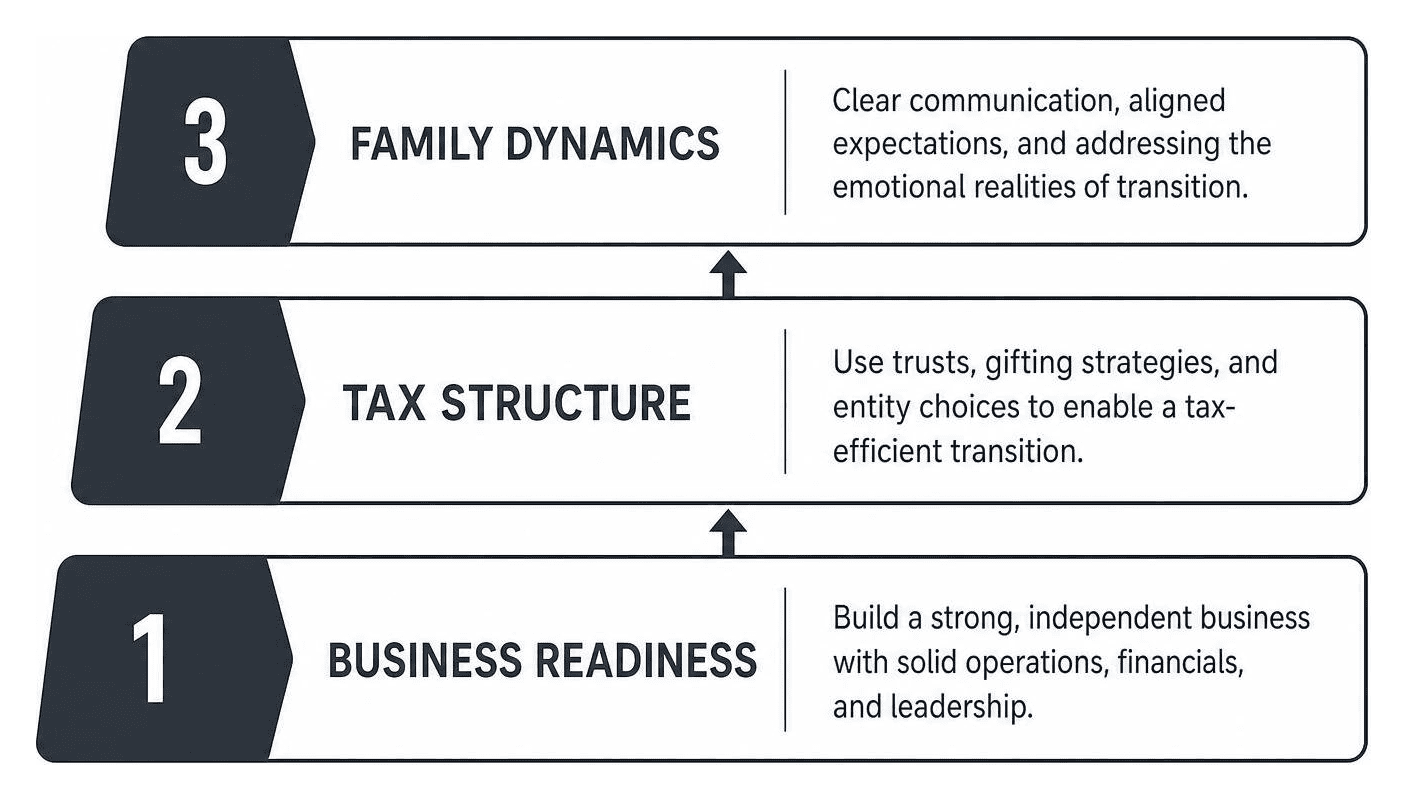
- Business Readiness: The business should be prepared to operate successfully with reduced dependence on the founder. This means establishing strong middle management, clean financial reporting, and reducing customer concentration.
- Tax Structure: Coordinating entity, transfer, trust, valuation, and payment strategies to manage tax exposure while supporting the business and family objectives.
- Family Dynamics: Ensuring clear communication, setting expectations, and addressing the emotional realities of the transition.
To ensure your business is legally and structurally prepared for these changes, see Year-End Tax Planning for Business Owners: Legal Strategies to Stay Ahead of the IRS.
Balancing the Interests of Active and Non-Active Family Owners
One of the most complex challenges in family business planning is managing siblings when only some of them work in the business. If you divide ownership equally among all children, those who are active in daily operations may feel frustrated that their hard work benefits siblings who are not active in the business. Conversely, siblings who are not active in the business may feel excluded from the family legacy.
To address this challenge, you can separate operating compensation from ownership returns:
- Market-Rate Compensation: One common governance approach is to compensate family members for bona fide operational roles at market-based rates, separately from distributions they receive as owners.
- Pro-Rata Distributions: Distributions are generally made in accordance with ownership rights and governing documents, while compensation reflects services performed. The actual policy should be documented and coordinated with the entity’s tax classification, cash-flow needs, and fiduciary obligations.
Some plans use non-business assets, including investment assets or appropriately structured life insurance, to provide value to family members who will not receive operating-business equity, leaving the operational business equity to the active successor. Whether that approach is feasible depends on available assets, insurance underwriting and policy performance, liquidity, and the family’s broader estate-planning objectives. Establishing a formal family constitution or governance agreement can document shared expectations and governance principles before a transition occurs. A family constitution is a governance tool and is not necessarily a legally binding substitute for operating agreements, shareholder agreements, employment agreements, or trust documents.
Hybrid Succession Structures and Retirement-Plan Strategies
If a direct, full transfer to the next generation of the family is not feasible or desirable, hybrid structures can provide an alternative path:
- Third-Party Sale with Retained or Rollover Equity: In some third-party transactions, a seller may receive liquidity for a controlling interest while retaining or rolling a minority interest into the post-closing structure. The economics, securities terms, tax treatment, control rights, and risk profile vary significantly by transaction.
- Employee Stock Ownership Plans (ESOPs): An ESOP is a qualified retirement plan designed to invest primarily in employer securities. In an appropriate company, it can provide a path to employee ownership and may offer tax advantages, but those benefits depend on the entity type, transaction structure, seller eligibility, financing, valuation, and continuing plan compliance. ESOP transactions also involve material setup and administration costs, fiduciary obligations, independent valuation requirements, and Department of Labor considerations. An ESOP is not merely a sale technique; it creates an ongoing qualified-plan structure that must be administered for participants in accordance with ERISA and applicable tax rules.
- Sequential Generation Transfers: Transitioning management responsibilities to the successor over a multi-year period appropriate to the business, successor, and ownership plan before transferring equity, allowing them to build independent operational credibility.
A qualified retirement plan can support employee benefits, owner retirement planning, and workforce retention, subject to rules that protect eligible family and non-family employees. By establishing a profit-sharing 401(k) plan or a defined benefit pension plan, employer contributions may produce a current business deduction subject to plan and tax limits, while participating family and non-family employees can accumulate retirement savings on a tax-deferred basis. Qualified Roth distributions may receive tax-free treatment when the applicable requirements are satisfied. A retirement plan must also satisfy coverage, nondiscrimination, contribution, fiduciary, and administrative requirements.
Frequently Asked Questions
What should family business owners know about federal estate and gift tax exemptions?
Federal estate and gift tax exemptions determine how much wealth can be transferred during life or at death before federal transfer tax may apply. Because these rules may change, family business owners should confirm the current exemption amount before making major gifts, trust transfers, or succession decisions.
Can an LLC elect Qualified Joint Venture status?
Generally, no. State-law entities, including LLCs and limited partnerships, are not eligible for the ordinary Qualified Joint Venture (QJV) election. A multi-member LLC owned by spouses is generally treated as a partnership for federal tax purposes unless it elects another eligible classification, and the ordinary QJV election is not available merely because the spouses are the only LLC members. A limited community-property exception may apply in certain other states, but Colorado is not a community-property state, so this exception generally does not apply to Colorado business owners.
What commonly creates problems in family-business succession?
Common challenges include delayed planning, founder dependence, unclear successor authority, inconsistent family expectations, and tax or ownership structures that do not support the intended transition. While tax planning is important, addressing family communication, sibling equity, and operational leadership can be critical to long-term survival.
Conclusion
Family-business tax planning works best when employment practices, ownership, succession, and estate planning are addressed as parts of one coordinated strategy. The appropriate structure depends not only on tax efficiency, but also on the company’s cash flow, leadership needs, governing documents, and family goals.
At Colorado Trusts & Taxes, I help Colorado business owners coordinate those decisions with their broader estate and succession plans. Schedule a consultation to review your current structure, identify planning gaps, and develop a practical transition strategy.
This article is provided for general educational purposes only and does not constitute individualized legal or tax advice. Please consult an attorney about your specific circumstances before making decisions about your family business.