

Proactive Colorado Business Tax Planning: Preparation vs. Strategic Planning
Many business owners view taxes as an annual obligation that occurs each spring. However, traditional tax preparation looks backward. It involves gathering receipts and income statements from the prior year to report transactions to the government. While accurate tax preparation is essential for compliance, it rarely changes the amount owed.
In contrast, proactive business tax planning evaluates financial operations in real time. By analyzing current revenue, structure, and expenses before the tax year closes, business owners can identify options that may reduce federal, state, and local liabilities. Engaging in Corporate Tax Planning for Wealthy Entrepreneurs allows companies across Colorado to evaluate structural opportunities, timing choices, and legal deductions while there is still time to implement them.
A forward-looking strategy also focuses on risk management. Aligning bookkeeping routines with legal standards is key to knowing How to Avoid IRS Penalties with Smart Tax Planning for Small Businesses. When financial accounting is synchronized with tax strategy, business decisions can be made with greater clarity and precision.
Understanding the Value of Year-Round Business Tax Planning in Colorado
Waiting until year-end often limits available tax strategies. When financial reviews take place on a quarterly basis, business owners can evaluate performance shifts, adjust estimated tax payments, and model major decisions before executing them.
A year-round approach generally offers several practical benefits:
- Real-time decision making: Business owners can evaluate equipment purchases, staffing changes, or facility expansions with clear knowledge of their current tax bracket.
- Cash flow management: Regular financial projections help prevent surprise liabilities when filing annual returns, keeping capital steady throughout the year.
- Accurate records: Maintaining synchronized bookkeeping throughout the year reduces errors, speeds up annual return preparation, and provides documentation in the event of an audit.
Colorado State and Local Tax Dynamics: Municipal vs. Federal Requirements
Businesses operating in Denver and across Colorado must navigate multiple tiers of tax compliance. While federal tax law applies uniformly across the United States, Colorado maintains its own statutory framework, and local municipalities frequently enforce separate tax rules.
At the state level, Colorado imposes a flat corporate income tax rate of 4.4% on C-corporations. This is the corporate income-tax rate, and it does not describe how every Colorado business is taxed. Partnerships and S-corporations generally do not pay Colorado income tax under the ordinary corporate income-tax regime, although qualifying pass-through entities may elect Colorado’s pass-through entity tax treatment. LLC treatment depends on the LLC’s federal tax classification, so not every LLC receives the same Colorado income-tax treatment. Colorado business owners must also monitor compliance with state-level withholding obligations and income allocation rules. A complete overview of these responsibilities is detailed in my guide on Colorado Business Tax Requirements Explained.
Local municipal rules create an additional layer of complexity. Colorado operates under a home-rule city system, which allows individual cities to collect and administer their own local taxes. Denver imposes local sales and use taxes in addition to applicable state and special-district taxes, and businesses operating across jurisdictions may have separate registration, collection, and filing obligations. Furthermore, business sales, asset transfers, or entity restructuring may trigger capital gains considerations, which are explored in my article on How to Avoid Getting Taxed to Death on Colorado Capital Gains.
Leveraging Enterprise Zones and Federal R&D Credits in Colorado
Colorado provides state-level economic incentives to encourage business investment in designated regions. The Colorado Enterprise Zone program offers state tax credits for specific activities conducted within economically distressed areas. Depending on the particular Enterprise Zone credit and its statutory requirements, potentially qualifying activities may include:
- Investment in eligible equipment or facility improvements.
- Job creation and employee training programs.
- Certain qualifying business investments, potentially including eligible commercial vehicles, where the applicable credit requirements are satisfied.
In addition to state incentives, businesses developing new products, software, or technical processes may qualify for the federal Research and Development (R&D) tax credit. Colorado does not have a generally available statewide R&D credit comparable to the federal credit, but qualifying research conducted in a Colorado enterprise zone may be eligible for Colorado’s Enterprise Zone Research and Development Tax Credit.
Strategic Entity Structuring and the S-Corp Salary Method
Choosing an appropriate entity and tax classification is an important part of tax planning for Denver and Colorado business owners. The combination of legal entity structure and federal tax classification affects how business income is taxed, the liability protections available to owners, and the payroll and reporting requirements that may apply.
Many small businesses start as single-member or multi-member Limited Liability Companies (LLCs). An LLC is a state-law entity rather than a single federal tax classification: a domestic single-member LLC generally defaults to disregarded-entity status for federal income-tax purposes unless it elects otherwise, while a domestic multi-member LLC generally defaults to partnership taxation unless another classification is elected. The resulting income-tax and employment-tax consequences depend on the entity’s federal tax classification and the owner’s specific circumstances. As a company’s net income grows, electing S-Corporation tax status may offer potential tax efficiencies by dividing owner income into salary and profit distributions. Reviewing Understanding the Pros and Cons of How Your Business is Taxed provides valuable background on how different legal forms operate under federal and Colorado law.
| Entity Structure | Tax Treatment | Self-Employment Tax Impact | Owner Compensation Method |
|---|---|---|---|
| Sole Proprietorship / Standard LLC | Pass-through entity | Standard self-employment tax applies to total net profit | Owner draws (not subject to withholding for payroll tax) |
| S-Corporation Election | Pass-through entity | Owner-employee wages are subject to applicable employment taxes; distributions generally are not treated as wages subject to Social Security and Medicare employment taxes | Reasonable W-2 salary plus owner profit distributions |
| C-Corporation | Separate taxable entity | Corporate income tax applies at the entity level, including Colorado’s 4.4% corporate rate; tax may also apply to dividends at the individual level | W-2 salary for working officers plus corporate dividends |
Executing S-Corp Strategy for Colorado Business Tax Planning
To implement an S-Corporation strategy effectively, business owners who work in their operations must pay themselves reasonable compensation via W-2 payroll. Internal Revenue Service rules require that owner compensation be reasonable based on the facts and circumstances, including the services performed, responsibilities, experience, time devoted to the business, and comparable compensation.
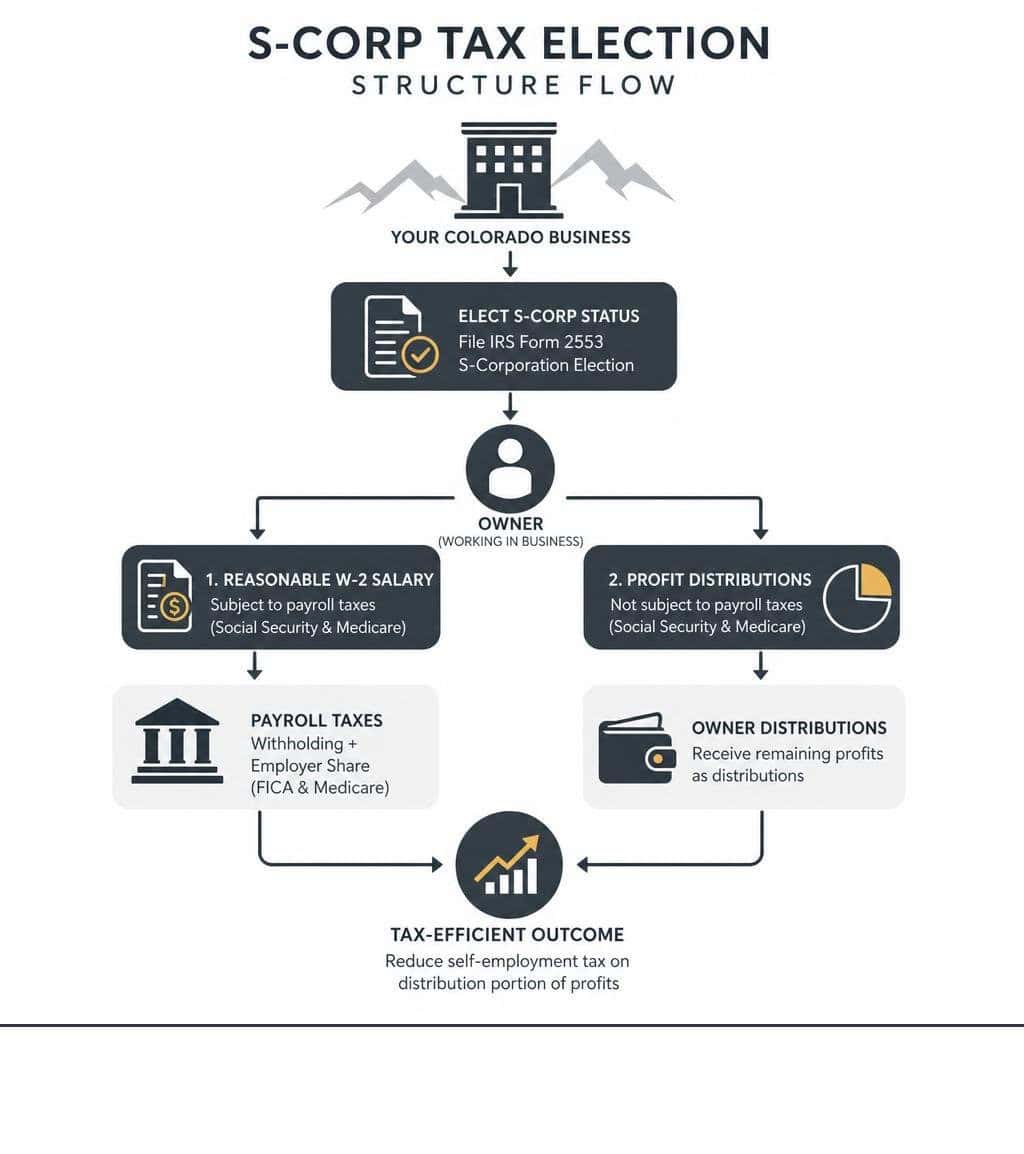
Once a reasonable salary is set, remaining profit may be paid out as distributions. Because distributions generally are not treated as wages subject to Social Security and Medicare employment taxes, this structure may reduce overall payroll tax burdens depending on individual facts and circumstances. However, my office emphasizes that the reasonable-compensation requirement applies regardless of how much profit is ultimately distributed, and it must be satisfied before any distribution strategy is implemented. In practice, I evaluate entity structure alongside compensation, cash flow, retirement-plan objectives, ownership agreements, and the owner’s longer-term succession and estate plan. A tax election that looks efficient in isolation may create problems elsewhere if those pieces are not coordinated.
Essential Colorado Tax Deadlines, Estimated Payments, and Overlooked Deductions

Maintaining compliance requires tracking federal, state, and local deadlines throughout the year. For small business owners and self-employed individuals, staying current on quarterly estimated tax payments is critical to avoiding underpayment interest and penalties.
Under standard filing timelines, and consistent with the IRS estimated tax payment schedule, the estimated tax payment deadlines for the 2026 tax year follow this calendar:
- First Quarter: April 15, 2026
- Second Quarter: June 15, 2026
- Third Quarter: September 15, 2026
- Fourth Quarter: January 15, 2027
To avoid underpayment penalties, taxpayers typically rely on Safe Harbor provisions. For federal estimated taxes, the required annual payment generally is the lesser of 90% of the current year’s total tax or 100% of the prior year’s total tax, with the prior-year percentage generally increasing to 110% for higher-income taxpayers whose prior year Adjusted Gross Income exceeded $150,000 ($75,000 if married filing separately), subject to applicable exceptions. Colorado applies a separate framework: for 2026, the current-year safe harbor generally uses 70% of actual net Colorado tax liability, with separate prior-year alternatives that generally use 100% or 110% of the preceding year’s net Colorado tax liability, subject to their specific eligibility requirements. Colorado taxpayers should also review Colorado Department of Revenue estimated tax guidance for state payment requirements. While Safe Harbor may help avoid underpayment penalties, my office reminds clients that it does not prevent a balance due at tax filing if annual revenue increases significantly.
Identifying legitimately deductible expenses is another routine part of ongoing tax strategy. Reviewing Common Tax Deductions Small Business Owners Might Be Overlooking can help ensure that everyday operational expenses are properly captured. Staying organized throughout the year is simpler when applying the record-keeping practices outlined in New Year, New Books: How Small Businesses Can Clean Up Records for Tax Time.
Maximizing Deductions and Depreciation for Small Businesses
Small business owners often miss standard operational deductions that can be applied within federal and state guidelines. Certain qualifying business-meal expenses generally may be 50% deductible when the applicable business-purpose, substantiation, and Section 274 requirements are satisfied, and eligible self-employed individuals may be able to claim an above-the-line deduction for qualifying health-insurance premiums, subject to earned-income, employer-plan eligibility, and other applicable limitations.
Other key deductions and write-off options include:
- Section 179 Expensing: Allows businesses to write off the cost of eligible equipment, machinery, and commercial software in the year it is placed in service rather than depreciating it over multiple years.
- Cost Segregation Studies: Real estate investors and business property owners can use cost segregation to reclassify certain building components into shorter depreciation schedules, potentially accelerating depreciation deductions for qualifying components. When analyzing real estate calculations, note that building basis excludes land value, separates structural improvements from acquisition costs, and begins depreciation when the property or improvement is placed in service.
- Home Office Deductions: Business owners who use a portion of their residence regularly and exclusively for business purposes may be eligible, subject to the requirements of Internal Revenue Code Section 280A, to deduct a simplified or actual-expense portion of rent, utilities, and maintenance.
- Vehicle Mileage Tracking: Business-related travel can be calculated using either the standard IRS mileage rate or actual operational costs, provided contemporaneous travel logs are maintained.
Year-End Tax Moves and Estate Integration for Colorado Business Owners
As the end of the tax year approaches, business owners have a brief window to execute strategic choices that impact their final tax position. Income timing is one lever worth considering: cash-method businesses may have some flexibility around when customer billings or operational expenses are recognized, but whether any of that actually shifts current-year taxable income depends on accounting method, constructive-receipt principles, contractual rights to payment, and the specific facts. Material year-end timing decisions should be coordinated with the client’s CPA before acting.
Establishing or funding retirement plans is another option worth considering before year-end. Options such as 401(ks)s, cash balance plans, Solo 401(k)s, SEP IRAs, and SIMPLE IRAs may provide opportunities for deductible or tax-advantaged retirement contributions, depending on plan design, participant elections, business structure, and applicable limits. Details on structuring retirement contributions effectively are discussed in Retirement Planning and Taxes: How to Save More for the Future. Additional strategies for closing out the financial year are available in my guide on Year-End Tax Planning for Business Owners: Legal Strategies to Stay Ahead of the IRS.
Proper tax strategy should also align with long-term asset protection and wealth transfer goals. When coordinating business tax planning with an estate plan, business owners should review beneficiary designations. Beneficiary designations generally control the disposition of non-probate assets, but overall tax efficiency and transfer outcomes depend on factor combinations such as valuation, federal exemption limits, state property law, and specific trust design.
Regarding federal tax law, business owners must keep in mind the federal estate and gift tax exemption. Federal law establishes a $15 million basic exclusion amount for 2026, with inflation adjustments thereafter, under legislation enacted in 2025. Planning ahead allows business owners to evaluate accumulated wealth, establish clear succession plans, and coordinate the transfer of assets to heirs or successors. Year-end planning works best when legal and tax decisions are modeled before transactions are completed, with the attorney, CPA, and financial advisor working from the same assumptions.
Frequently Asked Questions About Colorado Business Taxes
How does Colorado’s 4.4% flat tax rate compare to neighboring states?
Colorado’s flat corporate tax rate of 4.4% gives incorporated Colorado entities a predictable state-level income tax rate. However, calculating the total effective tax burden for a Colorado business requires evaluating local municipal taxes, property assessments, sales taxes, and employer payroll requirements alongside the state income tax rate.
What are the safe harbor rules for quarterly estimated taxes in Colorado?
Federal Safe Harbor rules generally protect taxpayers from underpayment penalties if estimated payments equal at least 90% of the current year’s tax or 100% of the prior year’s tax, with the prior-year percentage generally increasing to 110% for higher-income taxpayers whose prior year Adjusted Gross Income exceeded $150,000 ($75,000 if married filing separately), subject to applicable exceptions. Colorado applies a separate framework: for 2026, the current-year safe harbor generally uses 70% of actual net Colorado tax liability, with separate prior-year alternatives that generally use 100% or 110% of the preceding year’s net Colorado tax liability, subject to their specific eligibility requirements. Colorado taxpayers should also consult the Colorado Department of Revenue’s estimated tax guidance. Meeting these thresholds may prevent penalties, but taxpayers with expanding profit margins should monitor cash reserves to cover potential balances owed at filing.
Conclusion
Navigating local, state, and federal tax laws requires a proactive, structured strategy. Effective tax planning for Denver and Colorado business owners involves continuous management of record-keeping, quarterly estimates, entity choices, and local compliance requirements. By taking a year-round approach, companies can reduce uncertainty and make confident financial decisions.
Integrating tax planning with long-term legal and estate planning helps ensure that your business operates efficiently today while supporting your longer-term succession and wealth-transfer goals. If you are ready to explore tailored tax strategies for your company, visit my Business Tax Lawyer services page or contact my office in Centennial, Colorado, to schedule a consultation.