

What Qualifies as a Colorado Small Estate?
Colorado offers two simplified procedures for qualifying estates: collection of personal property by affidavit and summary administration after a personal representative is appointed. Under C.R.S. § 15-12-1201, the affidavit route requires a net estate value at or below the year-of-death cap and satisfaction of the other statutory conditions.
For affidavit eligibility, count the fair market value of all property subject to disposition by will or intestacy, wherever located, less liens and encumbrances. Do not limit the calculation to personal property. Even when an estate satisfies the small-estate dollar limit, JDF 999 cannot transfer title to real estate. A decedent’s solely owned real property may therefore require a separate probate or title procedure. The estate’s eligibility for the affidavit and the legal authority to transfer a particular asset are separate questions. These distinctions help explain the three types of probate in Colorado and whether an estate needs probate.
The Two Pathways: Affidavit vs. Summary Administration
Colorado provides two simplified procedures with different eligibility and administration requirements:
- Collection of Personal Property by Affidavit (JDF 999): Eligible successors may use a notarized affidavit to request probate personal property from a bank, transfer agent, or other holder. This process is handled outside probate court and does not require a personal representative.
- Small Estate Summary Procedure: This is a simplified procedure within a probate case, available after the court has appointed a personal representative. The statutory exception to creditor notice does not mean that all creditor claims are automatically extinguished. Personal representatives must still determine whether the estate satisfies the summary-administration requirements and comply with the applicable distribution, priority, and closing obligations. Unlike the small-estate affidavit, summary administration does not depend on a single annual dollar cap. Instead, the personal representative compares the net estate value with the specific allowances and expenses identified in the statute. Eligibility therefore requires an estate-specific calculation.
| Feature | Small Estate Affidavit (JDF 999) | Summary Administration (C.R.S. § 15-12-1203) |
|---|---|---|
| Court Involvement | No probate-court administration for qualifying collection; disputes can require court action | Personal-representative appointment and eligible summary closing within a probate case |
| Personal Representative | Does not require appointment of a personal representative; availability depends on whether an application or petition for appointment is pending or has been granted. | Court-appointed Personal Representative required |
| Real Estate Conveyance | Cannot transfer real estate | Can address probate real estate, subject to authority, title requirements, and the statutory value test |
| Waiting Period | At least 10 days post-death | Appointment required; § 15-12-1203 permits immediate distribution when its test is met |
| Primary Test | Worldwide property subject to will or intestacy, less liens and encumbrances, at or below the year-of-death cap | Net estate does not exceed the property, allowances, and expenses specified in § 15-12-1203 |
| Creditor Notice | Successor remains accountable to valid claims | No creditor notice under § 15-12-1203 if its conditions are met; closing-statement notices still apply |
Eligibility Limits and Rules for a Colorado Small Estate Affidavit
To use JDF 999, the fair market value of property subject to disposition by will or intestacy, wherever located, less liens and encumbrances, must not exceed the year-of-death limit. This value test includes probate real estate even though the affidavit cannot convey it. The Department of Revenue publishes the indexed amounts, also reflected in the Judicial Branch’s forms.
The Colorado Judicial Branch’s JDF 998 guide states that the cap is determined by the decedent’s year of death, not the date the affidavit is signed. The official limits are:
- Deaths in 2026: Maximum estate value of $88,000.
- Deaths in 2025: Maximum estate value of $86,000.
- Deaths in 2024: Maximum estate value of $82,000.
- Deaths in 2023: Maximum estate value of $80,000.
- Deaths in 2022: Maximum estate value of $74,000.
- Deaths in 2020 and 2021: Maximum estate value of $70,000.
The affidavit also has these statutory requirements:
- At least 10 days must have elapsed since the decedent’s date of death before executing the document.
- No application or petition for the appointment of a personal representative is pending or has been granted in any jurisdiction.
- The affiant must be at least 18 and be a successor or act on behalf of one or more successors. The affidavit must identify the people entitled to the property and their shares.
- The successor must complete standard official forms, specifically the state-approved [PDF] JDF 999 – Collection of Personal Property by Affidavit.
Assets Excluded from a Colorado Small Estate Calculation
Include property subject to disposition by will or intestacy, including amounts payable to the estate. Property passing under valid survivorship, beneficiary, or trust arrangements is generally outside that calculation. Review the actual ownership terms and surviving beneficiaries; an account’s name alone does not establish its treatment.
The following examples may pass outside probate when effective ownership terms, surviving beneficiary designations, or actual trust ownership and funding support the transfer. Do not exclude an asset based on its label alone:
- Joint Tenancy Property: Bank accounts or titled assets with effective survivorship terms may pass to a surviving joint owner.
- Payable-on-Death (POD) and Transfer-on-Death (TOD) Accounts: Financial accounts with designated surviving beneficiaries.
- Living Trust Assets: Property actually titled in or transferred to a trust may pass under its terms outside probate.
- Life Insurance and Retirement Accounts: Proceeds from 401(k) plans, IRAs, and life insurance policies with valid designations naming surviving beneficiaries.
For related ownership questions, see our guide to assets that are exempt from probate in Colorado.
How to Collect Personal Property Using Affidavit Form JDF 999
JDF 999 permits qualifying personal-property collection without appointing a personal representative. It does not resolve uncertain heirship, discharge debts, or determine tax filing duties. Assess the decedent’s final income-tax returns, any estate income-tax returns, and any estate-tax return requirements separately with the estate’s tax advisers before distributing collected property.
Step-by-Step Procedure to Complete and Present Form JDF 999
Use the following checklist and confirm the current form’s requirements before signing:
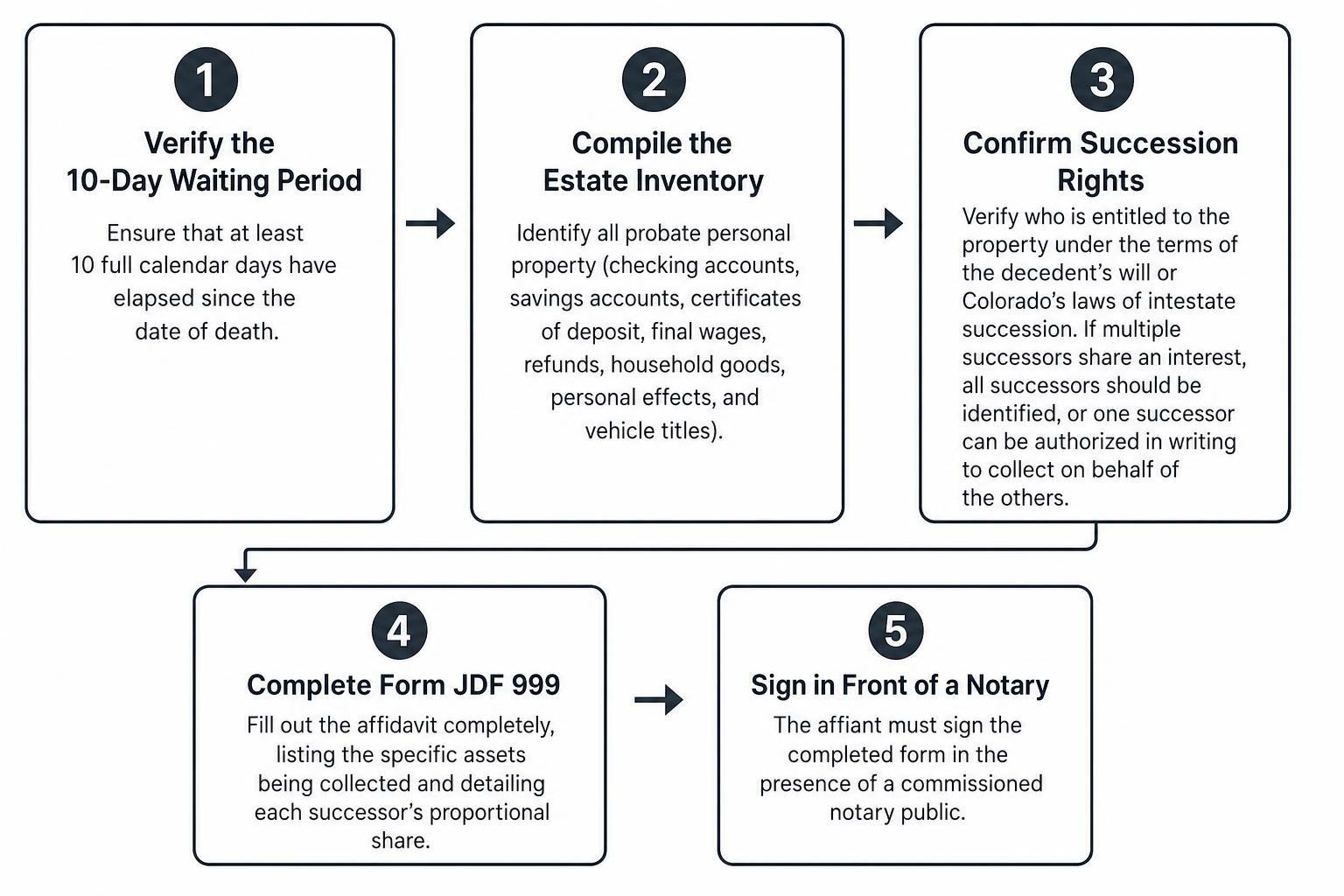
- Verify the 10-Day Waiting Period: Ensure that at least 10 days have elapsed since the date of death.
- Compile the Estate Inventory: Inventory all property subject to will or intestacy for the value test, including probate real estate. Separately identify the personal property the affidavit can collect and any vehicle requiring DMV forms.
- Confirm Succession Rights: Verify who is entitled to the property under the terms of the decedent’s will or Colorado’s laws of intestate succession. Identify every successor and the amount or proportion each is entitled to receive, even when one person collects for the others.
- Complete Form JDF 999: Fill out the affidavit completely, listing the specific assets being collected and detailing each successor’s proportional share.
- Sign in Front of a Notary: The affiant must sign the completed form in the presence of a commissioned notary public.
- Gather Supporting Documents: Secure certified copies of the decedent’s death certificate from the vital records office.
- Present the Affidavit to Third Parties: Present the notarized JDF 999 and a death-certificate copy to the property holder. Some institutions require a certified death certificate; confirm documentation requirements beforehand.
- Transfer Vehicle Titles at the DMV: The Colorado DMV requires its own affidavit, DR 2712, rather than JDF 999. Confirm the death-certificate, title, lien, and other requirements with the county motor vehicle office before submitting a transfer.
What Property Cannot Be Transferred via Affidavit
The small estate affidavit applies strictly to personal property. Under Colorado law, real estate (such as single-family homes, vacant land, condominiums, mineral rights, and commercial property) cannot be transferred using Form JDF 999.
JDF 999 cannot transfer a deed. Solely owned real estate without an effective nonprobate arrangement often requires probate or another legally available title procedure. Review beneficiary deeds, survivorship ownership, and the property’s title history before selecting a route; a modest value alone does not make the affidavit sufficient.
When Summary Administration Is Available
C.R.S. § 15-12-1203 provides a separate summary procedure for estates that satisfy its specific financial test. Insolvency, low value, or the need to sell real estate does not by itself establish eligibility.
Under this statute, an estate qualifies for simplified administration if the value of the entire estate, less liens and encumbrances, does not exceed the total sum of:
- The value of personal property held by or in the possession of the decedent as fiduciary or trustee
- The exempt property allowance
- The family allowance
- Costs and expenses of administration
- Reasonable funeral expenses
- Reasonable and necessary medical and hospital expenses from the decedent’s last illness
If the inventory and appraisal establish eligibility, an appointed personal representative may distribute under § 15-12-1203 without creditor notice and file the required closing statement under § 15-12-1204. Do not equate this financial test with family agreement: uncontested probate and summary administration address different questions.
When Summary Administration Applies and How to Appoint a Personal Representative
Summary administration requires an appointed personal representative. Informal appointment proceeds through the probate registrar; formal appointment involves judicial action in the appropriate district court or Denver Probate Court. Letters document the representative’s authority, but appointment alone does not establish eligibility for summary distribution.
Once appointed, the personal representative:
- Identifies and safeguards property within the representative’s authority.
- Prepares a verified estate inventory.
- Applies the statutory allowances, expense rules, and distribution priorities to determine who is entitled to receive property.
- Uses the no-creditor-notice procedure only after confirming that § 15-12-1203 applies; follows the separate notice and accounting requirements for closing.
Closing the Estate Informally with Form JDF 966SC
Unless a court order prohibits it, a personal representative administering an estate under § 15-12-1203, other than a supervised personal representative, may close the estate by filing a verified closing statement, officially known as Statement of Personal Representative Closing Small Estate (Form JDF 966SC), under C.R.S. § 15-12-1204.
The controlling summary-closing requirements appear in C.R.S. § 15-12-1204. Older general closing instructions can contain outdated values or timing guidance. Confirm the current form and the correct statutory procedure before filing:
- The closing statement states that, to the representative’s best knowledge, the net estate met § 15-12-1203’s value test, the estate was administered and distributed to those entitled, required copies were sent, and a full written account was furnished to affected distributees.
- Send the closing statement to all distributees and known creditors or claimants whose claims are neither paid nor barred. Furnish a full written account to distributees whose interests are affected.
- The representative may file the closing statement after the estate has been properly disbursed and distributed, provided the other requirements of C.R.S. § 15-12-1204 are met.
- If no actions or proceedings involving the personal representative are pending in the court one year after filing Form JDF 966SC, the appointment terminates. Termination is not blanket immunity from liability and is not a court approval of the representative’s conduct.
Successor Fiduciary Duties and Legal Protections
An affidavit recipient remains accountable to people with superior rights. An affiant acting for other successors owes agency duties, while an appointed personal representative owes statutory fiduciary duties. These roles have different responsibilities.
Under C.R.S. § 15-12-1202, a holder delivering personal property under the affidavit receives the same discharge as if it dealt with a personal representative. The recipient remains accountable to a later-appointed representative or another person with a superior right; the affidavit does not extinguish those obligations.
A recipient is accountable to a later-appointed personal representative or another person with a superior right under § 15-12-1202. Applicable claim procedures, priorities, and defenses still matter. A person acting for other successors also owes agency duties under § 15-12-1201(4). Relevant rights may include those of:
- Any other lawful successors who hold an ownership share in the collected assets.
- Any personal representative subsequently appointed by a probate court.
- Valid creditors whose claims are enforceable under the applicable procedures and priorities, subject to available defenses.
Misstatements or improper handling of collected property can lead to claims for relief. Liability depends on the person’s role, conduct, resulting loss, and applicable law.
Frequently Asked Questions About Colorado Estate Shortcuts
Can real estate be transferred using a small estate affidavit in Colorado?
No. JDF 999 collects qualifying personal property and cannot transfer land or a home. Vehicles require the DMV’s DR 2712 procedure. Real estate needs a separate title review to determine whether probate, a valid nonprobate transfer, or another procedure applies.
What happens if a bank or institution refuses to honor a valid small estate affidavit?
If a financial institution refuses to honor a properly completed affidavit, the successor may seek a court determination of the right to the property under C.R.S. § 15-12-1202. If the right is established and the institution refused delivery without reasonable cause, the statute provides for recovery of costs, including reasonable attorney fees. Before pursuing court action, confirm that the affidavit and supporting documentation satisfy the institution’s requirements
When can a personal representative close a summary administration estate?
A personal representative administering a small estate under summary administration may file a verified closing statement (Form JDF 966SC) once all qualifying disbursements and distributions have taken place. Under C.R.S. § 15-12-1204, this closing method is unavailable to supervised personal representatives or when prohibited by court order. An eligible representative may file after proper disbursement and distribution, once the statement, notice, and accounting requirements are met.
Conclusion
The right small-estate procedure depends on property ownership, the statutory value test, and the people entitled to receive assets. A clear inventory and accurate records can make the next steps easier to manage. Coordinate legal and tax questions before making distributions, especially where business interests, unpaid claims, or real estate are involved.
Colorado Trusts & Taxes can help you review estate valuation, successor rights, and administration choices. To discuss the documents and work needed for uncontested probate services, schedule a consultation with our Centennial office.