

Start Your Colorado Estate Settlement With the Right Closing Path
A Colorado estate settlement usually follows five practical steps: identify probate assets, pay valid debts and taxes, prepare a final accounting, distribute what remains, and close the estate through either an informal filing or a formal court order.
Choose the route based on the estate’s risk and complexity:
- Informal closing may fit an eligible unsupervised estate after administration and distribution are complete.
- Formal closing may help resolve disputed accounts, creditor issues, or distribution questions. Multiple heirs or business and real estate holdings do not by themselves require formal closing.
Colorado probate gives a personal representative broad authority to manage estate property, but that authority comes with fiduciary duties. The representative must act carefully, follow the will or Colorado intestacy law, communicate with interested parties, and make distributions only after the estate’s obligations are addressed. Keep detailed records from day one, including asset values, payments, creditor notices, distributions, and signed receipts from beneficiaries.
At Colorado Trusts & Taxes, we help personal representatives coordinate the legal, tax, and practical work of settling an estate. This guide explains closing options, court forms, and decisions that deserve particular attention.
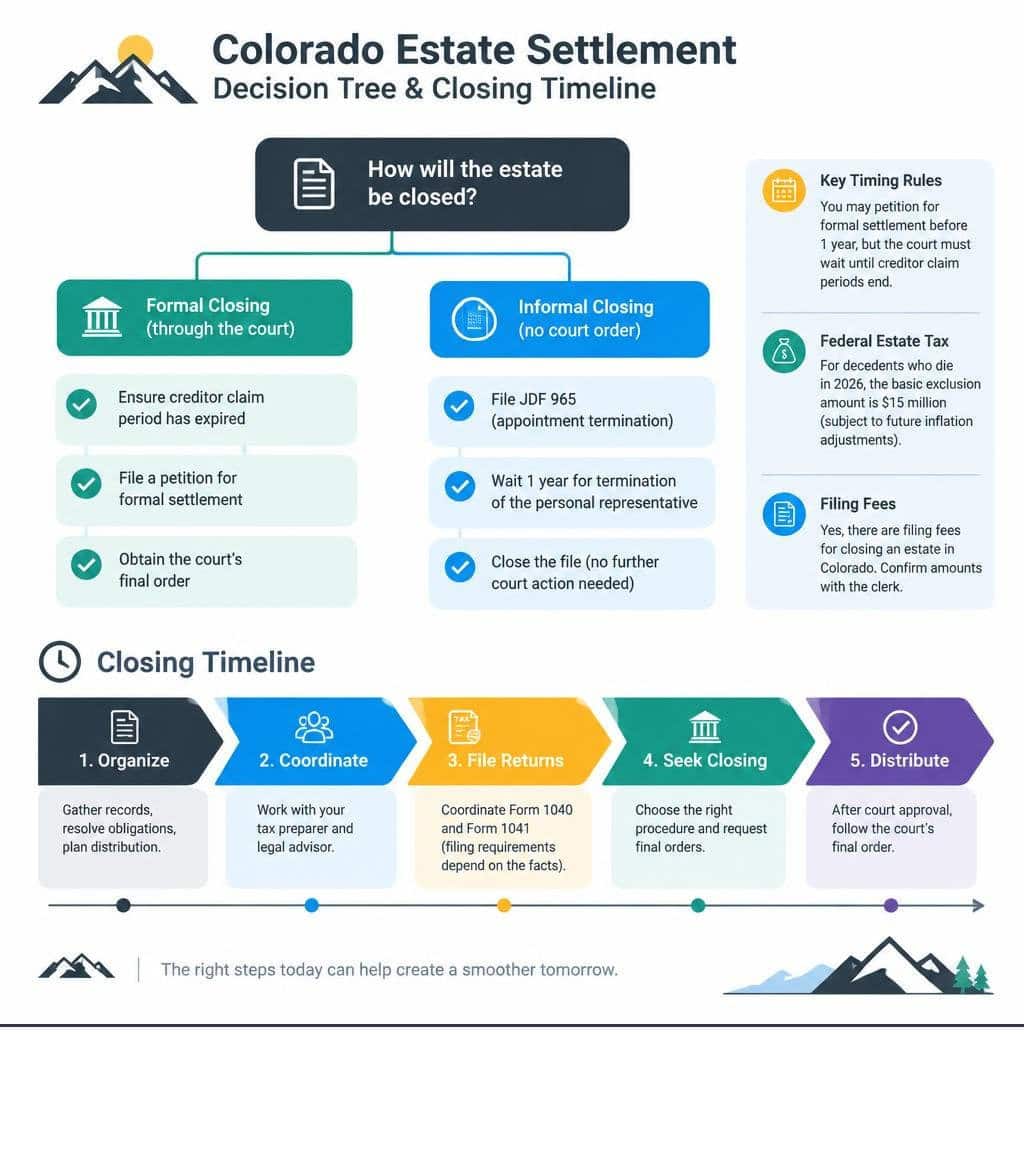
Pathways for Colorado Estate Settlement: Informal vs. Formal Closing
The procedure used to open probate does not necessarily determine how it must close. Unsupervised estates may qualify for informal closing; supervised administration requires court involvement. The Colorado Judicial Branch explains how to Close an Estate, including when to request formal settlement of an accounting or disputed distribution.
Before deciding on a closing path, it is helpful to review Understanding the Three Types of Probate in Colorado. Eligible small estates may use a personal-property affidavit without opening probate; confirm the date-of-death threshold and all statutory conditions. For an estate already in probate, these are the principal closing differences:
| Feature | Informal Estate Closing | Formal Estate Closing |
|---|---|---|
| Court Review | No judicial approval of the accounting merely from filing | Court considers the accounting and relief requested |
| Hearing Requirement | No hearing required | Hearing may be required (Appearance or Non-Appearance) |
| Required Closing Forms | JDF 965 is filed; JDF 942 is completed and delivered to interested persons, but not filed | Common forms may include JDF 960, JDF 942, JDF 964, JDF 963/711, JDF 730, JDF 731 |
| Fiduciary Discharge | Appointment terminates one year after filing if no proceedings involving the representative are pending | Discharge requires a signed decree; timing and scope depend on the case |
| Post-Closing Limitations | Certain successor and creditor claims against the personal representative for breach of fiduciary duty generally must begin within six months after the closing statement is filed | Order resolves matters within its scope, subject to notice and applicable law |
Informal Estate Closing: Timelines and Procedures
An informal closing is designed for administrative efficiency in an unsupervised administration. Under C.R.S. Section 15-12-1003, unless the court prohibits it, a personal representative in an unsupervised administration may file no earlier than six months after original appointment or one year after death, whichever occurs first. The estate must be fully administered and distributed as required by the statute. Any unresolved liabilities and arrangements for them must be disclosed in the statement. Send the statement to distributees and unpaid, unbarred known creditors, and provide a full account to affected distributees.
To close informally, the personal representative files a verified Statement of Personal Representative Closing Administration (JDF 965). The representative also completes an Interim/Final Accounting (JDF 942), checks the final-accounting box, and delivers a copy to interested persons, but does not have to file JDF 942 with the court. For many families, reviewing Understanding Uncontested Probate a Simple Guide for Grieving Families clarifies these administrative milestones.
The relevant limitation periods serve different purposes. Under C.R.S. Section 15-12-1005, certain claims by successors and creditors against the personal representative for breach of fiduciary duty are generally barred unless a proceeding begins within six months after the closing statement is filed. That six-month limitation has exceptions, including claims involving fraud, misrepresentation, or inadequate disclosure. Separately, the personal representative’s appointment terminates one year after the closing statement is filed if no proceedings involving the representative are pending. Informal closing does not itself provide a court-approved discharge.
When Formal Closing Is Required or Beneficial
Formal settlement asks the probate court to resolve the matters presented in a petition, such as the final accounting, distribution, or heirship. A settlement order and a later discharge decree serve different purposes; their effect depends on the relief granted, proper notice, and applicable law.
A formal closing is often necessary or beneficial when:
- Beneficiaries dispute the interpretation of the will, fiduciary fees, or proposed asset divisions.
- Disputed creditor claims or an insolvent estate call for court resolution.
- Business or real estate interests present a specific ownership, valuation, or distribution question requiring a court order.
- The personal representative seeks judicial approval of specified administration matters and an appropriate discharge.
Our overview, Why Do I Need Probate, explains the role of probate. For closing, identify the specific decisions you need the court to make; a decree’s protection depends on its scope and the applicable rules.
Step-by-Step Formal Estate Closing Process and Court Procedures

Formal settlement involves a petition, notice to interested persons, a final accounting, and requested court orders. The court may ask for additional information or resolve objections before approving settlement. Follow the applicable court instructions and any orders specific to the estate.
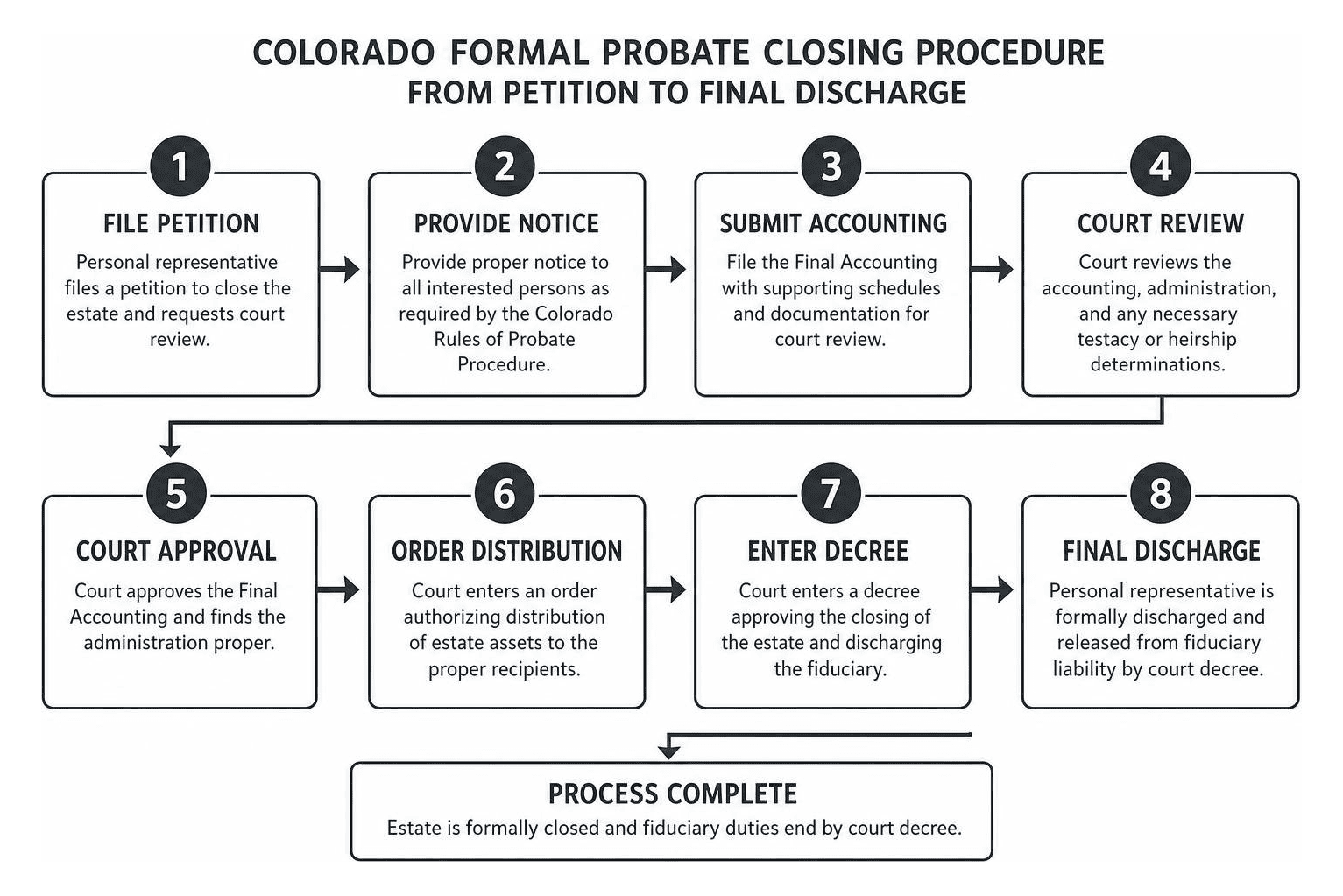
Required Forms and Filings for Formal Colorado Estate Settlement
Use the applicable Colorado Judicial Branch forms and follow local court procedures. The official Instructions for Closing an Estate Formally provide a useful checklist, but confirm current forms and any case-specific requirements:
- Information of Appointment (JDF 940) and Inventory (JDF 941): The formal-closing instructions ask that these documents be on file. The general inventory statute, C.R.S. Section 15-12-706, does not require court filing in every estate; follow the closing checklist and confirm any court-specific requirements.
- Proof of Publication: If closing within one year of death, proof that the Notice to Creditors was published in an appropriate local newspaper must be filed.
- Petition for Final Settlement (JDF 960): The primary pleading requesting approval of administration, determination of heirs or devisees, and formal settlement.
- Interim/Final Accounting (JDF 942): A detailed itemization of all estate receipts, disbursements, distributions, and remaining property.
- Notice of Hearing (JDF 711 or JDF 963): Notice served on all interested persons setting the court date or non-appearance response deadline.
- Order for Final Settlement (JDF 964): The proposed court order approving the accounting and directing final distribution.
- Final Decree of Discharge (JDF 730): Submit the proposed decree and required proof of distribution. Discharge depends on the signed order and applicable law.
Appearance vs. Non-Appearance Hearings in Probate Court
Under Colorado Rules of Probate Procedure (C.R.P.P. Rule 24), hearings on petitions for final settlement can proceed either on an appearance docket or a non-appearance docket.
- Non-Appearance Hearing (JDF 963): Follow Rule 24 and current JDF 963, including service at least 14 days before the hearing date. Written objections must be filed and served by the stated deadline. No attendance is expected. If no objection is filed, the court may act on the papers; approval is not automatic.
- Appearance Hearing (JDF 711): An objection does not automatically produce an evidentiary hearing. The objector must contact the court within 14 days after filing to set an appearance hearing; the court determines how to address the dispute. Follow its directions concerning attendance and evidence.
Final Distribution, Receipt and Release, and Decree of Final Discharge
Carry out the remaining distributions as directed by the Order for Final Settlement (JDF 964), while retaining any required reserves. Some distributions may lawfully occur before final settlement; the order is not the only possible source of authority. Our guide to How to Claim Your Inheritance After an Uncontested Probate explains practical steps for beneficiaries. Verify transfer instructions and document each payment or property transfer.
After final distribution, collect signed Receipts and Releases (JDF 731) and document the transfers with records such as deeds, canceled checks, or brokerage confirmations. Submit the required receipts and proposed Final Decree of Discharge (JDF 730) under the court’s instructions. A signed discharge ends the appointment as ordered; it is not blanket immunity for undisclosed misconduct or every possible claim.
Fiduciary Duties, Asset Valuation, and Statutory Rules
Personal representatives in Colorado operate under strict fiduciary obligations comparable to those of a trustee. Under Colorado Revised Statutes Title 15. Probate, Trusts, and Fiduciaries Section 15-1-804, fiduciaries have administrative powers, but must exercise them consistently with their duties and applicable limits. For personal representatives, Sections 15-12-703, 15-12-712, and 15-12-715 also address duties, liability for improper conduct, and estate-management powers. Business operations, property sales, and payments require attention to the will, court orders, and the estate’s obligations.
Fiduciary Responsibilities and Asset Distribution in Colorado Estate Settlement
Under Colorado Revised Statutes Section 15-12-703, a personal representative has a duty to settle and distribute the estate in accordance with the terms of any probated will and the Colorado Probate Code as expeditiously and efficiently as is consistent with the best interests of the estate.
Several provisions require particular care before distribution:
- Search for Designated Beneficiary Agreements: C.R.S. Section 15-12-703(5) provides conditional protection involving a records search in Colorado counties where the representative actually knows the decedent was domiciled during the prior three years, together with the absence of actual notice or knowledge of a valid agreement affecting intestate succession. This is not a blanket search rule based on every former residence.
- Surcharges: Statutory authority and protection for authorized conduct do not excuse a breach of fiduciary duty. Improper exercises of power may create liability under C.R.S. Section 15-12-712.
Also identify What Assets Are Exempt from Probate in Colorado. Life insurance payable to a named beneficiary and property held in valid joint tenancy with survivorship generally pass outside probate. Ownership and beneficiary terms differ, and nonprobate status does not necessarily eliminate creditor exposure or other legal claims.
In-Kind Asset Valuation and the 30-Day Objection Rule
Distributing estate assets often involves transferring physical property, shares, or real estate directly to heirs rather than liquidating everything to cash. Under C.R.S. Section 15-12-906, the applicable rules depend on the type of distribution and the will’s terms:
- Fair Market Value Standard: C.R.S. Section 15-12-906(2) applies specific valuation rules when property satisfies a monetary devise or allowance in kind. It does not impose one valuation date on every estate transfer. For assets without a readily ascertainable value under that rule, a reasonable valuation date may be no more than 30 days before distribution.
- Securities Valuation: Under those valuation rules, use the last sale price on the preceding business day, or the median between bid and asked prices if there was no sale.
- Written Proposal and 30-Day Objection Window: After probable estate charges are known, the representative may send a distribution proposal to persons entitled to object. Objections to the proposed kind or value of assets must be received by the representative within 30 days after mailing or delivery, unless that right was waived earlier. This is not a blanket deadline for all estate claims.
Income vs. Principal Allocation and Tax Considerations
Administering estate assets that generate revenue during probate requires proper accounting under C.R.S. Section 15-1.2-702. These are fiduciary accounting allocations, not a determination of taxable income. Apply the governing instrument and statutory exceptions, including the special timing rules for entity distributions:
- Periodic Receipts: Subject to statutory exceptions, periodic income receipts and disbursements due before death are allocated to principal; those due on or after death are allocated to income. Entity distributions have separate rules for determining the due date.
- Day-to-Day Apportionment: Nonperiodic items, or items without a stated due date, are generally treated as accruing daily and apportioned across the relevant period.
Coordinate any required final individual income tax return (Form 1040) and estate fiduciary income tax return (Form 1041) with the tax preparer; filing requirements depend on the facts. For decedents who die in 2026, the federal estate-tax basic exclusion amount is $15 million. The amount is scheduled to be adjusted for inflation in later years. Whether a federal estate tax return or other planning is appropriate depends on the estate’s value, deductions, prior taxable gifts, portability considerations, and applicable law. Engaging comprehensive probate services may help personal representatives coordinate tax filings and fiduciary accounting.
Frequently Asked Questions About Settling a Colorado Estate
When can a Personal Representative or interested person petition to close an estate?
Under C.R.S. Section 15-12-1001, a personal representative may petition for formal settlement without waiting a year after appointment, but the court cannot entertain the petition until the period for presenting claims arising before death has expired. Other interested persons must also wait one year after the original appointment. Confirm the applicable creditor deadlines and remaining administration tasks before seeking settlement.
What happens if an estate is never formally closed by the court?
A valid informal closing does not require a formal closing order. After JDF 965 is filed, the appointment terminates one year later if no proceedings involving the personal representative are pending. Simply leaving a file inactive is different: court closure for inactivity under C.R.S. Section 15-12-1009 does not discharge fiduciary liability. Unfinished administration or later-discovered property may require further court proceedings.
Are there filing fees for closing an estate in Colorado?
Yes, there are filing fees published by Colorado Judicial Branch. Confirm the amounts with the clerk.
Conclusion

A sound closing starts with accurate records, resolved obligations, and a clear plan for distribution. Choose the closing procedure that fits the estate, communicate with beneficiaries, and coordinate legal and tax questions before requesting final orders. These steps can reduce avoidable disputes, but no closing procedure guarantees freedom from every later claim.
At Colorado Trusts & Taxes, we work with personal representatives and their tax and financial advisors throughout Colorado. If you need help reviewing a final accounting, coordinating tax filings, or choosing a closing procedure, explore our uncontested probate services or contact our office to discuss the estate’s next steps.
Sources and current guidance: Colorado Revised Statutes, Title 15; Colorado Judicial Branch estate-closing guidance; current JDF 963 hearing notice; and court document fees. Reviewed September 2026.
This article provides general educational information, not individualized legal or tax advice. The appropriate steps depend on the estate, applicable law, and court orders.