
What Uncontested Probate in Colorado Means
Uncontested probate generally refers to an estate administration in which interested persons are not asking the court to resolve disputes over matters such as the will, appointment of the personal representative, or distribution.
An uncontested estate is one in which interested parties generally are not disputing the administration. Informal probate is a particular statutory procedure available when the requirements for informal probate or appointment are satisfied. Although many uncontested estates proceed informally, an estate can require a formal proceeding even when no beneficiary objects.
In plain terms:
- A personal representative handles the estate. Colorado uses this term instead of executor.
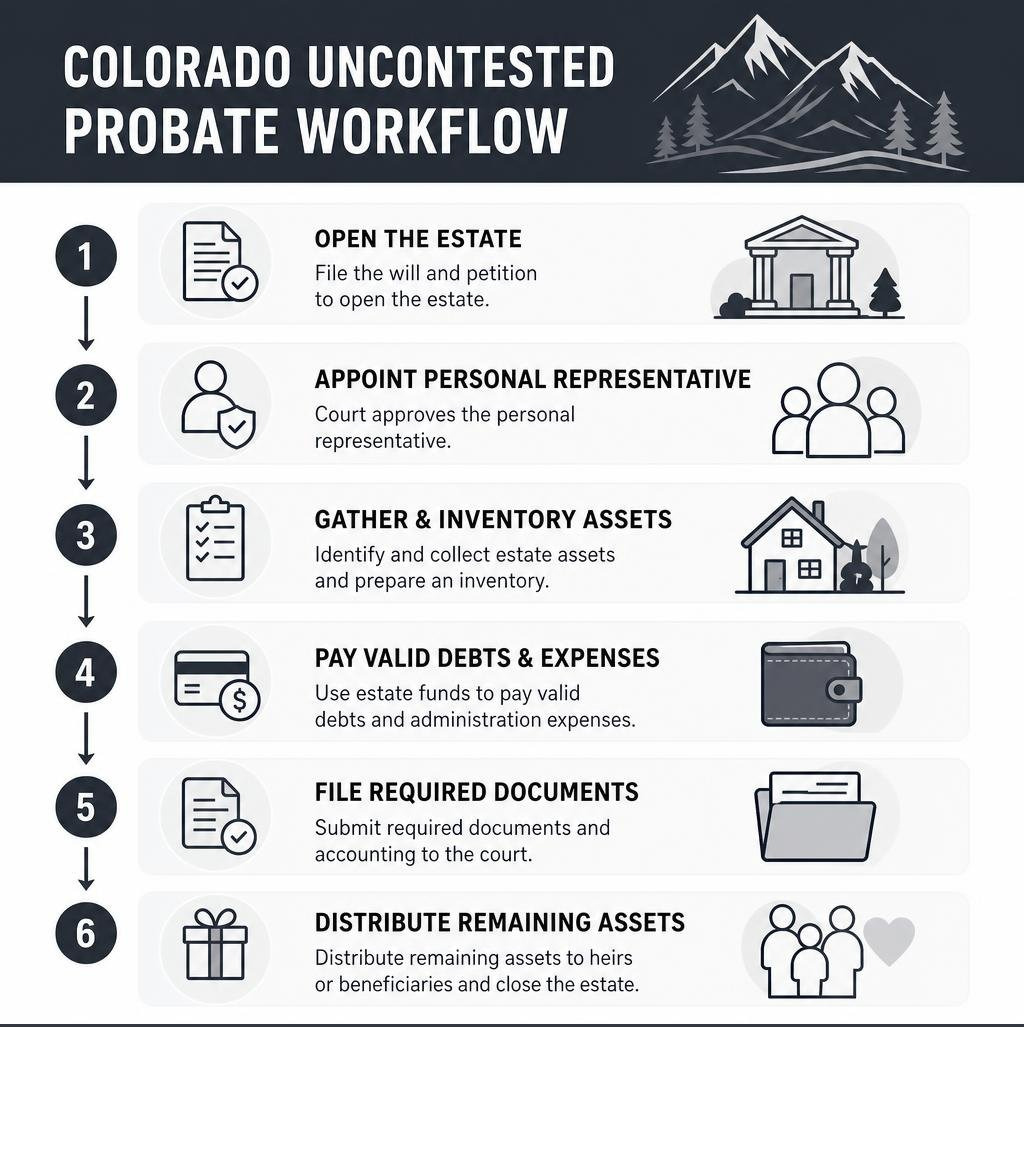
- The representative gathers probate assets, pays valid debts, gives required notices, and distributes what remains.
- Informal probate is often available when there is a valid original will, or clear heirs when there is no will, and no dispute requires a judge to decide the issue.
- Some smaller estates may avoid a court probate case entirely if they meet Colorado’s small-estate rules.
Even an informal probate has deadlines, court forms, creditor rules, and fiduciary duties. A clear process can help loved ones move the probate forward while keeping records organized and reducing avoidable delays.
In my probate practice, I help Colorado families and personal representatives understand the steps required to administer an estate and identify issues that may require additional court involvement.
Understanding Uncontested Probate in Colorado and Estate Categories
Navigating the court system during a time of loss can feel overwhelming, but understanding how Colorado categorizes probate makes the process far more manageable. The legal framework establishes distinct paths depending on the nature of the estate’s assets and whether any interested parties disagree on the administration.
When an estate is uncontested, it typically proceeds through informal probate administration. Informal probate is an administrative procedure managed by a court registrar rather than a judge. Under statutory guidelines such as C.R.S. § 15-12-303, the registrar reviews filings to confirm statutory compliance without holding formal courtroom hearings. For a closer look at these court options, see Understanding the Three Types of Probate in Colorado alongside guidance from the Probate in Colorado – Denver Bar Association.
| Probate Option in Colorado | Real Property Trigger | Personal Property Threshold | Primary Court Mechanism |
|---|---|---|---|
| Small Estate Affidavit | No real property titled solely in decedent’s name | Year-specific threshold, for example, $88,000 for a decedent dying in 2026 and $86,000 for a decedent dying in 2025 | Out-of-court process using JDF 998 instructions and JDF 999 affidavit presented directly to asset holders |
| Informal Probate | Real property present OR personal property exceeds the applicable small estate year-specific threshold | Total probate assets exceed the applicable small estate year-specific threshold | Administrative approval by court registrar without formal hearings |
| Formal Probate | Real property present OR personal property exceeds the applicable small estate year-specific threshold | Total probate assets exceed the applicable small estate year-specific threshold | Judicial determination by a judge. A hearing may or may not be required depending on the proceeding and whether issues are disputed. |
Three Tiers of Probate in Colorado
Colorado law provides three main avenues for handling a decedent’s property. Determining which tier applies is the first practical step in estate administration. You can explore whether court intervention is required by reading Do All Estates Have to Go Through Probate in Colorado?.
- Small Estate Affidavit (JDF 999): If the decedent owned no real property titled solely in their name and held personal property valued below the applicable year-specific small-estate threshold, the estate may avoid formal court filings. At least 10 days generally must have elapsed after death before this small-estate procedure may be used, and meeting the dollar threshold alone does not establish eligibility. Colorado Judicial Branch instructions are provided in JDF 998, while JDF 999 is the affidavit used to collect personal property. Those instructions identify the threshold as $88,000 for a decedent dying in 2026 and $86,000 for a decedent dying in 2025. Successors can collect financial balances, personal property, and vehicle titles by executing a notarized Small Estate Affidavit (Form JDF 999) and presenting it directly to financial institutions. For a current overview of Colorado intestacy and probate steps, see Probate with No Will | Colorado Law Help.
- Informal Probate: When probate assets exceed the applicable year-specific small-estate threshold or the decedent owned real estate titled solely in their name, informal probate offers a streamlined route. This administrative path may be available when the requirements for informal probate or appointment are satisfied, for example, when the original will is available, if there is one, the application and appointment requirements can be met, and no issue requires formal judicial determination.
- Formal Probate: If there are unanswered legal questions regarding a will’s execution, missing documentation, minor or incapacitated heirs needing specialized protection, or active disputes among beneficiaries, the estate might go through formal probate before a district court judge.
Contested vs Uncontested Probate Dynamics
The practical distinction between contested and uncontested administration generally turns on whether an interested person is asking the court to resolve a dispute concerning matters such as will validity, appointment of the personal representative, heirship, claims, or distribution.
Under statutory rules including C.R.S. § 15-12-405, when formal filings are required solely due to procedural rules but remain unopposed by beneficiaries, the court can grant orders directly on the pleadings by a hearing without appearance. However, if an interested party files an objection regarding will validity, claims undue influence, or contests the appointment of the personal representative, the proceeding becomes contested. A contested matter may require formal hearings, discovery, witness testimony, and judicial rulings if the dispute is not otherwise resolved, which can increase administration time and legal expense.
How to File an Uncontested Estate Step-by-Step
Filing an uncontested probate case in Colorado requires careful attention to statutory timelines, filing requirements, and document submission standards. A custodian of the decedent’s will generally must deliver it for lodging with the court having probate jurisdiction within 10 days after the testator’s death, or as soon thereafter as the death becomes known to the custodian. Venue generally lies in the county where the decedent was domiciled, with Denver probate matters handled by the Denver Probate Court. To better understand why court oversight is necessary to transfer clear legal title, consult Why Do I Need Probate?.

Step-by-Step Instructions for Uncontested Probate in Colorado with a Will
When the decedent leaves a valid, unrevoked Last Will and Testament, the informal testate probate process proceeds through specific judicial forms and statutory checkpoints:
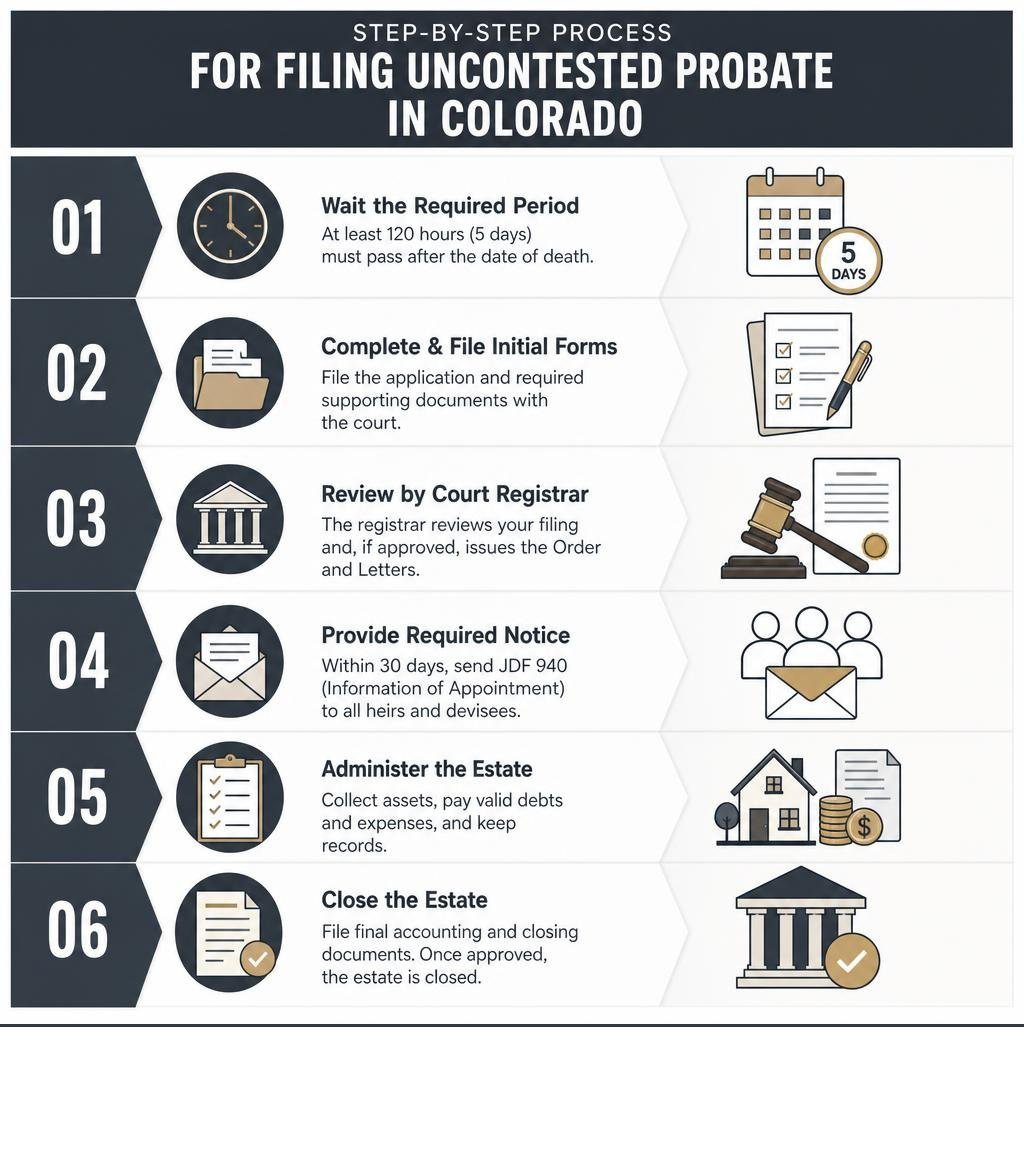
- Observe the Statutory Waiting Period: Under Colorado law, an application for informal probate cannot be acted upon by the court registrar until at least 120 hours (5 days) have elapsed from the time of death.
- Complete and File Initial Opening Forms: The applicant completes the Application for Informal Probate of a Will | Colorado Judicial Branch using Form JDF 910. Accompanying documents include Form JDF 911 (Acceptance of Appointment). For an informal appointment, Colorado Judicial Branch instructions require JDF 912 from a person with the same or greater priority to serve who is not seeking appointment. A person nominated as personal representative in the will who does not wish to serve also uses the form to renounce the appointment, unless the application addresses that person’s death.
- Review by Court Registrar: The registrar reviews the application and supporting documents to determine whether the requirements for informal probate and appointment have been satisfied. Once approved, the registrar issues Form JDF 913 (Order for Informal Probate) and official Letters Testamentary (Form JDF 915).
- Provide Required Post-Appointment Notices: Within 30 days of appointment, the newly appointed personal representative must send Form JDF 940 (Information of Appointment) to all named devisees and statutory heirs, filing proof of service with the court.
For practical tips on staying organized and communicative during these initial weeks, see How to Ensure a Smooth Uncontested Probate Process: Tips from an Expert.
Filing an Intestate Uncontested Probate in Colorado Without a Will
When a decedent dies without leaving a valid will, the estate is classified as intestate. In an uncontested intestate scenario, the family agrees on who will manage the estate according to statutory priority rules set by Colorado law.
To open an informal intestate estate, the applicant files Form JDF 916 (Application for Informal Appointment of Personal Representative in Intestacy). Colorado law establishes statutory priority rules for appointment of a personal representative. Depending on the family circumstances and the persons entitled to priority, individuals with equal or higher priority who are not seeking appointment may need to renounce or nominate another person. For an informal appointment, Colorado Judicial Branch instructions require JDF 912 from a person with the same or greater priority to serve who is not seeking appointment. Once the registrar approves the application, Letters of Administration are issued, empowering the representative to manage estate accounts. If you are weighing whether professional legal counsel is necessary, see Do You Need a Lawyer for Uncontested Probate?.
Duties, Deadlines, Costs, and Assets for Personal Representatives
Serving as a personal representative carries important fiduciary duties under Colorado law. The individual appointed must act impartially, protect estate property, accurately account for financial transfers, and prioritize valid legal claims before making distributions to beneficiaries.

When opening an informal probate estate, the applicable court filing fee applies, and additional charges may apply for certified copies of official orders and certified Letters Testamentary. Because court fees can change, confirm the current amount with the Colorado Judicial Branch before filing. Key procedural deadlines include:
- Notice of Appointment (JDF 940): Must be delivered to all interested heirs and devisees within 30 days of appointment.
- Estate Inventory (JDF 941): The personal representative generally must complete a detailed inventory of all probate assets, including date-of-death fair market values, within 90 days of appointment. The inventory generally is maintained by the personal representative and provided to interested persons as required or requested, rather than routinely filed with the court.
- Creditor Claim Window: Publication of the notice to creditors generally begins a four-month nonclaim period for claims subject to that notice, while different deadlines can apply to known or reasonably ascertainable creditors who receive direct notice.
Estate planning and probate strategies must also account for broader changes in the tax environment. Properly structuring asset transfers and maintaining clean financial records during probate helps ensure accurate tax reporting for both the decedent’s final income tax returns and fiduciary estate returns.
Probate vs Non-Probate Assets
A critical task for any personal representative is distinguishing between assets subject to court-supervised probate and those that pass directly to surviving individuals by operation of law. You can read a complete breakdown of non-probate property at What Assets Are Exempt from Probate in Colorado?.
- Probate Assets: Property titled solely in the decedent’s name without a named beneficiary or joint owner. Examples include individual bank accounts, real estate titled solely to the decedent or as tenants in common, personal belongings, and business interests owned individually.
- Non-Probate Assets: Property that transfers automatically upon death via contract or titling structure. Beneficiary designations generally control the disposition of non-probate assets such as life insurance proceeds, retirement accounts (IRAs and 401ks), Transfer-on-Death (TOD) brokerage accounts, and Payable-on-Death (POD) bank accounts. Similarly, real property held in joint tenancy with right of survivorship passes directly to the surviving joint owner outside of probate.
Personal Representative Fiduciary Obligations and Estate Closing
To fulfill their fiduciary duties and reduce the risk of personal liability, personal representatives should resolve creditor claims and fulfill public notification obligations:
- Creditor Notification: The personal representative publishes Form JDF 943 (Notice to Creditors) in a legal newspaper in the county where probate was filed once a week for three consecutive weeks. The personal representative also must evaluate whether direct notice is required for known or reasonably ascertainable creditors and comply with the applicable statutory notice requirements.
- Managing Claims and Accounting: Valid debts, final medical expenses, tax obligations, and administration expenses are paid from estate funds. The personal representative maintains internal records and prepares Form JDF 942 (Interim/Final Accounting), providing copies to interested parties upon request.
- Closing the Estate: For an informal closing, the personal representative generally may file the closing paperwork six months after appointment or one year after the decedent’s death, whichever occurs first, assuming the other requirements for closing have been satisfied. Once debts are satisfied and assets distributed, the personal representative files Form JDF 965 (Statement of Closing Administration). After the Statement of Closing is filed, interested persons generally have one year to come forward with objections. The personal representative’s appointment generally terminates one year after filing if no proceeding involving the personal representative is then pending.
For guidance on collecting distributions, see How to Claim Your Inheritance After an Uncontested Probate.
When Formal Probate Is Required Despite an Uncontested Estate
Even when family members and beneficiaries agree entirely on asset distribution, certain legal circumstances may require formal probate court administration. In these scenarios, the court registrar may lack statutory authority to grant informal probate, requiring a formal petition and court order.
Common reasons a registrar may decline informal probate include:
- Missing or Copy Will: The original Last Will and Testament cannot be located, and the applicant presents a photocopy or secondary evidence.
- Physical Alterations or Ambiguities: The original document exhibits handwritten mark-outs, unexplained interlineations, missing signature pages, or ambiguous legal language regarding key beneficiaries.
- Potentially Defective Execution: A will with unresolved execution concerns, unclear witness or signature facts, or other validity questions may require closer legal review and, in some cases, formal probate if those issues cannot be resolved through the informal process.
When a registrar declines an informal application, the personal representative transitions the case to formal probate by filing Form JDF 920 (Petition for Formal Probate). Under C.R.S. § 15-12-405, if all parties remain in agreement and no objections are filed after formal notice, the district court judge can review the file and enter a final decree approving probate based on the written pleadings without holding an extensive trial.
Frequently Asked Questions About Colorado Probate
What is the minimum waiting period before filing informal probate in Colorado?
Colorado law requires an applicant to wait at least 120 hours (5 days) from the exact time of death before the court registrar can issue formal orders or Letters Testamentary in an informal probate proceeding.
How long does an uncontested informal probate estate take to close in Colorado?
The timing varies. For an informal closing, Colorado Judicial Branch guidance generally allows the closing paperwork to be filed six months after appointment or one year after the decedent’s death, whichever occurs first, assuming the other requirements for closing have been satisfied. The time required to administer an uncontested estate varies based on creditor claims, asset sales, tax matters, beneficiary issues, and other circumstances. Even when no dispute exists, statutory waiting periods and administration requirements can prevent immediate closing.
What happens if an heir cannot be located during an uncontested probate proceeding?
An unlocated heir or devisee can complicate an otherwise uncontested administration. Colorado Judicial Branch instructions provide that when the address or identity of an heir is unknown, the Information of Appointment must also be sent to the Colorado Attorney General’s Office. The personal representative should document reasonable efforts to locate the person and determine what additional notice, court, or distribution procedures apply before distributing that person’s share or closing the estate. Different procedures may apply depending on whether the missing person is an heir, devisee, or other interested person.
Conclusion
Handling an uncontested estate in Colorado does not have to feel overwhelming. By understanding the three probate tiers, adhering strictly to statutory waiting periods, maintaining complete inventory records, and properly delivering notice to heirs and creditors, personal representatives can approach the administration more systematically while working to satisfy their fiduciary responsibilities.
I invite you to learn more about my comprehensive legal guidance by reviewing my uncontested probate services and browsing my full suite of estate planning solutions under Services. If you are serving as a personal representative or need personalized assistance opening an estate in Centennial, Denver, or the surrounding Colorado communities, please reach out directly to my office to schedule an initial consultation.