

Introduction
When selling investment real estate, the taxable gain usually differs from the sale price minus the original purchase price. Selling costs, improvements, and depreciation all affect the calculation. Before agreeing to a sale, review the depreciation schedule and estimate how the different portions of gain will be taxed.
Depreciation spreads the cost of eligible property over time, or accelerates eligible deductions under special rules. Deductions generally reduce tax basis, even when allowable depreciation was not claimed. On a sale at a gain, Section 1245 ordinary-income recapture and unrecaptured Section 1250 gain can produce different federal tax results. Colorado generally begins with federal taxable income, then applies state adjustments.
Understanding how to compute adjusted basis, distinguish between real and personal property components, and evaluate federal and Colorado tax provisions is essential before executing a sale.
Depreciation Recapture for Colorado Investors: Rates and Rules
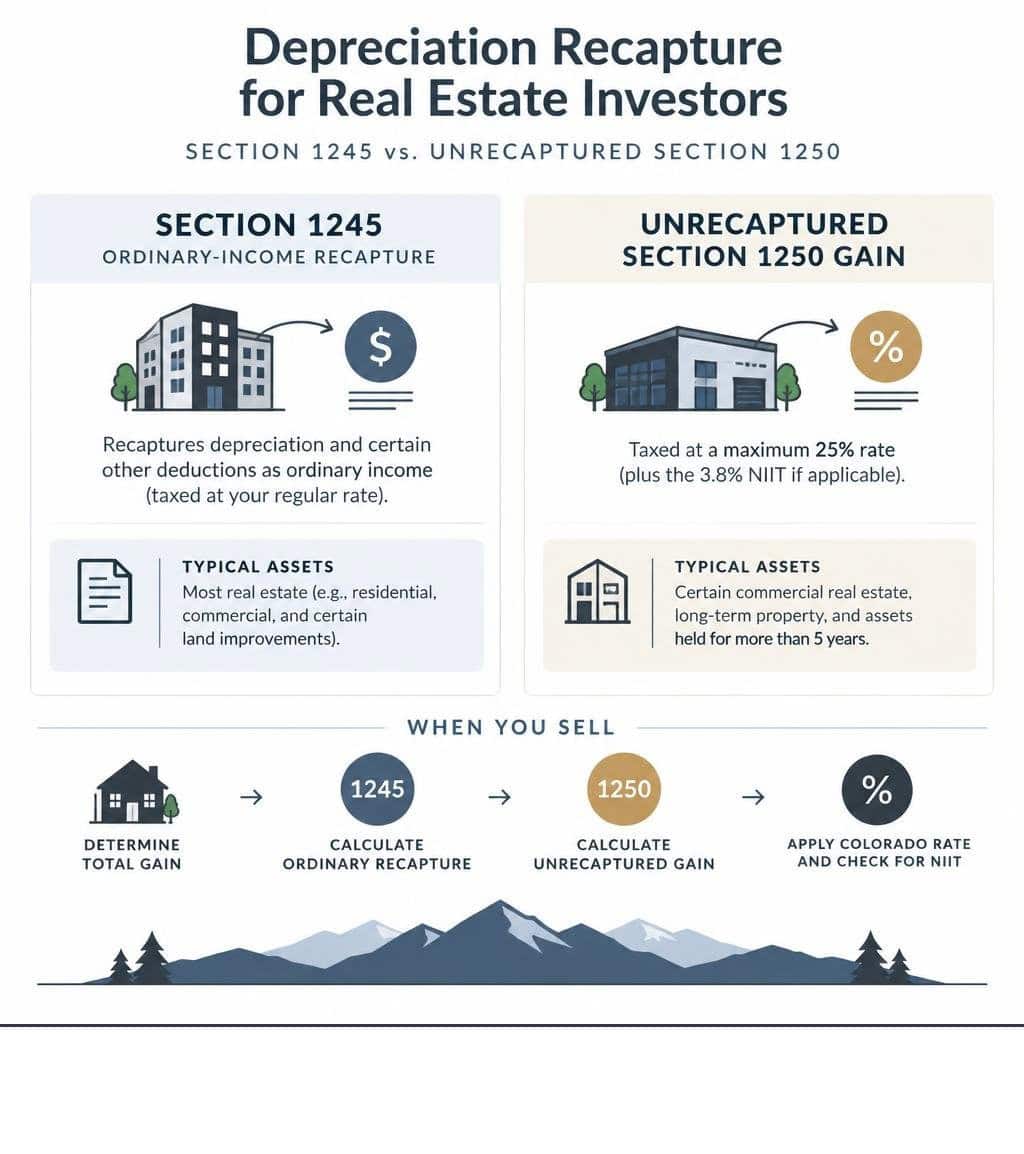
“Depreciation recapture” is often used broadly, but ordinary-income recapture and unrecaptured Section 1250 gain are distinct. For a typical rental building depreciated using the straight-line method and held more than one year, depreciation-related gain generally falls into the unrecaptured Section 1250 category rather than ordinary Section 1250 recapture. Accelerated depreciation and special rules can change that result.
Tax treatment depends significantly on the classification of the underlying asset:
- Unrecaptured Section 1250 gain: Generally, depreciation-related long-term gain on Section 1250 real property that is not ordinary income. For individuals, its maximum federal rate is 25%, not a mandatory flat rate. The Schedule D calculation considers applicable netting rules.
- Section 1245 recapture: Gain on Section 1245 property is generally ordinary income up to depreciation allowed or allowable, limited by the gain. Individual ordinary rates currently reach 37%. Appliances and equipment may qualify, but fixtures and land improvements require asset-specific classification.
Compute gain by subtracting adjusted basis from the amount realized, taking selling expenses into account. Allocate the transaction among land, buildings, and other assets using supportable values. After ordinary recapture is determined, remaining business real property gain may pass through the Section 1231 netting system, so prior Section 1231 losses within the lookback period can cause otherwise capital gain to be treated as ordinary income.
Calculating Adjusted Basis and Potential Recapture
To determine true tax liability, an investor must correctly compute adjusted basis rather than relying on a simple purchase-price calculation.
For a purchased asset, a simplified basis calculation is:
Adjusted basis = acquisition cost + capital improvements − depreciation allowed or allowable, subject to other applicable basis adjustments.
Allocate acquisition cost between land and depreciable assets. Land is not depreciated, but its basis still matters when the entire property is sold. Capital improvements generally increase the basis of the relevant asset and are depreciated when placed in service, subject to applicable expensing rules. Distinguish improvements from deductible repairs using the facts and tax rules.
The table below shows how accumulated depreciation affects the final tax exposure on an investment property compared with an unadjusted calculation. For a comprehensive walkthrough of local tax modeling, review The Complete Guide to Denver Real Estate Tax Calculations.
This hypothetical building-only example assumes a holding period over one year, straight-line depreciation, no ordinary recapture, and no Section 1231 lookback or capital-loss adjustments. Land and personal-property components are excluded. The purchase-price-only column deliberately omits improvements and depreciation; it is not an alternative tax method. Dollar amounts represent gain, not tax owed.
| Financial metric | Purchase-price-only estimate | Adjusted-basis example |
|---|---|---|
| Purchase Price (Building Basis Excludes Land) | $500,000 | $500,000 |
| Capital Improvements (Placed in Service) | $0 | $50,000 |
| Cumulative Depreciation (Allowed or Allowable) | $0 | ($150,000) |
| Adjusted Tax Basis at Sale | $500,000 | $400,000 |
| Amount realized after selling costs (building allocation) | $900,000 | $900,000 |
| Total Realized Gain | $400,000 | $500,000 |
| Potential unrecaptured Section 1250 gain (maximum 25% federal rate) | $0 | $150,000 |
| Remaining gain (assumed long-term capital-gain treatment) | $400,000 | $350,000 |
Section 1250 Real Property vs Section 1245 Personal Property
Common recovery periods under the general MACRS system are shown below. Alternative depreciation rules, asset use, and elections can change the applicable period or method:
- Residential rental buildings: Generally depreciated straight-line over 27.5 years under the general MACRS system. Depreciation-related gain may be unrecaptured Section 1250 gain, limited by recognized gain and other applicable rules.
- Nonresidential real property: Generally depreciated straight-line over 39 years under that system, with buildings and structural components usually treated as Section 1250 property.
- Shorter-lived components and land improvements: Depending on classification, assets may have 5-, 7-, or 15-year recovery periods. A shorter recovery period does not by itself determine recapture character. Many site improvements identified in a cost segregation study may be Section 1245 property, while buildings and structural components generally remain Section 1250 property. Each component should be classified based on its function, attachment, and applicable tax authority.
Cost segregation can accelerate eligible deductions, but it does not make every component Section 1245 property. The study should support each asset’s classification, recovery period, and allocation of cost. Model both current deductions and later sale treatment, including any ordinary recapture from accelerated depreciation on Section 1250 property.
Federal and Colorado Tax Treatment: Rates, NIIT, and Conformity

Federal gain and recapture calculations generally enter Colorado’s starting point of federal taxable income. State additions, subtractions, residency, and sourcing rules then affect Colorado taxable income. The federal maximum rates below do not apply uniformly to every dollar of gain.
The combined tax burden on recaptured depreciation and capital appreciation may comprise:
- Federal unrecaptured Section 1250 rate: A maximum of 25% for individuals; actual tax depends on the overall return. Section 1245 ordinary-income recapture follows ordinary rates.
- Colorado income tax: Apply the state rate and adjustments for the relevant tax year. Colorado does not use the federal preferential capital-gain rate structure.
- Net Investment Income Tax: A possible additional 3.8% tax on the lesser of net investment income or MAGI above the applicable threshold. The FAQ below explains thresholds and a relevant business-income exception.
High-earning property owners must structure their dispositions carefully. Reviewing Tax Strategies for High Income Earners Reduce the Sting of Higher Brackets can help you evaluate comprehensive timing and bracket management strategies.
Bonus Depreciation and Colorado Tax Treatment
For eligible property placed in service under current federal law, Section 168(k) may allow substantial or full first-year bonus depreciation, subject to acquisition date, placed-in-service date, property type, election rules, and any subsequent legislative changes. Colorado conformity should be verified for the deduction year because state treatment may not always match federal treatment.
The existing hypothetical illustrates the arithmetic: if a $750,000 rental has $600,000 allocated to depreciable assets and a supportable study identifies 18.3% of that amount as eligible shorter-lived property, the allocation is $109,800. The percentage is an assumption, not a typical result or promised deduction. Actual eligibility, acquisition dates, elections, passive-activity rules, and at-risk limits determine whether and when deductions reduce taxable income.
The Colorado Capital Gain Subtraction and Depreciation Limits
Colorado offers a state-specific capital gain subtraction under Colorado Revised Statutes § 39-22-518, allowing qualifying taxpayers to subtract up to $100,000 of net capital gains from their Colorado taxable income. However, real estate investors must understand the strict statutory constraints governing this provision.
According to Colorado Department of Revenue guidance, significant restrictions apply:
- Agricultural Limitation: For tax years 2022 and later, the Colorado capital gain subtraction is restricted solely to capital gains recognized from the sale of qualifying agricultural real property.
- Schedule F Requirement: The taxpayer claiming the subtraction must file IRS Schedule F (Profit or Loss From Farming).
- Five-Year Holding Period: The agricultural real property must have been acquired on or after May 9, 1994, and held for at least five consecutive, uninterrupted years.
- Dollar Caps: The subtraction is limited to the lesser of the qualifying gain, total net capital gain, or $100,000 per taxpayer.
Additional context on state gain exclusions is covered in our analysis on How to Avoid Getting Taxed to Death on Colorado Capital Gains.
Exclusions for Residential and Commercial Rental Property Recapture
Ordinary residential rentals, commercial offices, and industrial properties generally do not meet the agricultural-property requirement for this subtraction. Recognized gain generally enters the Colorado tax calculation, subject to other applicable adjustments and taxpayer-specific rules. Do not assume that federal preferential capital-gain rates also apply at the state level.
The Department of Revenue excludes income treated as ordinary income federally, including ordinary depreciation recapture, from this subtraction. Unrecaptured Section 1250 gain is a distinct capital-gain category; the fact that a transaction is reported on Form 4797 does not by itself establish that every amount is ordinary recapture. For agricultural sales, confirm the character of each gain component and all subtraction requirements with the tax preparer.
Planning Options for Depreciation-Related Gain
Investors seeking to minimize or defer depreciation recapture liabilities have several statutory planning options. Because tax efficiency depends on asset valuation, individual tax brackets, deal design, and applicable state law, investors should evaluate these structures well before executing a purchase and sale agreement.
Evaluating a Section 1031 Exchange Before the Sale
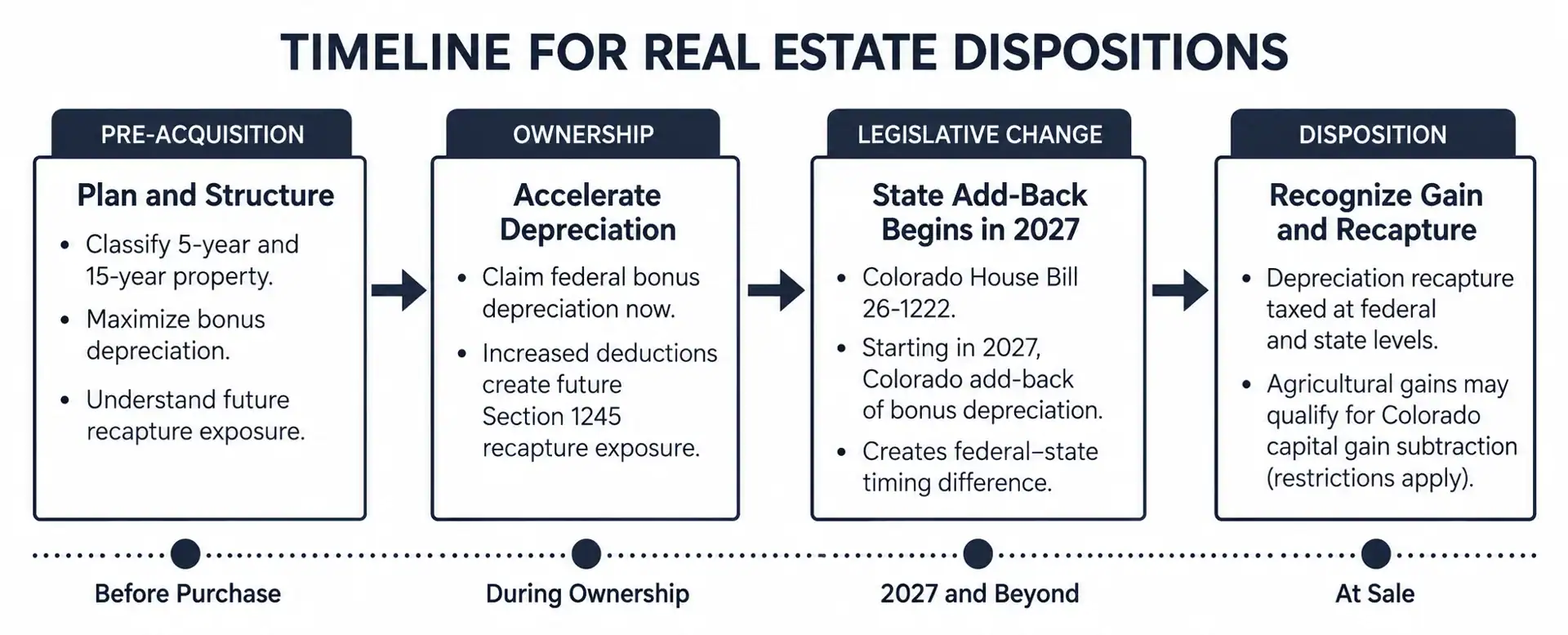
A properly structured Section 1031 exchange may defer gain on qualifying business or investment real property. Buying replacement property after you receive the sale proceeds is not enough. Arrange the exchange before closing, commonly through a qualified intermediary, and avoid actual or constructive receipt of the proceeds. Cash, debt relief, nonqualifying property, or recapture rules can cause current taxable gain.
Key mechanics of a Section 1031 exchange include:
- Strict timelines: Identify replacement property in writing within 45 days after transferring the relinquished property. Receive it by the earlier of 180 days after transfer or the federal return due date, including extensions, for the transfer year.
- Basis and recapture: Replacement basis generally carries forward deferred gain, with adjustments for money, other property, and recognized gain. Personal property does not qualify under Section 1031, and even some exchanges involving Section 1245 property can trigger ordinary recapture. Review components separately.
- State treatment: Federal nonrecognition generally flows into Colorado’s starting taxable income. Current recognized gain and any state-specific adjustments still need review.
- Delaware statutory trusts: An interest in a properly structured DST may qualify under Revenue Ruling 2004-86 if all exchange requirements are met. Not every DST qualifies. Review limited control, illiquidity, sponsor risk, fees, and securities requirements before selecting an investment.
For a detailed review of exchange structuring, consult our guide on Strategic 1031 Planning for Investors.
Estate Planning and the Step-Up in Basis Rule
Property qualifying under Section 1014 generally receives a basis equal to its fair market value at death, or another applicable estate-tax valuation. This may be an increase or a decrease. For qualifying directly inherited property, the adjustment can remove pre-death appreciation and depreciation-related gain from a later sale calculation, but it is not a universal rule for every trust or entity asset.
When evaluating a potential basis adjustment:
- Confirm which property qualifies for the basis adjustment and what valuation date applies; an adjustment is not always a step-up.
- Distinguish an inherited entity interest from the entity’s underlying real estate. A partnership’s asset-basis adjustment may require a Section 754 election or another applicable rule; corporate real estate does not automatically receive a new basis when stock is inherited.
- For qualifying inherited rental assets, establish the beneficiary’s depreciable basis and new depreciation treatment. Exclude land and review exceptions, including income in respect of a decedent.
When incorporating real estate into a comprehensive estate plan, investors must account for federal estate tax thresholds. Federal law enacted in 2025 increased the basic estate and gift tax exclusion amount to $15 million per individual for 2026, with future inflation adjustments. High-net-worth property owners should consider both income-tax basis planning and potential estate and gift tax exposure when structuring their estate plans. Explore these structures further in A Practical Guide to Tax Planning Strategies for Real Estate.
Coordinate deeds, entity agreements, beneficiary arrangements, and any trust documents with the estate plan. A trust is not required for every real estate holding, and transferring property to a trust does not by itself create a basis adjustment. Legal counsel, the tax preparer, and valuation professionals should review the ownership structure together.
Compliance, Documentation, and State Tax Reporting
Keep depreciation and basis records throughout ownership. The required returns depend on the owner, property, and transaction. Common forms for an individual investor include:
- IRS Form 4797: Reports relevant business-property sales and ordinary recapture. Unrecaptured Section 1250 gain is determined using the applicable Schedule D worksheet.
- IRS Schedule D (Form 1040): Reports and combines capital gains and losses, including relevant amounts from Form 4797 and the unrecaptured Section 1250 worksheet.
- Colorado Form DR 0104: The individual state return begins with federal taxable income and applies Colorado adjustments. Entity owners may have different filing obligations.
- Colorado Form DR 1316: The capital-gain affidavit supports a qualifying Colorado capital gain subtraction; it is not required for every property sale.
- IRS Form 3115: May be appropriate for an eligible depreciation accounting-method correction and Section 481(a) adjustment. Some errors instead require an amended return; confirm current procedures and deadlines.
- Transaction-specific forms: Form 8824 reports a like-kind exchange, Form 6252 may apply to an installment sale, and Form 8960 computes NIIT when required.
Maintaining complete documentation, including closing statements, capital expenditure receipts, engineering cost segregation reports, and historical tax returns, is vital for audit readiness. If you have questions regarding entity structuring or state tax controversies, learning What Is a Tax Lawyer can help clarify how legal counsel protects your rights during complex transactions.
Frequently Asked Questions about Real Estate Depreciation Recapture
Can I avoid depreciation recapture if I never claimed depreciation deductions on my tax return?
No. Internal Revenue Code Section 1016(a)(2) mandates that property basis must be reduced by the depreciation allowed or allowable. Even if an investor failed to claim depreciation deductions on past tax returns, the basis reduction can increase gain on sale; the recapture calculation still depends on actual gain and asset classification. Taxpayers who failed to claim allowable depreciation in prior years may be able to file IRS Form 3115 to request an accounting method change and claim an appropriate Section 481(a) adjustment rather than amending multiple prior-year returns. Confirm the applicable IRS procedures for the year the change is filed.
How does the 3.8% NIIT apply to recaptured depreciation for Colorado sellers?
For individuals, NIIT is 3.8% of the lesser of net investment income or MAGI above the filing-status threshold: $200,000 for single or head-of-household filers, $250,000 for joint filers, and $125,000 for married filing separately. Rental and disposition gains often count, including applicable depreciation-related gain, but qualifying nonpassive trade-or-business income may be excluded. A real-estate-professional designation alone does not establish an exemption.
Does a 1031 exchange permanently eliminate depreciation recapture taxes?
A qualifying Section 1031 exchange generally defers gain rather than erasing it. Replacement-property basis reflects the exchange calculation, and some gain or recapture may still be recognized in the exchange year. A later taxable disposition can trigger deferred gain. A subsequent qualifying inheritance may change basis, but ownership structure and Section 1014 exceptions must be evaluated separately.
Conclusion
A useful exit plan separates ordinary recapture, unrecaptured Section 1250 gain, and any remaining gain before estimating taxes. Apply the Colorado rate for the sale year and determine whether NIIT applies. The maximum federal rates should not simply be added together and applied to the entire sale price or gain.
Compare a taxable sale, a properly structured exchange, and longer-term ownership against cash needs, investment risk, and estate objectives. Installment sales may spread eligible gain over time, but ordinary depreciation recapture is generally taxable in the year of sale even if no payment is received. Unrecaptured Section 1250 gain follows separate installment-allocation rules.
At Colorado Trusts & Taxes, we provide personalized legal counsel to real estate investors and business owners throughout Centennial and the Denver metro area. We coordinate tax planning with estate and trust considerations, working alongside your tax and financial advisors. To evaluate your property exit strategy, explore our comprehensive legal and tax planning services or contact our office to discuss your ownership structure, basis records, and sale timeline.
Sources and current guidance: IRS Publication 544, Publication 946, Publication 551, Publication 537, and IRS NIIT guidance. Colorado subtraction guidance is linked above. Reviewed September 2026.
This article provides general educational information, not individualized legal, tax, or investment advice. Results depend on the assets, ownership structure, transaction, and applicable law.