
Start the Colorado Probate Court Process With the Right Steps
For probate in Centennial or elsewhere in Colorado, start by locating the will and listing assets, ownership details, and beneficiary designations. Determine which assets require probate, identify the proper court, and choose the filing procedure. After appointment, the personal representative gives notices, inventories property, addresses claims and taxes, and arranges distribution and closing.
Colorado probate law applies statewide. Venue generally depends on where the decedent was domiciled at death, with different rules for nonresidents. Centennial is in Arapahoe County, served by the 18th Judicial District; the personal representative’s own address does not determine where to file. The estate’s assets, will, and any disputes help determine the appropriate procedure.
Probate can feel like a long list of forms and deadlines while a family is grieving. A clear process helps the personal representative protect estate assets, meet court duties, and avoid distributing money or property before debts and claims are resolved.
At Colorado Trusts & Taxes, we help families and personal representatives coordinate probate, tax questions, and the administration of business and real estate interests. The steps below explain the main decisions and records to organize before moving an estate toward distribution.

Basic Colorado probate terms:
- Personal representative: The court-appointed fiduciary who administers the probate estate.
- Beneficiary: A person entitled to receive property under a will, trust, or beneficiary arrangement. Accurate beneficiary designations help determine how nonprobate assets pass.
- Intestacy: The statutory inheritance rules that apply to property not effectively disposed of by a will. A broader estate plan coordinates wills, trusts, and ownership arrangements.
- Trustee: The fiduciary administering trust property, a role distinct from personal representative. Choosing a corporate or individual trustee involves separate considerations.
Understanding When and Why Probate Is Required in Colorado

When an individual passes away in Colorado, state law governs how their property transfers to living heirs or named beneficiaries. Many people ask whether every estate requires formal court intervention. To determine whether opening an estate through the court is necessary, first evaluate the ownership structure and title of each asset. Asking do all estates have to go through probate in Colorado is a common first step when assessing a decedent’s property.
In Colorado, probate is generally needed to transfer real estate that lacks an effective nonprobate transfer mechanism, or personal property that cannot be collected through a valid beneficiary arrangement or the small-estate affidavit procedure. Sole ownership alone is not conclusive: a valid beneficiary deed, for example, may transfer real estate outside probate. Review title documents and the statutory eligibility rules before selecting a path.
The following arrangements commonly transfer assets outside estate administration. They do not eliminate every possible court dispute, creditor claim, or tax obligation:
- Survivorship ownership: Valid joint tenancy or account survivorship terms generally transfer the deceased owner’s interest to a surviving owner. Not every jointly owned asset has survivorship rights, and survival requirements or disputes can affect the result.
- Beneficiary arrangements: Valid POD/TOD accounts, life insurance beneficiary designations, and qualifying beneficiary deeds generally transfer property under their governing terms. Confirm the designation, surviving recipient, and any applicable legal restrictions.
- Trust assets: Property properly held in a trust generally passes under its terms without probate estate administration. Trust administration, taxes, creditor issues, or court proceedings may still be necessary.
Reviewing what assets are exempt from probate in Colorado can clarify whether full court administration is mandatory for your situation.
Determining Estate Eligibility and Choosing the Right Filing Path
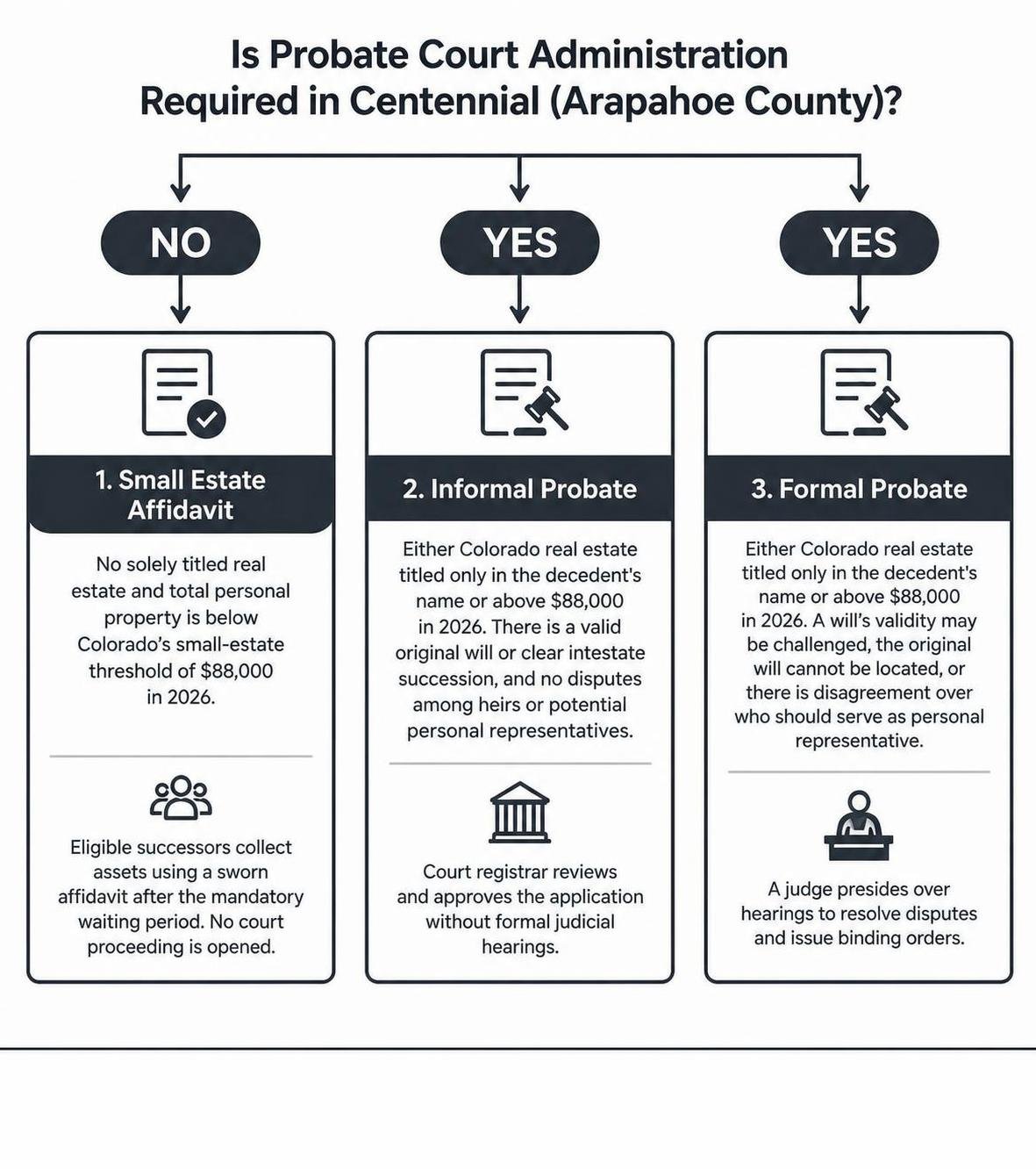
If court administration is required, Colorado law provides distinct mechanisms depending on the estate’s size, asset structure, and the presence of family disputes. A clear understanding of the three types of probate in Colorado can help you select the correct procedural route.
- Small-estate affidavit: JDF 999 may collect eligible personal property at least ten days after death if all statutory conditions are met. For a 2026 death, all property subject to the will or intestacy, wherever located, must total no more than $88,000 after liens and encumbrances. Include probate real estate in that value test even though the affidavit cannot transfer real estate. No petition for appointment of a personal representative may be pending, and no appointment may have been granted in any jurisdiction. The affiant must be at least 18 and entitled to collect the property or authorized to act for an entitled successor. Follow JDF 998; vehicle title transfers use the separate DMV procedure.
- Informal probate: A registrar may approve a qualifying application without a formal hearing, generally where the original will is available or intestate succession and appointment priority are clear. Informal administration still requires notices, records, and compliance with fiduciary duties.
- Formal probate: A judge determines matters presented for decision, including will validity, a missing original will where a copy is available, heirship, or appointment. Formal proceedings can also be requested in an uncontested estate. Formal opening does not automatically mean supervised administration; that is a separate issue.
Choosing the incorrect pathway can result in delayed distributions and unnecessary administrative costs. Obtaining help choosing the right probate type in Colorado may help personal representatives navigate the process efficiently.
Navigating the Colorado Probate Court Process: Step-by-Step Filing Guide
For a decedent domiciled in Arapahoe County, probate generally proceeds in the Arapahoe County District Court, part of the Combined Courts in the 18th Judicial District. Denver has a separate Probate Court. Confirm venue, filing location, and current local instructions before submitting documents; statewide forms do not replace case-specific court orders.
Opening an estate generally requires a filing fee. Check the current court fee schedule and any applicable waiver procedure with the clerk or self-help center; eligibility and supporting documentation must be evaluated under the court’s rules.
Use the Colorado Judicial Branch’s current opening instructions: JDF 906 for probate with a will and JDF 907 for probate without a will. The forms differ further depending on whether the requested proceeding is informal or formal.
Initiating an Informal Colorado Probate With JDF Forms
For an estate with a will, informal probate generally begins with JDF 910, Application for Informal Probate of a Will. Related forms may include JDF 911, Acceptance of Appointment; JDF 912, Renunciation and/or Nomination of Personal Representative when applicable; JDF 913, Order for Informal Probate of Will and Informal Appointment of Personal Representative; and JDF 915, Letters Testamentary/of Administration. Estates without a will generally use JDF 916 and JDF 917 instead.
Once submitted, the registrar reviews the paperwork. Ordinary informal probate and appointment generally require at least 120 hours after death, along with the other statutory conditions; special-administrator and nonresident rules may differ. Once appointment and qualification requirements are met, Letters document the representative’s authority. Exploring understanding uncontested probate can help families manage this streamlined administrative path.
Formal Colorado Probate Filings and Disputed Issues

Formal proceedings ask a judge to decide matters such as the validity of a will, heirship, or appointment. With a will, the usual petition is JDF 920; without a will, JDF 922 seeks adjudication of intestacy and formal appointment. Formal proceedings may be used even without a contest. A separate beneficiary-designation dispute does not automatically determine the procedure for the entire estate.
Depending on the relief requested, formal proceedings involve:
- Notice to interested persons, usually with JDF 711 and the petition, following applicable service rules and court directions.
- Evidence, testimony, or other submissions needed for the requested determination; not every matter requires a contested evidentiary hearing.
- Judicial resolution of the will, heirship, appointment, or other issues properly presented.
- The appropriate order: generally JDF 921 for formal probate with a will or JDF 923 for formal intestacy and appointment, with Letters issued as appropriate.
Use the statewide Colorado Judicial Branch opening instructions and confirm local requirements with the court handling the estate. A packet prepared for another county is not a substitute for Arapahoe County’s current directions.
Fiduciary Responsibilities and Managing Creditor Claims in Colorado Estates
A personal representative is a fiduciary and must administer the estate under the will, applicable law, and court orders. Keep estate funds separate, protect property, document decisions, and respect the rights of creditors and beneficiaries. Personal interests must not override these duties. Within 30 days after appointment, provide the required information to heirs and devisees, generally using JDF 940, and file the required notice record.
A primary duty involves identifying, evaluating, and addressing creditor claims against the decedent. Under Colorado probate statutes, personal representatives must handle both known and unknown creditors:
- Known or reasonably ascertainable creditors: Identify them and evaluate direct written notice. Do not assume publication alone cuts off their rights. Under § 15-12-801, a direct notice generally uses the later of the published deadline or 60 days after mailing or delivery, subject to the one-year limit after death.
- Publication: Unless at least one year has elapsed since death, the statute requires publication at least three times in three successive calendar weeks in the qualifying newspaper. The published deadline generally follows the four-month-from-first-publication rule, subject to the one-year anniversary limit. Confirm the exact date and newspaper requirements before publishing.
Calendar deadlines separately for published notice, direct notice, and claims arising after death. Pre-death claims may face a one-year outside deadline, but liens and other statutory exceptions require separate analysis. Investigate timely claims and follow allowance or disallowance procedures; missing a response deadline can affect the estate’s position.
Allowed claims follow the priorities in C.R.S. § 15-12-805, summarized below. Also account for secured claims, statutory family protections, and applicable federal law. Claims within the same class receive no preference over one another. Obtain advice before paying creditors if assets may be insufficient.
| Order | Claim category (summary) |
|---|---|
| 1 | Property held as fiduciary or trustee, subject to statutory administration-expense provisions |
| 2 | Other estate administration costs and expenses |
| 3 | Reasonable funeral and final-disposition expenses |
| 4 | Debts and taxes with federal preference |
| 5 | Reasonable and necessary medical and hospital expenses of the last illness, including attendants |
| 6 | Debts and taxes with preference under other Colorado laws |
| 7 | State Department of Health Care Policy and Financing claim for qualifying medical assistance |
| 8 | Specified agency claims for excess public assistance, including child-care assistance, received while ineligible |
| 9 | Qualifying unpaid child support and future child support as determined by the court |
| 10 | All other claims |
Estate Asset Protection, Tax Strategy, and Beneficiary Distributions
Prepare the estate inventory, generally using JDF 941, within three months after appointment unless the statutory successor-representative exception applies. List date-of-death fair market values and encumbrances. The general statute permits filing the inventory with the court or providing copies to requesting interested persons; court orders or particular circumstances can impose additional requirements. Keep valuation support for accounting and any required tax returns.
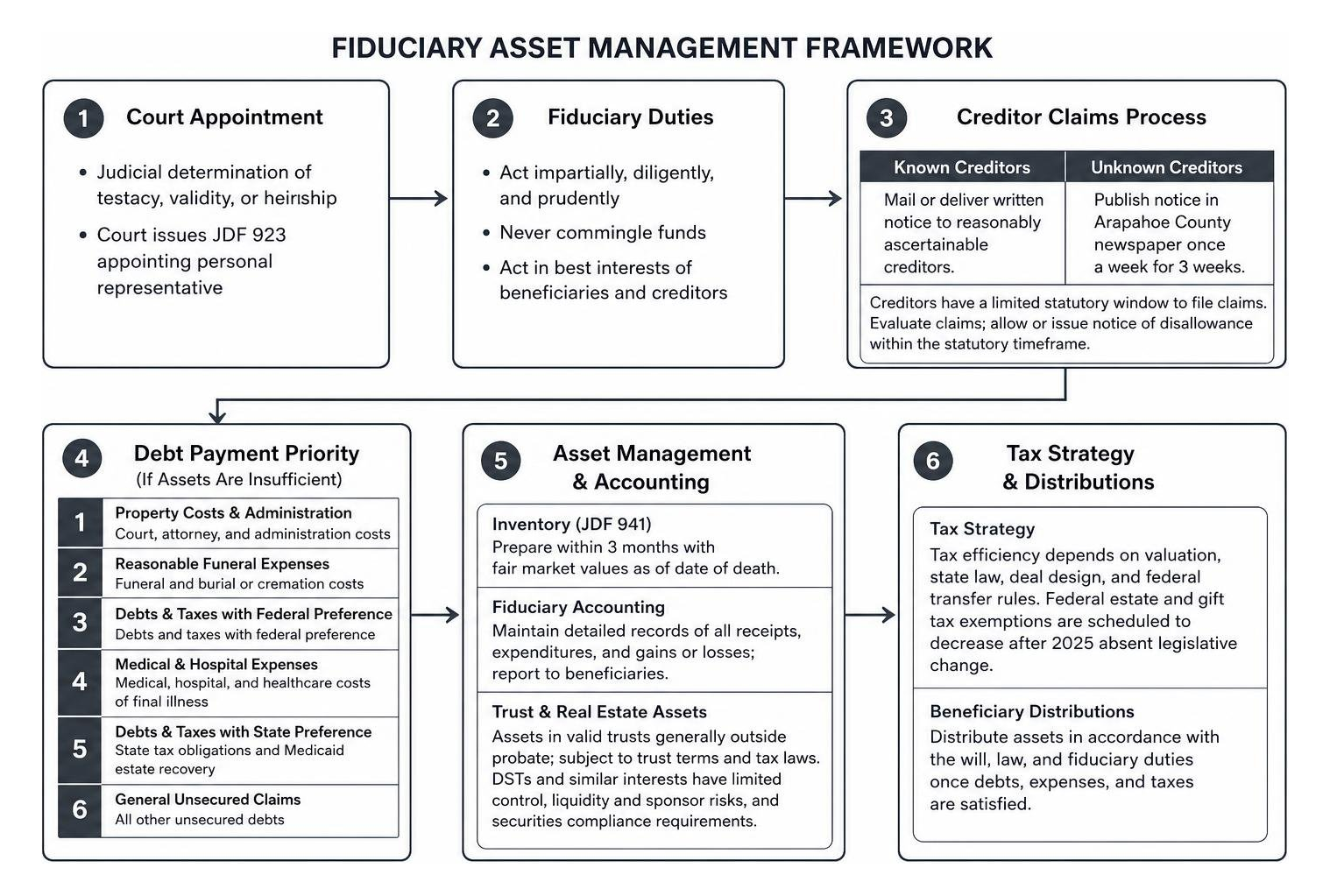
Asset management and distribution require careful planning:
- Fiduciary accounting: Keep records of receipts, expenses, transactions, and distributions. Provide required information and accountings to interested persons and follow any court reporting orders.
- Trust, business, and real estate assets: Confirm who owns each asset and which fiduciary has authority. Review deeds, trust terms, entity agreements, transfer restrictions, valuation needs, and liquidity before a sale or distribution. A trust’s property and an estate’s interest in an entity require different analysis.
- Tax coordination: Work with the tax preparer on any required final individual and estate income-tax returns. Colorado does not currently impose a separate state estate tax, but tax coordination can still be important. The estate may need a final federal and Colorado individual income-tax return, fiduciary income-tax returns, federal estate-tax analysis, basis reporting, or planning around income in respect of a decedent. The federal estate-tax basic exclusion is $15 million for 2026, with later inflation adjustments. Filing obligations and planning depend on prior taxable gifts, deductions, portability, asset values, and other facts; a smaller estate can still have income-tax duties.
Before final distribution, address administration costs, allowed claims, taxes, statutory family protections, and any necessary reserves. Document transfers and obtain appropriate receipts. Our guide to how to claim your inheritance after an uncontested probate explains practical beneficiary steps. Distribution alone does not close the estate: use the applicable informal closing statement or formal settlement procedure and follow any court orders.
Frequently Asked Questions About Colorado Probate Court
How long does the probate court process take in Colorado?
Timing depends on creditor deadlines, asset sales, tax filings, disputes, and the closing procedure. For eligible unsupervised estates, a verified informal closing statement cannot be filed earlier than six months after original appointment or one year after death, whichever occurs first, and the other statutory conditions must also be met. That is an eligibility rule, not a promise of completion. Complex estates may take substantially longer.
Do family members inherit personal responsibility for a decedent’s debts in Colorado?
Family relationship alone generally does not make someone personally liable for the decedent’s debts. A co-borrower, guarantor, or person liable under another legal rule may still owe payment; merely being an authorized user or joint deposit-account owner is not the same as being a joint borrower. Certain nonprobate transferees or recipients of improper distributions may face claims. Do not assume creditors are limited exclusively to probate assets.
Can you complete the probate process in Colorado without hiring an attorney?
An individual may choose to file probate documents pro se (representing themselves) in Colorado. However, personal representatives are subject to strict legal duties and can be held personally liable for administrative missteps, miscalculating creditor priority, or distributing assets prematurely. Assessing whether you need a lawyer for uncontested probate can help identify when legal guidance is useful. Court self-help staff can explain procedures but cannot provide individualized legal advice.
Conclusion
Handling the probate process in Colorado requires careful attention to detail, strict compliance with statutory deadlines, and an objective understanding of Colorado fiduciary law. Whether an estate qualifies for informal administration or demands formal judicial resolution, following a methodical process may help the personal representative meet court obligations and preserve estate assets for rightful beneficiaries.
At Colorado Trusts & Taxes, we provide personalized legal guidance to personal representatives, trustees, and families navigating estate administration throughout Colorado, including Centennial and the greater Denver area. If you are serving as a personal representative or need assistance establishing a comprehensive estate planning strategy, contact our office to discuss the estate’s assets, filing path, and next deadlines. We can coordinate legal questions with your tax and financial advisors.
Sources and current guidance: Colorado Judicial Branch: Open an Estate; Close an Estate; Colorado Revised Statutes, Title 15; and the Arapahoe District Court Self-Help Center. Reviewed September 2026.
This article provides general educational information, not individualized legal or tax advice. The appropriate procedure depends on the estate, applicable law, and court orders.