

Why Proactive Tax Planning Matters for Small Business Owners
A smart tax strategy is one of the most valuable tools small business owners have for keeping more of what they earn, legally. According to the National Small Business Association, 90% of small business owners say federal taxes have at least some impact on day-to-day operations, and one in three cite a significant impact.
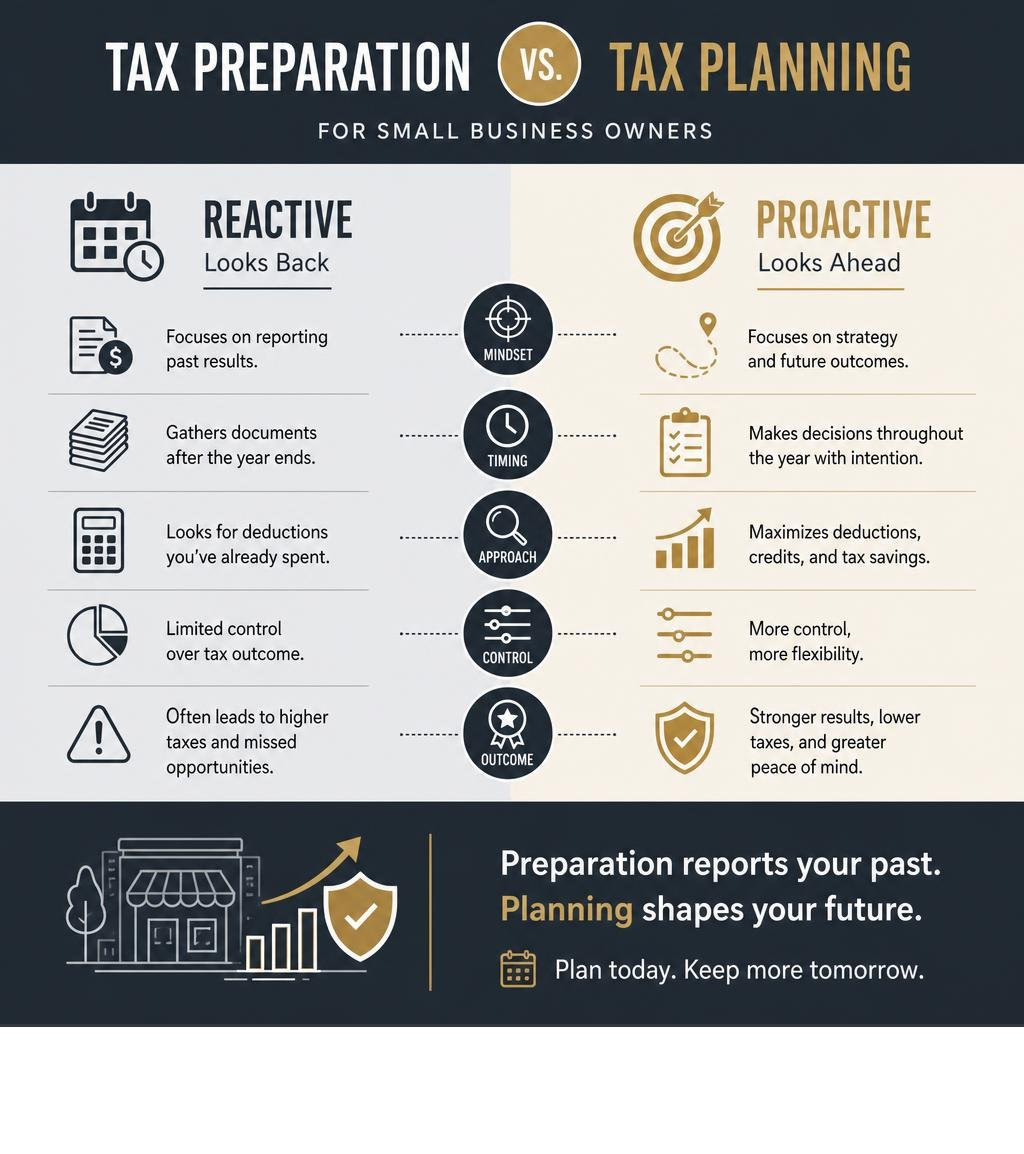
That gap is not usually about cheating or errors. It is about the difference between reacting to taxes and planning for them.
Here is a quick overview of tax strategies small business owners may want to evaluate in 2026:
- Evaluate your business entity and tax classification to understand their effect on income and employment taxes
- Maximize depreciation deductions using Section 179 and 100% bonus depreciation under the OBBBA
- Contribute to retirement plans (401(k), cash balance plan, Solo 401(k), SEP-IRA, or Defined Benefit plan) to lower taxable income
- Elect Pass-Through Entity (PTE) tax at the state level to help manage the federal SALT limitation for pass-through income
- Claim the 20% QBI deduction under Section 199A, now made permanent by the OBBBA
- Shift income legally through family employment and the Augusta Rule
- Time income and expenses strategically before December 31 each year
Most small business owners only think about taxes in the spring, when their CPA asks for documents. By then, many timing-sensitive opportunities may no longer be available after year-end. True tax planning happens before the numbers are locked in, not after.
The good news is that the current tax landscape, shaped significantly by the One Big Beautiful Bill Act (OBBBA) of 2025, offers Colorado small business owners more planning tools than they have had in years.
I’m Gerard Deffenbaugh, a Colorado attorney with over a decade of experience helping small business owners and real estate investors build an effective tax strategy that protects their income, their assets, and their families. In this guide, I will walk you through the strategies that matter most in 2026, from entity selection to year-end moves.
Entity Selection and Tax Election: The Foundation of Business Tax Planning
Your business legal structure and tax election important factors affecting how business income is taxed. It dictates which forms you file, how much self-employment tax you owe, and whether you are vulnerable to double taxation.
Many business owners default to a sole proprietorship or a basic single-member LLC when starting out. While this can be simple to administer, it may become less tax-efficient or otherwise less suitable as the business grows. My guide on Understanding the Pros and Cons of How Your Business is Taxed breaks down how these options compare. In my experience, the right entity decision rarely comes down to tax savings alone, it is worth weighing alongside compensation planning, cash flow needs, retirement plan design, ownership structure, a future exit, and how the business fits into your overall estate plan, ideally with input from your CPA and financial advisor.

S-Corporation vs. C-Corporation Tax Planning
If your business generates significant net income, you should evaluate whether an S-Corporation or C-Corporation structure is more advantageous.
An S-Corporation is not a separate type of business entity, it’s a federal tax election (made using IRS Form 2553) that an eligible corporation or LLC can make to be taxed under Subchapter S. The primary potential benefit relates to employment-tax treatment: owner-employees who perform services for the business are generally required to receive reasonable compensation, subject to FICA taxes (Social Security and Medicare), before any additional profit is distributed. Amounts distributed to an owner in excess of reasonable compensation generally are not treated as wages subject to Social Security and Medicare employment taxes, although the compensation amount cannot be set arbitrarily, it must reflect the value of the services actually performed.
For illustration only: assume a business nets $150,000 and pays a salary of $75,000 that is reasonable for the owner’s role. In that hypothetical, applicable employment taxes would apply to the $75,000 salary, while the remaining $75,000 distributed to the owner generally would not be treated as wages subject to Social Security and Medicare employment taxes. Reasonable compensation depends on the facts and circumstances of each business and cannot be selected solely to minimize taxes, it should reflect what an unrelated party would be paid for comparable services.
A C-Corporation, by contrast, is taxed as a separate legal entity at a flat federal corporate tax rate of 21%. While C-Corps are subject to “double taxation” (where profits are taxed at the corporate level and then taxed again on your personal return when paid out as dividends), they offer unique advantages for high-earning businesses that reinvest their profits. You can explore these advanced structures in my article on Corporate Tax Planning for Wealthy Entrepreneurs.
Furthermore, under Section 1202 of the Internal Revenue Code, C-Corporations may qualify for Qualified Small Business Stock (QSBS) treatment. The OBBBA changed the QSBS exclusion rules for qualifying stock acquired after July 4, 2025, by adding a tiered exclusion: 50% after a three-year holding period, 75% after four years, and 100% after five years or more, subject to the greater of the $15 million exclusion cap or 10 times the taxpayer’s basis. Older QSBS generally remains subject to the prior Section 1202 rules. If you plan to scale and sell your business, starting as or converting to a C-Corp early may be worth evaluating with tax counsel, as outlined in the IRS guidance on Section 1202.
Colorado Business Tax Requirements and Entity Defaults
In Colorado, if you do not make a specific election, a single-member LLC defaults to a “disregarded entity” for tax purposes. This means your business income and expenses are reported on Schedule C of your personal Form 1040.
While this default status is easy to manage, for an owner actively carrying on the business, net earnings from self-employment generally are subject to self-employment tax, subject to the applicable Social Security wage base, Medicare rules, and other limitations, in addition to state and federal income taxes. In Colorado, you must also navigate state-specific rules, which I explain in detail in Colorado Business Tax Requirements Explained.
Maximizing Deductions and Depreciation Under the OBBBA
The One Big Beautiful Bill Act (OBBBA), passed in mid-2025, brought major changes to business deductions. Understanding these updated provisions can help business owners and their advisors identify deductions that may apply in 2026
Section 179 and Bonus Depreciation Rules in 2026
For asset-heavy businesses, depreciation is one of the more significant tax reduction tools available. The OBBBA permanently restored 100% bonus depreciation for qualified property placed in service on or after January 19, 2025, reversing the scheduled phase-down under previous law.
Additionally, Section 179 allows you to write off the full purchase price of qualifying equipment, software, and vehicles in the year of purchase. For 2026, the Section 179 deduction limit is set at $2.56 million, with the phase-out threshold beginning at $4.09 million.
To claim these deductions, the asset must meet the “placed-in-service” requirement by December 31. This means the equipment must be fully installed and operational. Simply purchasing or receiving delivery of an asset on December 28 does not qualify if it sits in a warehouse until January. Because these rules interact with your overall tax picture, it’s worth confirming the timing and treatment of major asset purchases with your CPA before year-end.
| Feature | Section 179 Expensing | Bonus Depreciation |
|---|---|---|
| 2026 Limit | Up to $2.56 Million | No dollar limit |
| Flexibility | Can choose which specific assets to expense | Must apply to entire classes of property |
| Tax Loss Rule | Cannot create a net business loss | Can create or increase a Net Operating Loss (NOL) |
| Property Types | New and used equipment, software, furniture | Generally qualifying MACRS property with a recovery period of 20 years or less, plus certain other qualifying property |
The IRS guide on commercial property depreciation has more detail on how these rules apply.
Overlooked Deductions and Credits for Colorado Businesses
Business owners sometimes overlook deductions that may apply to ordinary operating expenses. Common write-offs include the home office deduction, vehicle mileage (for 2026, the optional business standard mileage rate is 72.5 cents per mile for miles driven from January 1 through June 30 and 76 cents per mile for miles driven from July 1 through December 31), continuing education, and software subscriptions. To make sure you aren’t missing any, check my list of Common Tax Deductions Small Business Owners Might Be Overlooking.
In addition to deductions, tax credits provide a dollar-for-dollar reduction of your actual tax liability:
- Research & Development (R&D) Tax Credit (Section 41): This credit is not limited to technology companies. If you are developing new products, improving manufacturing processes, or designing proprietary software, you may qualify, subject to applicable eligibility requirements. Separately, the OBBBA added Section 174A, which generally restores current deductibility for qualifying domestic research or experimental expenditures beginning in 2025.
- Work Opportunity Tax Credit (WOTC): This credit is available to businesses that hire individuals from targeted groups, such as veterans or the long-term unemployed.
Leveraging Retirement Plans and Family Income Shifting
Protecting your business income is not just about writing off expenses; it is also about strategically moving money into tax-advantaged environments.

Retirement Options for Business Owners
Setting up a retirement plan can be an effective way to build personal wealth while securing an immediate business tax deduction, depending on your business structure and cash flow.
- Solo 401(k): Designed for self-employed individuals with no employees (except a spouse). In 2026, the employee deferral limit is $24,500, and the total contribution limit is up to $72,000. Savers age 50 or older can make an additional $8,000 catch-up contribution, and under the SECURE 2.0 Act, savers ages 60 through 63 may be eligible for a higher catch-up limit of $11,250 instead. This plan is highly flexible and offers both traditional (pre-tax) and Roth options.
- SEP-IRA: This plan allows you to contribute up to 25% of your eligible net self-employment earnings, subject to an overall dollar limit (up to $72,000 in 2026). It is simple to set up but lacks the employee deferral feature of a 401(k).
- Defined Benefit and Cash Balance Plans: If your business is highly profitable and you are over 45, these plans may allow you to shelter substantial amounts of income through tax-deductible contributions based on actuarial calculations. The specific amount depends heavily on your age, income, and plan design, and can vary widely from one business owner to the next.
These plans involve different eligibility rules, deadlines, and administrative requirements, so it’s worth reviewing the IRS guide on retirement plans for small businesses and coordinating the details with your CPA or financial advisor before committing to a plan design.
Shifting Income: Hiring Kids and the Augusta Rule
Income shifting involves moving income from your high tax bracket to a family member in a lower tax bracket.
If you employ your children under age 18 to do legitimate work for your business, such as managing social media, cleaning offices, or handling administrative tasks, you can pay them a reasonable wage. Depending on the child’s total income, filing situation, other income, and the applicable standard deduction rules, some or all of those wages may avoid federal income tax.
The Augusta Rule (Section 280A(g)) is another tax planning option worth considering. This rule allows you to rent your personal home to your business for up to 14 days per year, provided the use serves a bona fide business purpose (such as board meetings or planning sessions) and the rent charged is reasonable compared to what similar local venues would cost. When these requirements are met, the business may deduct the rental expense under Section 162, and you generally do not have to report the rental income on your personal tax return under Section 280A(g). The statute itself does not mandate specific paperwork, but maintaining documentation such as a written lease agreement, meeting minutes, and local market comparables is a prudent way to substantiate the arrangement if it is ever questioned by the IRS.
Pass-Through Entity (PTE) Taxes and the QBI Deduction
Pass-through entities, such as LLCs, partnerships, and S-Corporations, do not pay federal income tax directly. Instead, profits flow through to the owners’ personal tax returns. Two key provisions help reduce the tax burden on this pass-through income.
Managing the SALT Cap with Colorado’s PTE Election
The Tax Cuts and Jobs Act of 2017 introduced a $10,000 cap on individual deductions for State and Local Taxes (SALT). The OBBBA raised this individual cap to $40,400 for 2026 ($20,200 for married taxpayers filing separately), but that increased limitation is subject to filing-status rules and is reduced for higher-income taxpayers, so the higher cap is not universally available. State-level Pass-Through Entity Tax (PTET) elections remain a relevant tool regardless of where an individual’s SALT cap lands.
Colorado’s SALT Parity Act allows qualifying pass-through entities, including S-Corporations and partnerships, to elect entity-level state income tax treatment. Because the entity pays the tax, that state tax may be deductible at the federal entity level, subject to applicable federal and state rules. The net benefit depends on the entity’s and owners’ specific circumstances and should be modeled with your CPA before making the election. Electing entities also take on Colorado filing and payment obligations tied to the election.
Optimizing the Section 199A QBI Deduction
The Qualified Business Income (QBI) deduction allows eligible self-employed individuals and pass-through entity owners to deduct up to 20% of their qualified business income. While this deduction was originally set to expire, the OBBBA made the QBI deduction permanent.
The QBI deduction begins to phase out for Specified Service Trades or Businesses (SSTBs), such as doctors, lawyers, accountants, and consultants, once taxable income exceeds these thresholds. For 2026, the applicable threshold is $403,500 for married couples filing jointly, $201,775 for married taxpayers filing separately, and $201,750 for other returns. These are threshold amounts rather than hard cutoffs: the deduction is subject to phase-in and other limitation rules above these levels. Separately, the OBBBA established a $400 minimum Section 199A deduction for eligible taxpayers with at least $1,000 of qualified business income, effective for taxable years beginning after December 31, 2025, though the usual Section 199A requirements still apply.
If your income is near these thresholds, strategies such as maximizing retirement contributions can help manage taxable income. Reasonable-compensation requirements still apply to S-Corporation shareholder-employees, and wages paid to a shareholder-employee are a direct input into the QBI calculation, so compensation should not be lowered solely to preserve the deduction. For more on how the phase-in and limitation rules work, see the IRS overview of the Qualified Business Income deduction.
Year-End Planning and Avoiding Common Tax Mistakes
Effective tax planning is a year-round process, but the final quarter of the year is when you must execute your key timing strategies.
To stay organized during this window and protect your business, review the comprehensive checklist on Year-End Tax Planning for Business Owners: Legal Strategies to Stay Ahead of the IRS.
Accelerating Expenses and Deferring Income
If your business uses the cash method of accounting, you have significant control over when income and expenses are recognized:
- Prepaying Expenses: Certain prepaid expenses, such as rent, insurance, or software subscriptions, may qualify for a current-year deduction when the IRS “12-month rule” and your accounting method’s requirements are both satisfied. Confirm any material prepayments with your CPA before year-end.
- Deferring Income: Timing of income recognition depends on your accounting method, constructive-receipt principles, and your contractual rights to payment. Delaying an invoice does not, by itself, automatically shift income to the following year. Whether deferral is available depends on the specific facts, so review any planned timing with your CPA.
Common Mistakes: Worker Misclassification and Poor Recordkeeping
Even the most sophisticated tax strategy can fail if you make basic compliance errors.
One of the most heavily scrutinized areas is worker classification. The IRS and the Colorado Department of Labor and Employment both actively review whether workers are properly classified as employees versus independent contractors. Misclassification can lead to employment-tax assessments, interest, penalties, wage-and-hour exposure, and state-law consequences, making it essential to review your worker agreements and actual working relationships regularly.
Another common mistake is mixing personal and business finances. Commingling funds can lead to rejected deductions and complicate an IRS audit. To protect yourself, maintain separate bank accounts and keep clean financial records. If your books need attention, read my guide on New Year, New Books: How Small Businesses Can Clean Up Records for Tax Time.
Frequently Asked Questions about Small Business Taxes
Navigating small business tax rules can be challenging. To help you stay compliant, I have answered some of the most common questions below. For more details on penalty avoidance, see How to Avoid IRS Penalties with Smart Tax Planning for Small Businesses.
How do I calculate and pay estimated quarterly taxes to avoid penalties?
As a small business owner, you generally must make estimated tax payments if you expect to owe $1,000 or more when you file after subtracting withholding and credits, both parts of the IRS test apply. The percentage of income worth setting aside varies significantly based on your income, filing status, self-employment tax, deductions, credits, state tax, and withholding, so there is no single monthly percentage that works as a substitute for calculating your actual liability.
To avoid underpayment penalties, you must meet the IRS safe harbor rules. This requires paying either 90% of your current-year tax liability or 100% of your prior-year tax liability, through timely quarterly payments. For higher-income taxpayers, the prior-year safe harbor generally increases from 100% to 110% when prior-year AGI exceeds $150,000 ($75,000 if married filing separately).
What are the major tax changes introduced by the OBBBA for 2026?
The OBBBA brought several key changes that benefit small businesses:
- Permanent QBI Deduction: The 20% pass-through deduction is now permanent.
- 100% Bonus Depreciation: Fully restored for qualified property.
- SALT Cap Increase: The individual SALT deduction cap was raised to $40,400 for 2026 ($20,200 if married filing separately), subject to filing-status rules and a phase-down for higher-income taxpayers.
- Immediate R&D Deduction: Repealed the 5-year amortization requirement for domestic R&D costs, restoring immediate deductibility.
When is the right time to elect S-Corporation taxation?
There is no universal profit level at which an S-corporation election becomes advantageous. The analysis should compare potential employment-tax effects with reasonable compensation, payroll and return-preparation costs, state taxes, retirement-plan objectives, Section 199A consequences, and administrative requirements.
Conclusion
A successful tax strategy for small business owners is not about finding loopholes at the last minute. It is about building a proactive, compliant structure that aligns with your long-term business goals. By choosing the right entity, maximizing your deductions, and utilizing state tax elections like Colorado’s PTET, these strategies can support a more coordinated approach to tax compliance and long-term business planning.
At Colorado Trusts & Taxes, I provide personalized legal guidance to help you protect your business, your wealth, and your family. If you are ready to build a proactive tax and estate plan tailored to your needs, please visit my Services/Business Tax Lawyer page or contact my office in Centennial, CO, to schedule a consultation.